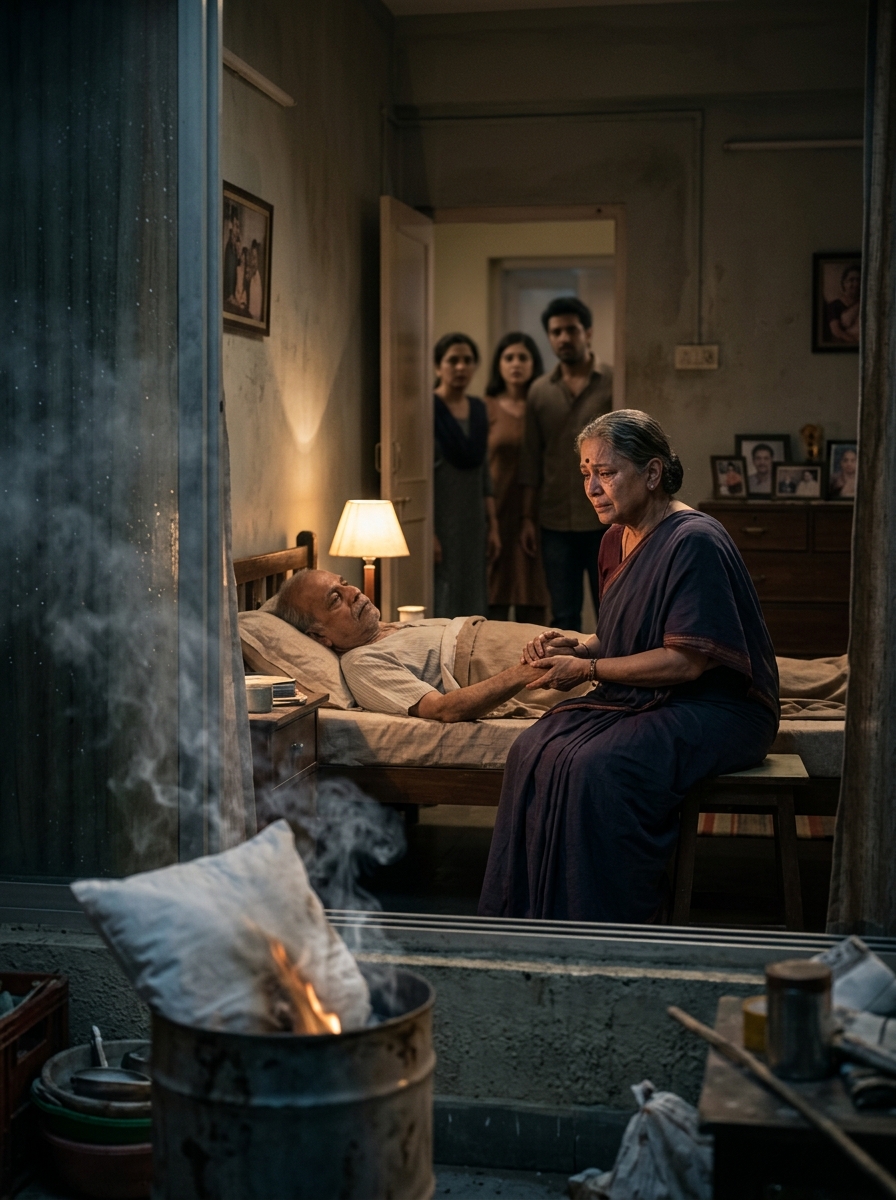
The first morning after peace was the cruelest.
I woke at 5:12 a.m. because Arvind always coughed at that time.
For one foolish second, my hand moved across the bed, searching for the glass of water I kept ready for him.
My fingers touched only cold sheet.
Then memory opened its eyes.
The house was silent.
Not the old silence, not the one with a white pillow breathing between us. This silence had no anger in it. No punishment. No waiting. It was simply the silence of a room from which one soul had departed and left the furniture behind.
I sat up slowly.
The middle of the bed still held the shape of my body.
His side was neat.
Mine was wrinkled.
The wall was gone, but the emptiness had learned its place.
In the kitchen, I made tea for two.
I realized it only after pouring the second cup.
For eighteen years, I had served him tea without touching his hand. For the last three months of his life, I had held the cup to his lips while he drank like a tired child. Now the cup sat across from me, steaming for a man whose ashes were still fresh in the river.

I did not throw it away.
I placed it near the window.
“Drink before it gets cold,” I whispered.
No one answered.
And for the first time, I understood that peace was not the same as comfort.
On the fourth day after the rituals, Rohan found the diary.
I had wrapped it in Arvind’s old shawl and kept it in the top shelf of the cupboard. I intended to decide later what to do with it.
But grief makes children curious. Or maybe suspicion does.
He came into the living room holding the diary as if it were a weapon.
“Ma,” he said, “what is this?”
Kavya looked up from folding the white mourning clothes.
My stomach turned.
“Your father’s diary.”
“I know that.” His voice was tight. “Why is he writing about punishment? Why is he writing that you cried every night? What happened eighteen years ago?”
Kavya stood very still.
Outside, a vegetable seller called out prices in the lane. A pressure cooker whistled next door. The world, shameless as ever, continued.
I looked at my children.
They were not children now. Rohan had grey near his temples. Kavya had two daughters who called me Aaji. Yet in that moment, they looked young, frightened, and betrayed.
I could have lied.
I had lied by omission for eighteen years.
Their father and I had protected the family’s respectable face until it became a mask glued to our skin.
I was tired of masks.
“Sit,” I said.
Rohan did not move.
“Sit,” I repeated, with the voice I had used when he was ten and had tried to hide a broken window.
This time, he obeyed.
I told them.
Not everything in ugly detail. A mother does not need to hand her children the full knife. But I told enough.
Sameer.
The rain.
The lodge.
My confession.
Their father’s blood report.
The illness he hid.
The pillow.
The years we spent punishing each other while teaching our children to believe we were quiet because we were dignified.
Rohan’s face changed many times.
Disbelief.
Disgust.
Rage.
Pain.
Kavya covered her mouth and began to cry.
When I finished, no one spoke.
Then Rohan stood.
“So Papa suffered because of you?”
I accepted the blow.
“Yes,” I said. “And I suffered because of him. That does not cancel what I did.”
“You destroyed him.”
“No,” Kavya said suddenly.
Rohan turned on her. “What?”
“She did wrong,” Kavya said, tears slipping down her face. “But Papa chose what he did after. He chose silence. He chose the pillow. He chose not to tell us he was sick.”
“He was protecting her.”
“He was also protecting his pride.”
The room shook with the truth of his own daughter saying it.
Rohan looked at me as if I had stolen his father a second time.
“Why are you telling us now?” he asked.
“Because if I die with lies still standing in this house, your children will inherit ghosts and call them values.”
His jaw clenched.
He left without another word.
The door shut hard.
Kavya remained.
After a while, she came and sat beside me on the floor. Not close enough to comfort. Not far enough to accuse.
“I used to think you and Papa had a simple marriage,” she said.
I smiled sadly. “No marriage is simple. Some are only better hidden.”
“Did you love him at the end?”
“At the end,” I said, “I finally loved him without begging him to be innocent.”
She leaned her head on my shoulder then, and we cried together—not as daughter and mother who understood everything, but as two women who had learned that men are not gods, women are not temples, and homes can be built over buried screams.
Rohan did not call for nine days.
On the tenth, he came alone.
I was sorting Arvind’s papers on the dining table. Insurance forms. Hospital bills. Old prescriptions. A receipt for the green saree he had bought me twelve years ago and never given.
I found it still wrapped in brown paper, hidden behind tax files.
When Rohan entered, I was holding it.
He looked at the saree. Then at me.
“I read the whole diary,” he said.
I nodded.
He sat across from me.
His eyes were red.
“He wrote about me,” he said.
“Yes?”
“He wrote that when I was born, he was afraid to hold me because he thought his blood made him dangerous.”
I closed my eyes.
“He held you anyway,” I said. “I placed you in his arms and told him not to be foolish.”
Rohan swallowed.
“He wrote that you saved money secretly for my engineering college because he had spent his bonus on treatment.”
“Yes.”
“He wrote that he once saw you sleeping outside Kavya’s exam hall because she had fever, and he wanted to sit beside you, but he stood behind a pillar instead.”
I remembered that day. My back had ached for a week from the plastic chair.
Rohan pressed his palms to his eyes.
“I am angry with you,” he said.
“You should be.”
“I am angry with him too.”
“You should be.”
“I don’t know where to put it.”
I pushed the diary toward him.
“Put some of it there. The rest will move inside you for years. Let it move. Don’t build a house around it.”
He laughed once, broken and unwilling.
“You talk like Papa in his last days.”
“No,” I said. “Your father learned to talk like me.”
For the first time since the funeral, my son smiled.
It lasted only a second.
Then he reached across the table and touched my hand.
Not forgiveness.
Not yet.
But contact.
Sometimes that is the first bridge.
The thirteenth-day guests had gone, but gossip does not need food to survive.
It came back through relatives.
A cousin called Kavya and said, “Your mother is talking too much now that your father is gone.”
An aunt told Rohan, “A woman’s mistakes should be buried with her husband’s greatness.”
Someone whispered that I had trapped Arvind in shame.
Someone else said he had been a saint for keeping me.
At first, I burned.
Then I grew tired.
On the first monthly death ceremony, when relatives gathered again with white clothes and careful faces, I placed Arvind’s diary, his medical file, and his final letter on the table.
Not the whole diary.
Some truths belonged to us.
But his letter was addressed clearly.
To my children, and to anyone who makes a statue of me.
His handwriting had grown weak near the end, but the words stood straight.
Do not call me a saint. Saints do not sharpen silence and sleep beside it. Your mother broke my trust once. I broke her spirit for eighteen years. We both paid. Do not use my death to punish her. Do not use her mistake to worship me. If you loved me, let the truth be human.
No one spoke after Rohan read it aloud.
The aunt who had called him noble adjusted her pallu and looked at the floor.
I did not feel victorious.
Victory is loud.
This was quieter.
This was the sound of a locked room opening and finding, not monsters, but two frightened people sitting in the dust.
After that day, fewer relatives came.
The house breathed easier.
A month later, a letter arrived with no return address.
My name was written in a hand I had not seen for eighteen years.
Naina.
My blood went cold.
Sameer.
I stood near the door with the envelope in my hand while the afternoon sun burned through the curtains. For years, he had been less a man in my memory than a stain. A name I had carried like a coal in my throat.
I opened it.
He had seen Arvind’s obituary in the newspaper.
He wrote that he was sorry.
He wrote that he had been sick for years.
He wrote that he had not known at the time, then later had known, then had been too ashamed to contact me.
He wrote that he wanted to meet once before leaving Mumbai for good.
At the bottom, he had written a phone number.
I stared at it for a long time.
Then I called.
We met in a public garden near Sion, not far from the neighborhood where I had ended one life and begun eighteen years of another.
Sameer arrived late.
He no longer looked like temptation.
Time had removed that insult.
His hair had thinned. His stomach had grown. His face carried the loose, tired softness of a man who had made many excuses and believed some of them.
When he saw me, he stood.
“Naina,” he said.
My name in his mouth did nothing.
I sat on the bench.
“Say what you came to say.”
He looked embarrassed. Good.
“I am sorry about Arvind.”
“You are not allowed to say his name gently.”
He flinched.
A child ran past us with a red balloon. Somewhere, an old man laughed at something on his phone.
“I didn’t know then,” Sameer said.
“About your illness?”
“No. I swear. I found out later.”
“How much later?”
His silence answered before he did.
“Six months.”
Six months after the lodge, while I was still sleeping beside a pillow and Arvind was learning to hate his own blood.
“You could have told us.”
“I was afraid.”
I looked at him then, really looked.
Afraid.
Men used that word as if it were holy water. Arvind had been afraid. Sameer had been afraid. I had been afraid. Between our fears, an entire marriage had drowned.
“You let us suffer in ignorance,” I said.
“I thought maybe nothing had happened.”
“You thought, or you hoped?”
He looked away.
“Both.”
For a moment, I wanted to slap him.
Not because I loved Arvind.
Not because I hated Sameer.
Because the young woman I had been deserved at least one clean truth from someone.
Instead, I opened my bag and took out a small packet.
Inside was a pinch of grey ash.
The pillow.
I had kept a little without telling anyone.
I placed it on the bench between us.
“What is this?” he asked.
“The wall you helped build.”
His face drained.
“You are not the only one who built it,” I said. “I did. Arvind did. Shame did. Pride did. But you carried one brick and ran away before the house collapsed.”
He began to cry.
I felt nothing.
That surprised me.
For eighteen years, I had feared this man’s memory. I thought seeing him would reopen some secret hunger, some ancient guilt, some proof that I had once been weak.
But he was just a man on a bench.
And I was no longer the woman who needed him to explain me.
“Keep it,” I said, pushing the packet toward him.
“I don’t deserve—”
“It is not a gift.”
He took it with trembling fingers.
I stood.
“Naina, can you forgive me?”
I looked down at him.
“No.”
His face crumpled.
“But I can leave you behind,” I said. “That is more useful.”
I walked away before he could answer.
At home, I bathed.
Not because I felt dirty.
Because the day had been hot.
That evening, I wore the green saree Arvind had bought and never given me.
It was slightly old-fashioned. The border was heavier than I liked. But when Kavya saw me on a video call, she smiled.
“Papa chose that?”
“Yes.”
“He had good taste.”
“He had delayed taste,” I said.
She laughed.
Rohan came two weeks later with his wife and son. He brought tools and fixed the loose balcony railing Arvind had been promising to repair since before his illness worsened.
While he worked, my grandson played on the bed, rolling from one side to the other.
“Dadu slept here?” he asked.
“Yes,” I said.
“And you slept here?”
“Yes.”
“What was in the middle?”
Rohan froze.
I answered before he could.
“Once, a pillow. Then nothing.”
My grandson considered this seriously.
“Nothing is better. More space.”
Rohan turned his face away.
His shoulders shook once.
Not with anger.
With grief finally finding a softer door.
Months passed.
I began volunteering twice a week at the hospital where Arvind had received treatment. Not in the liver ward. I was not that brave. I sat in the counseling room with families who spoke in whispers, women who folded shame into the edges of their dupattas, men who stared at diagnosis reports as if paper could insult them.
I never told them my whole story.
I did not need to.
I only said, “Tell the truth before silence becomes another illness.”
Some listened.
Some did not.
But sometimes a woman would grip her husband’s hand after I spoke. Sometimes a man would look at his wife and cry. Sometimes a daughter would ask the question everyone else feared.
Those days, I came home tired but lighter.
On Arvind’s first death anniversary, the children came again.
No grand ritual.
No crowd.
Only us.
We cooked his favorite poha too soft, the way he liked it. Kavya’s daughters made a crooked paper garland. Rohan placed fresh jasmine near the photograph.
Not the large framed wedding photo.
That one remained wrapped away.
This was a later picture.
Arvind in his last month, sitting near the window, thin and smiling faintly as if peace had arrived late and he was too polite to complain.
After lunch, we went to the balcony.
The metal drum was still there.
I had cleaned it, but one black mark remained on the bottom, stubborn as memory.
Rain gathered over the city.
Kavya asked, “Do you miss him?”
“Yes,” I said.
Rohan asked, “Do you regret telling us?”
“No.”
The first drops fell.
I lifted my face.
For years, rain had belonged to my mistake. Then to his death. Then to the burning pillow.
Now it was only rain.
Water from a sky that did not care about sin, pride, marriage, gossip, or forgiveness.
It fell on all of us the same.
That night, after the children slept, I sat alone in the bedroom.
The bed no longer frightened me.
I had changed the sheets. Moved the cupboard. Placed a small lamp near the middle, where the wall had been. On the bedside table lay Arvind’s diary and my own new notebook.
I had started writing because memory, if left alone, becomes either poison or myth.
I opened to a blank page.
At the top, I wrote:
I betrayed my husband once.
Then I paused.
For a long time, I listened to the rain.
Then I added:
And we both betrayed ourselves for eighteen years after. But at the end, we told the truth. At the end, we removed the wall. At the end, that was enough to let love die honestly, and sometimes honest love leaves behind more light than perfect love ever could.
I closed the notebook.
I lay down in the middle of the bed.
Not as punishment.
Not as proof.
As a woman who had crossed every border inside her own life and finally come home.
Outside, the rain kept falling.
Inside, no one slept on the other side.
And this time, I did not whisper to the empty room.
I turned off the lamp.
I placed my hand where Arvind’s hand had once found mine in the dark.
Then I slept.
Not forgiven by everyone.
Not innocent.
Not holy.
Free.