PART 3
That evening, I began to understand that I might have been the only one thinking about it that way.
Wesley noticed my expression. “Mom?” I looked up.
He was standing beside the dining table, holding his new leather duffel by its handles.
“What are you doing with your phone?” “Checking something.”
He gave a short laugh. “At Christmas dinner?” “Yes.”
Renee leaned back in her chair. “Is everything okay, Dorothy?”
Her voice was pleasant, but there was something impatient underneath it.
I looked at her.
“Actually, I think something is about to become much clearer.”
Wesley put the duffel down.
“Mom, what does that mean?”
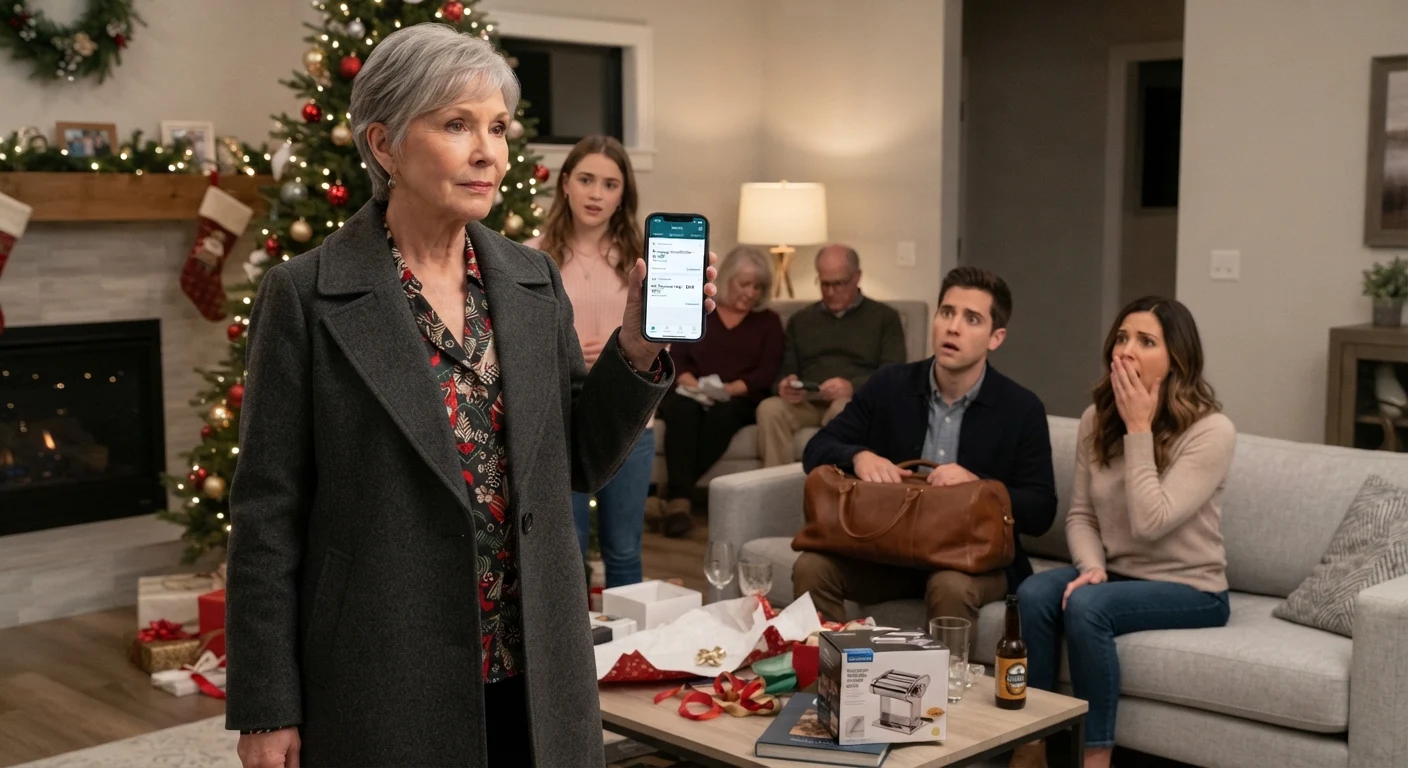
I turned the screen toward myself again.
Then I pressed the scheduled payment for the mortgage contribution.
A small menu appeared.
I selected cancel.
The banking app asked whether I was sure.
I pressed yes.
Then I did the same thing with the car payment.
Two scheduled transfers disappeared.
It took less than a minute.
Four years of automatic payments had ended while the Christmas candles were still burning.
Wesley stared at me.
“What did you just do?”
“I cancelled the two monthly transfers.”
His expression changed immediately.
“What transfers?”
“The mortgage contribution and the car assistance.”
Then Renee put down her wineglass.
“You’re joking.”
“No.”
“Why would you do that?”
I looked at her, then at my son.
“Because apparently I have everything I need, and you have other things you need to prioritize.”
Wesley frowned.
“Mom, that’s not what I meant.”
I nodded slowly.
“I know exactly what you meant. You said I didn’t need you to buy me anything because I had everything I needed.”
“That’s true.”
“Then I think we can agree that you don’t need me to keep buying things for you either.”
His mouth opened, but no words came out.
Renee looked toward her parents.
Ron suddenly became very interested in the remaining piece of pie on his plate.
Beverly reached for her glass.
Cleo finally moved.
She put her napkin down and looked directly at her brother.
“Are you serious right now, Wesley?”
He turned toward her.
“Cleo, don’t start.”
“No. I’m asking a simple question. Mom has been helping you pay for this house and your car for four years, and you just told her she didn’t deserve a Christmas present because she can afford to buy things herself?”
“That’s not what happened.”
“Then what happened?”
Wesley rubbed his forehead.
“Money is tight. We’re trying to renovate the bathroom. We have property taxes, insurance, the kids’ expenses, and everything else. We can’t keep buying presents for everyone.”
I glanced at the leather duffel.
It was a beautiful bag.
I had seen the brand in a shop window downtown. It was not something a person bought because they had no other choice.
But I didn’t say that.
Instead, I asked a quieter question.
“Did you ever think about calling me before Christmas to tell me money was tight?”
He looked confused.
“What?”
“Did you ever think about telling me you were struggling?”
“We are telling you now.”
“No, Wesley. You’re telling me why you didn’t buy me anything. Those are two different conversations.”
Renee crossed her arms.
“Dorothy, I really don’t think we need to turn Christmas into a financial discussion.”
I looked at her.
“You brought financial priorities into the conversation when my daughter asked where my present was.”
“That’s not fair.”
“Perhaps not. But neither is asking one person to keep contributing while making that same person feel like an inconvenience.”
Wesley pulled out his chair and sat down.
“Mom, you can’t just stop the payments without warning us.”
I looked at him for several seconds.
Then I asked, “Why not?”
“Because we depend on them!”
There it was.
The first completely honest sentence of the evening.
Not because they loved me.
Not because they appreciated my help.
Because they depended on the money.
I felt something painful move through my chest.
I had always known they depended on the transfers.
I simply hadn’t understood that they had begun to think of them as something they were entitled to.
“Wesley,” I said gently, “when I started helping you, I thought I was giving you a hand while you got settled. I never signed an agreement saying I would pay your mortgage and car expenses forever.”
“Nobody said forever.”
“Then why are you speaking as though I have broken a promise?”
He looked away.
Renee answered for him.
“Because we have built our budget around your help.”
I nodded.
“That is something you should have discussed with me before building your budget around my retirement savings.”
Her face tightened.
“Your retirement savings?”
“Yes.”
I took a sip of water.
“I don’t work at the food bank because I need somewhere to go in the afternoon. I volunteer because I enjoy helping people. But I also have bills, repairs, insurance, and a future to think about. Gerald and I worked hard to make sure I wouldn’t have to worry about money when I got older.”
Wesley looked at me.
“Dad would have wanted you to help us.”
That sentence hurt more than I expected.
Gerald had been gone for six years.
He had loved Wesley fiercely. He had taught him how to ride a bicycle, helped him with his first car, and attended every school event he could.
But Gerald had also believed that helping someone should make them stronger, not permanently dependent.
I remembered something he had told me once when Wesley was still in university.
“Give that boy a chance to stand on his own feet, Dorothy. Don’t carry him so far that he forgets he has legs.”
At the time, I had laughed.
Now I wished I had listened more carefully.
“Your father would have wanted you to be responsible for your own family,” I said.
Wesley shook his head.
“That’s a pretty convenient interpretation.”
I didn’t answer.
I wasn’t going to argue about what a dead man would have wanted simply because my son needed another reason to keep receiving money.
Cleo stood up.
“I’m going to help Mom with her coat.”
Renee looked surprised.
“She’s not leaving yet. We haven’t even finished dinner.”
Cleo gave her a tired look.
“I think she’s finished.”
I gathered my handbag.
I had brought four bags of presents into that house.
I left with my coat, my handbag, and the little gift bag containing the atlas Wesley hadn’t opened.
He noticed it.
“Mom, you’re taking my present?”
I looked down.
“Oh. I suppose I am.”
He stared at me.
“You bought it for me.”
“I did.”
“Then why are you taking it?”
I thought about the book.
It was a beautiful atlas of Canada’s national parks. I had chosen it because Wesley once told me he wanted to spend more time outdoors.
I had imagined him opening it, turning the pages, and perhaps telling me about a place he wanted to visit.
“I don’t know,” I said. “Perhaps I thought it would be nice to give something to someone who was interested in receiving it.”
I didn’t mean to sound unkind.
But the words landed heavily.
Cleo picked up her coat.
We said goodbye to Ron and Beverly.
They both looked uncomfortable.
Beverly actually stood up.
“Dorothy, I’m sorry about tonight.”
I appreciated that she said it.
“Thank you, Beverly. Merry Christmas.”
Then I walked out.
The cold air hit my face, and I took a long breath.
Cleo followed me down the steps.
“Mom, are you all right?”
I nodded.
Then, for the first time that evening, I cried.
Not loudly.
Not dramatically.
Just a few tears that came without asking permission.
Cleo put her arms around me.
“I’m sorry.”
I shook my head.
“You didn’t do anything wrong.”
“I should have said something earlier.”
“You did say something. I asked you not to make a scene.”
She held me tighter.
We stood there for a moment while the Christmas lights blinked along the roofline.
Then she walked me to my car.
Before I got inside, she asked whether I wanted to come to her apartment.
I told her I wanted to go home.
I needed to think.
And I needed to do something I hadn’t done in a very long time.
I needed to look after myself.
When I arrived home, the house was quiet.
Gerald’s old clock ticked in the hallway.
I hung my coat, put the kettle on, and sat at the kitchen table.
The atlas was still beside my handbag.
I opened it.
On the first page, I had written:
For Wesley. Maybe one day we’ll take a trip together. Love, Mom.
I stared at those words.
Then I closed the book.
I didn’t throw it away.
I put it on the shelf beside Gerald’s old travel books.
There was no reason to destroy something simply because the person I had bought it for had disappointed me.
The next morning, Wesley called.
I let the phone ring twice before answering.
“Morning, Mom.”
“Good morning.”
There was a pause.
“About last night…”
I waited.
“Renee is upset.”
I looked out the kitchen window.
Snow had gathered along the fence.
“I’m sorry she’s upset.”
“Mom, this is serious.”
“I know.”
“We have the mortgage coming out on the first.”
“I know.”
“And the car payment is due too.”
“I know that as well.”
He exhaled sharply.
“So what are we supposed to do?”
I held the phone against my ear.
“Make a budget that works without my money.”
“That’s not funny.”
“I’m not joking.”
He lowered his voice.
“Mom, you can’t leave us like this.”
I closed my eyes.
“Your father and I raised you to manage your own life, Wesley. I didn’t raise you to depend on your mother’s bank account.”
“We’re not asking for much.”
I almost laughed.
Not because it was funny, but because I had heard those words so many times.
A little help with the furnace.
A little help with the fence.
A little help with the car.
A little help with the mortgage.
Every request had sounded small when considered separately.
Together, they had become a second household I was paying for.
“I need you to understand something,” I said. “I’m not angry because you didn’t buy me a present. I’m hurt because you treated my help as an obligation and my feelings as an inconvenience.”
He went quiet.
Then he said something I wasn’t expecting.
“Renee thinks you’re doing this to punish us.”
I looked at the clock.
“No, Wesley. I’m doing this because I finally understand that I have been making your life easier while making mine smaller.”
He sighed.
“Can we talk about this later?”
“Of course.”
I ended the call.
For the rest of the day, I didn’t hear from him.
Two days later, I received a message from Renee.
It was longer than I expected.
She explained that they had already planned the bathroom renovation. The contractor had given them a quote, and they had expected to use some of their savings for the project.
However, without my monthly contribution, they would need to reconsider.
She also mentioned that the children were disappointed because they had been promised a trip during the school holidays.
I read the message twice.
There was no mention of Christmas.
No mention of the empty place at the table.