“Before you sign anything with Atlanta,” I said, “you need to look at the name on the front of this, and the number on the last page, and then read me the second paragraph of this agreement.”
She took it with two fingers.
“Mr. Gaskins, I really don’t have time to—”
“Then make time.”
Something in my voice made her stop.
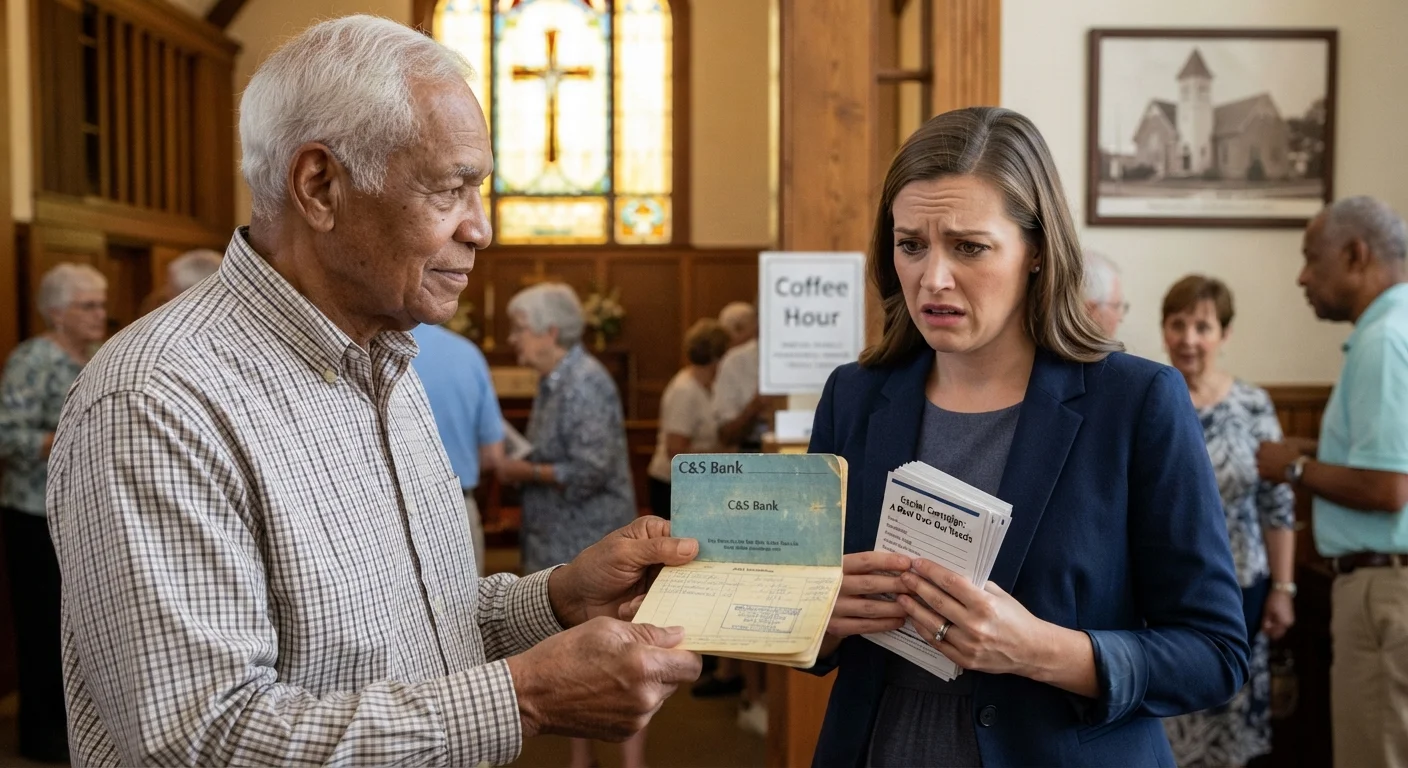
She looked down at the passbook.
The cover was faded blue. The corners were worn. The name written across the front was Pleasant Grove United Methodist Church Roof Fund.
Her eyebrows moved slightly.
“What’s this?”
“Something that has been sitting in my shed longer than you’ve been alive.”
She opened it.
The first deposit was dated November 17, 1974.
Ten dollars.
Then another.
Ten dollars.
And another.
She flipped through the pages. There were dozens of entries, written in different handwriting over the years. Some deposits were mine. Some were Ernestine’s. Some had been made by people whose names she recognized from the old church membership rolls.
Her fingers stopped on the final page.
She looked at the balance.
Then she looked at me.
“One hundred and twelve thousand dollars?”
“That’s what the passbook says.”
She blinked.
“That’s impossible.”
“No, ma’am. It’s arithmetic.”
“Where did this money come from?”
“Sunday envelopes. Interest. A few larger gifts from people who knew what we were doing. And fifty-two years of patience.”
She looked around the narthex.
A few people had noticed us. Pastor Jordan was standing near the sanctuary doors, speaking with two members of the choir.
Whitney lowered her voice.
“Mr. Gaskins, this account isn’t in our current financial system.”
“I know.”
“That’s a serious problem.”
“That’s why I’m standing here.”
She opened the folded paper.
It was a two-page agreement, yellowed at the edges, with Pastor Lyle Barfield’s signature at the bottom.
She read the first paragraph silently.
Then the second.
Her expression changed.
“Where did you get this?”
“Pastor Barfield signed it. I signed it. The church treasurer witnessed it. November 10, 1974.”
She read the paragraph again.
I watched her eyes move from left to right.
Then she looked up.
“Are you telling me the church has an account that it doesn’t know about?”
“I’m telling you the church has an account that somebody stopped asking about.”
She looked back at the document.
The second paragraph said:
The funds deposited into the Pleasant Grove Roof Account shall remain designated exclusively for the maintenance, repair, replacement, and preservation of the sanctuary roof. The account shall be administered for the benefit of Pleasant Grove United Methodist Church and shall not be diverted to general operating expenses without the written consent of the original contributors or their lawful representatives.
There was more.
A lot more.
But that was the sentence that mattered.
Whitney looked uncomfortable.
“Mr. Gaskins, I think we need to have our attorney review this.”
“Absolutely.”
“Until then, we can’t assume this account is valid.”
“That’s why I brought the original.”
She held the passbook more carefully now.
“Who has control of it?”
I pointed at the agreement.
“Read the third paragraph.”
She did.
Then she went completely quiet.
The third paragraph stated that the account had been established as a restricted church trust, with the bank serving as custodian and the church’s trustees serving as designated beneficiaries. It also stated that the original agreement would remain binding until the account was properly transferred or legally dissolved.
There were three signatures.
Pastor Barfield.
The church treasurer.
And mine.
But there was something else.
At the bottom, in smaller handwriting, was a sentence written by the old treasurer.
Any future roof committee shall first consult Mr. Ozell Gaskins regarding the condition of the sanctuary roof and the availability of these funds.
Whitney read it twice.
Then she handed the papers back.
“I’ll need to make copies.”
“That’s fine.”
“And we’ll need to schedule a meeting.”
“That’s fine too.”
She looked toward the sanctuary.
“Why didn’t you tell anyone about this before?”
I considered that question.
For fifty-two years, I’d put ten dollars in an envelope every Sunday.
I’d never asked for recognition.
I’d never asked for my name on a plaque.
I’d never asked anybody to stand up and thank me.
“I thought the church knew,” I said.
She didn’t answer.
I took my passbook back.
“One more thing, Miss Strickland.”
“Yes?”
“That three-hundred-and-eighty-thousand-dollar roof proposal. You said the Atlanta company inspected the building?”
“Yes.”
“Did they give you a detailed report?”
“Of course.”
“Did they inspect the flashing around the north bell tower?”
She hesitated.
“I believe so.”
“Believe or know?”
“I’ll have to check.”
“Do that.”
I turned toward the door.
Behind me, she said, “Mr. Gaskins?”
I stopped.
“Is there any reason you kept this secret?”
I looked at her.
“Because it wasn’t mine.”
Then I walked outside.
The Georgia sun was bright, and the air smelled like wet grass.
For the first time in fifty-two years, I wondered whether the roof fund had been waiting for something besides a roof.
It might have been waiting for somebody to remember why it existed.
That afternoon, I called the old bank.
Citizens and Southern had changed names years ago, and the original branch had closed. But the account number was still on the passbook.
A woman in the records department listened while I explained.
She asked me to hold.
I waited almost fifteen minutes.
When she came back, her voice was different.
“Mr. Gaskins, we have located an account matching that number. It has been transferred through several institutional mergers.”
“Is it still there?”
“Yes, sir.”
“Is the balance what the book says?”
“No, sir. The current balance is higher.”
I sat down at my kitchen table.
“How much higher?”
She told me.
I didn’t speak for several seconds.
The account held $186,742.19.
I asked her to send me an official statement.
Then I called Pastor Jordan.
He answered on the fourth ring.
“Ozell! How are you doing?”
“Pastor, I need to talk to you about something.”
“Everything all right?”
“I think the church is about to spend three hundred and eighty thousand dollars on a roof it doesn’t need.”
He was quiet.
Then I told him about the passbook.
I told him about the agreement.
And I told him about the money.
When I finished, he said something I wasn’t expecting.
“Mr. Gaskins, can you come to my office tomorrow morning?”
“Yes.”
“And could you bring everything you have?”
“I will.”
There was a pause.
Then he asked, “Do you think the church has been missing something all these years?”
I looked through my kitchen window.
Across the yard, the old shed stood beneath the pecan tree.
“Yes, Pastor,” I said. “I think we’ve been missing the point.”
PART 3 — THE MEETING THAT CHANGED EVERYTHING
Monday morning, I arrived at Pleasant Grove at nine o’clock.
Pastor Jordan was already in his office.
Whitney was there too.
So was the church’s senior trustee, Harold McKinney, a seventy-six-year-old retired school principal who had been attending Pleasant Grove since he was a boy.
There was a stack of papers on the desk.
The passbook.
The original agreement.
The bank statement.
And Whitney’s printed financial records.
She had a laptop open.
“Mr. Gaskins,” she said, “I’ve reviewed the bank’s confirmation.”
“All right.”
“The account is legitimate.”
“I figured.”
She didn’t smile.
“However, we still need to establish exactly how the funds should be administered under current church policy.”
Harold leaned forward.
“Whitney, I think we’re getting ahead of ourselves.”
She turned toward him.
“I’m simply saying we need to be careful.”
“And I’m saying we need to understand what we’re looking at.”
Pastor Jordan raised his hand.
“Let’s take this one step at a time.”
Whitney turned the laptop toward us.
“I’ve reconstructed the financial history as far as the records allow. The account was established in 1974. There were deposits over several decades. The balance increased through interest and additional contributions.”
“Correct,” I said.
“But the church’s annual financial statements don’t list this account.”
Harold frowned.
“That doesn’t mean it wasn’t legitimate.”
“It means it wasn’t included in the statements I’ve inherited.”
“Then perhaps we should find out why.”
Whitney looked at the agreement.
“There’s another issue.”
She pointed to the signatures.
“The original treasurer is listed as a custodian. But I haven’t found any document formally transferring the account to the current trustees.”
Pastor Jordan looked at me.
“Do you know what happened?”
I shook my head.
“Not exactly.”
I remembered Mr. Ransom taking over the church books in the early eighties. I remembered Mrs. Pope helping him. I remembered a few conversations about the account.
But I had never managed it.
I had trusted the people who did.
Harold picked up the agreement.
“Pastor Barfield wouldn’t have established something like this without making sure the trustees understood it.”
“Do you remember him?” I asked.
Harold nodded.
“He married my wife and me.”
“Then you remember what kind of man he was.”
Harold smiled faintly.
“I do.”
Whitney typed something.
“There’s one more thing. The Atlanta contractor’s proposal includes a complete roof replacement, new decking, structural reinforcement, drainage improvements, and replacement of the bell tower flashing.”
“Did they document structural damage?” I asked.
“Yes.”
“Where?”
She scrolled through the report.
“Page fourteen.”
“Read it.”
She looked.
“Localized moisture intrusion near the north bell tower.”
“Localized?”
“Yes.”
“Any evidence of widespread decking failure?”
She continued reading.
“Not specifically.”
“Any evidence of structural damage throughout the roof?”
“Not specifically.”
I leaned back.
“Then why are we replacing the whole roof?”
Whitney folded her hands.
“The company recommended replacement because the roof is old.”
“Old isn’t the same as failed.”
“Mr. Gaskins, the church has a responsibility to maintain a safe building.”
“I agree.”
“And we can’t simply rely on somebody’s memory.”
“I agree with that too.”
She looked surprised.
I continued.
“That’s why you get an independent inspection. Not one from the company that wants to sell you a three-hundred-and-eighty-thousand-dollar roof.”
Harold nodded.
“That sounds reasonable.”
Pastor Jordan wrote something in his notebook.
“Let’s arrange an independent inspection.”
Whitney sighed.
“Fine.”
I looked at her.
“There’s another thing I’d like to know.”
“What?”
“How much did the church spend on the new accounting system?”
She hesitated.
“That’s unrelated.”
“Maybe. But I’d like to know.”
She gave us the figure.
The new software, consulting, training, and financial restructuring had cost the church nearly $18,000.
I didn’t criticize it.
A church needed accurate books.
But I wondered how much of that money had gone toward replacing a system that had been working for decades.
Harold seemed to be thinking the same thing.
He closed the agreement.
“Whitney, I want to ask you something.”
“Yes?”
“Did you know about Ozell’s Sunday envelopes?”
She looked at the table.
“I knew he made designated donations.”
“And did you know what they were for?”
“I knew they were labeled ROOF.”
“Did you know he’d been doing it for fifty-two years?”
She nodded.
“Yes.”
Harold shook his head.
“Then why did you send them back?”
Whitney took a breath.
“Because there was no roof fund in the current chart of accounts. I couldn’t keep accepting money designated for an account I couldn’t reconcile.”
“Then why didn’t you ask?”
“I thought I was correcting an outdated practice.”
Harold stared at her.
“That practice was older than you.”
The room went quiet.
Pastor Jordan finally spoke.
“Let’s focus on resolving this properly.”
We agreed on three things.
First, the church would obtain an independent roof inspection.
Second, the bank would provide a complete account history and documentation of the trust.
Third, the trustees and church attorney would review the original agreement before anyone moved or spent the money.
Whitney wrote everything down.
When the meeting ended, she caught me near the office door.
“Mr. Gaskins.”
I turned.
“I owe you an apology.”
I waited.
“I shouldn’t have returned your envelope without asking about its history.”
“That’s true.”
“And I shouldn’t have written that ten dollars wasn’t moving the needle.”
“No, ma’am. You shouldn’t have.”
She looked down.
“I didn’t understand.”
I nodded.
“That’s the trouble with looking at a number without looking at the people behind it.”
She looked at me for a moment.
Then she asked, “Did your wife contribute too?”
“Every week she could.”
“What was her name?”
“Ernestine.”
Whitney wrote it down.
“Would you mind telling me about her?”
I looked through the office window.
The sanctuary was quiet.
The morning light was falling across the third pew.
“She was the reason I kept going,” I said.
And for the first time since the envelope came back in my mailbox, Whitney looked like she understood that the story was bigger than a bank account.
The independent inspection took place the following Thursday.
The church hired a licensed roofing engineer from Tifton who had no connection to the Atlanta contractor.
His name was Daniel Reeves.
He spent almost six hours on the building.
He inspected the shingles.
He checked the valleys.
He examined the decking.
He climbed around the bell tower.
He took photographs.
He measured the roof.
He even went into the attic with a flashlight and a moisture meter.
I watched him from the ground.
When he finally came down, he wiped his forehead.
“Mr. Gaskins?”
“Yes, sir.”
“You were right about the flashing.”
“How bad?”
“Bad enough to cause the ceiling stain. Not bad enough to justify replacing the entire roof.”
I folded my arms.
“What about the shingles?”
“They’re aging. Some granule loss. A few repairs needed. But the roof system is still serviceable.”
“Decking?”
“Solid.”
“Structure?”
“Sound.”
He handed me his preliminary notes.
The recommended work included replacing the north tower flashing, repairing several sections of damaged shingles, improving drainage in two areas, and performing routine maintenance.
Estimated cost: $24,600.
I read the number twice.
Twenty-four thousand six hundred dollars.
Not three hundred and eighty thousand.
Pastor Jordan was standing beside Whitney.
She looked at the report.
Then at me.
“That’s a significant difference.”
“Yes, ma’am.”
“Are you saying the Atlanta company was wrong?”
“I’m saying they recommended replacing a roof that doesn’t need replacing.”
The engineer spoke carefully.
“I can’t comment on their intentions. But based on my inspection, a complete replacement isn’t technically necessary at this time.”
Whitney nodded slowly.
“Could we get that in writing?”
“You’ll have a complete report by Monday.”
I looked up at the bell tower.
For fifty-two years, that little white church had stood beside Old Clyattville Road.
People had married there.
People had been baptized there.
People had buried their parents from there.
And the roof had been keeping the rain off all of them.
I felt Ernestine beside me.
Not literally.
But I remembered the way she’d stand in the kitchen every Sunday morning, counting out ten dollars while I tied my Sunday shoes.
“Don’t forget the envelope, Ozell,” she’d say.
I never did.
The following Sunday, Whitney stood before the congregation.
The pledge cards were still stacked on the table.
But the PowerPoint presentation was gone.
She held a printed copy of the engineer’s report.
“I want to update everyone on the proposed sanctuary roof project,” she began.
She explained the inspection.
She explained the findings.
She explained that the original estimate of $380,000 was no longer recommended.
There were murmurs throughout the sanctuary.
Then she paused.
“There’s something else.”
She looked toward the third pew.
“Mr. Ozell Gaskins has brought forward documentation of a restricted roof account established in 1974.”
A few heads turned.
“That account currently holds $186,742.19.”
Someone gasped.
Whitney continued.
“The account was established through a written agreement between Pastor Lyle Barfield, the church treasurer, and Mr. Gaskins. It was intended specifically for roof maintenance and replacement.”
She held up the agreement.
“The church is having its attorney review the documentation. We will not spend or transfer any of these funds until the legal and accounting requirements are satisfied.”
Then she said something I hadn’t expected.
“I also want to apologize publicly to Mr. Gaskins. I returned his designated contribution and told him that ten dollars a week wasn’t moving the needle. I was wrong to dismiss a tradition without understanding its purpose.”
The sanctuary became very quiet.
Whitney looked directly at me.
“Mr. Gaskins, I’m sorry.”
I nodded.
“Thank you.”
Then she sat down.
Pastor Jordan stood.
“I think we should remember something today. A church is more than its financial statements. Our records matter, but the people who built this congregation matter too.”
He looked toward the third pew.
“Somebody began caring for this roof long before any of us were here.”
I looked at the empty space beside me.
And for the first time that morning, I wished Ernestine could have heard it.
But the biggest surprise was still waiting.
Because when the church attorney finished reviewing the account, he found something none of us had expected.
And it changed the future of Pleasant Grove forever.
FULL ENDING — THE MONEY WAS NEVER THE MOST IMPORTANT PART
The attorney’s name was Robert Ellison.
He was a church member, seventy-two years old, and had practiced law in Valdosta for almost forty-five years.
He came to my house on a Tuesday afternoon.
I was sitting on the porch, drinking coffee, when his truck pulled into the driveway.
He carried a leather briefcase.
“Mr. Gaskins?”
“Come on up.”
He sat across from me.
I poured him coffee.
He opened his briefcase and removed a folder.
“I’ve reviewed the agreement, the bank records, and the church’s historical documents.”
“All right.”
“The account is legitimate. The original agreement is valid, and the bank has confirmed the account’s continuous existence.”
I nodded.
“Good.”
“There is one complication.”
I put my cup down.
“What kind?”
“The original agreement establishes the account as restricted for roof-related purposes. But the church’s records don’t clearly show how administrative responsibility passed from the original trustees to the current board.”
“Can that be fixed?”
“Yes. The current trustees can formally acknowledge the account, adopt its restrictions, and document its administration. The bank will need updated authorization.”
“Anything else?”
He smiled.
“Actually, yes.”
He took out another piece of paper.
“This is a copy of a letter written by Pastor Barfield in 1974.”
I recognized the handwriting immediately.
Lyle Barfield had written with a fountain pen. His letters leaned slightly to the right.
“Where did you find that?”
“In the church archives. It was tucked inside an old trustee ledger.”
Robert handed it to me.
I began reading.
To the trustees of Pleasant Grove United Methodist Church:
I am writing to clarify the purpose of the roof account established this month.
Mr. Ozell Gaskins has generously repaired the sanctuary roof without compensation. However, I do not want this church to mistake his kindness for an obligation that will continue forever.
He has a family. He has a business. He has a life outside these walls.
The roof account is being established so that the church will never again depend on one man’s generosity to protect its congregation.
I stopped.
I read that paragraph again.
Robert watched me.
“Keep going.”
I continued.
I have asked Mr. Gaskins to accept responsibility for helping us establish this fund, but not for carrying it alone. The church must contribute. Its members must contribute. Every gift, no matter how small, must be respected.
Then came the final paragraph.
One day, the people who remember this agreement will be gone. When that happens, I pray the church will remember that a dollar is not measured by its size, but by the faithfulness and love with which it is given.
I lowered the paper.
For a moment, I couldn’t speak.
Robert let the silence sit.
Finally, I said, “I remember him saying something like that.”
“He wanted the agreement to survive changes in leadership.”
“He was a good man.”
“Yes, he was.”
Robert opened another folder.
“There is also a question concerning the original contributors.”
“What question?”
“The agreement says the funds may not be diverted without written consent from the original contributors or their lawful representatives.”
I looked at him.
“Does that mean the church can’t use the money?”
“Not at all. The money is restricted for the roof. The church can use it for that purpose. But if the trustees ever wanted to use it for something else, the agreement imposes conditions that would have to be addressed.”
“Then we don’t use it for something else.”
Robert smiled.
“That would certainly make things simpler.”
He explained that the church could restore the account to its official books, appoint trustees to oversee it, and create a written maintenance plan.
He also recommended that the church establish a separate reserve for future building repairs.
“That way,” he said, “the roof fund remains dedicated to the roof, while the church can prepare for other expenses.”
I nodded.
“That sounds sensible.”
Then I asked the question that had been sitting in my mind.
“Can the church use the money to fix the roof?”
“Absolutely. That’s exactly what the fund was created to do.”
I looked down at my coffee.
“Then that’s what it should do.”
Robert smiled.
“I thought you might say that.”
The church council met the following Thursday.
This time, the fellowship hall was full.
People had heard about the account.
Some were curious.
Some were embarrassed.
Others simply wanted to know what would happen next.
Whitney sat at the front with the financial documents.
Pastor Jordan sat beside her.
Harold McKinney opened the meeting.
“Before we begin, I’d like to say something.”
He looked around.
“I’ve attended this church for seventy-six years. I’ve seen pastors come and go. I’ve seen families move away and new families arrive. I’ve watched this congregation bury people, welcome babies, celebrate marriages, and help neighbors through terrible times.”
He paused.
“But I’ve never seen anything quite like what we’re discussing tonight.”
He lifted the original agreement.
“Fifty-two years ago, a man decided he didn’t want our church to face another leaking roof without a plan.”
He looked at me.
“That man was Ozell Gaskins.”
There was applause.
I raised my hand.
“Don’t do that. We haven’t fixed anything yet.”
A few people laughed.
Harold smiled.
“Fair enough.”
Whitney stood.
“I’ve prepared a proposed resolution.”
She read it aloud.
The church would officially recognize the Pleasant Grove Roof Fund.
The bank account would be documented as a restricted account.
The trustees would be responsible for oversight.
The church would obtain an independent annual inspection.
Any expenditure would require proper authorization and supporting invoices.
The account could only be used for roof maintenance, repairs, replacement, and directly related preservation expenses.
Then she addressed the $380,000 proposal.
“The finance committee recommends that the church reject the complete replacement proposal at this time and proceed with the repair plan prepared by the independent roofing engineer.”
Harold nodded.
“Do we have a motion?”
“I move that we approve the resolution,” said Faye Pope.
“Second,” another trustee answered.
Harold called for discussion.
A man in the second row raised his hand.
“Why don’t we just use the entire $186,000 to replace the roof anyway? Then we’ll have a brand-new roof and won’t have to worry about it.”
It was a reasonable question.
Whitney answered before I could.
“Because the engineer has determined that a complete replacement isn’t necessary. The roof fund exists to preserve the building responsibly, not to spend money simply because money is available.”
I looked at her.
She was learning.
Another member spoke.
“What happens if we spend the twenty-four thousand and the roof needs replacement in ten years?”
Whitney opened her folder.
“The remaining balance will continue earning interest, subject to the account’s terms. We’ll also establish a maintenance schedule and continue accepting voluntary contributions.”
Someone near the back raised a hand.
“Can we still give ten dollars a week?”
Whitney looked toward me.
Then she smiled.
“Yes. And I promise it won’t be returned.”
The room laughed.
But it wasn’t the kind of laughter I’d heard two weeks earlier.
It was warmer.
Harold called the vote.
The resolution passed unanimously.
For a moment, nobody spoke.
Then Pastor Jordan said a short prayer.
He thanked God for the people who had cared for Pleasant Grove before any of us knew we would need it.
He thanked Him for the people who continued to care for it.
And he asked that the church never confuse the size of a gift with the size of the heart behind it.
I sat quietly.
I thought about Ernestine.
And I thought about Pastor Barfield.
Both of them had been gone for years.
But their signatures were still on that agreement.
Their names were still part of the church’s history.
The repair work began three weeks later.
I went out to the church on the first morning.
The roofing crew was already unloading materials.
The foreman was a young man named Caleb.
He walked over when he saw me.
“Mr. Gaskins?”
“That’s me.”
“My grandfather used to talk about you.”
“Who was your grandfather?”
“Sam Reeves. He worked with you in the seventies.”
I smiled.
“Sam was a good roofer.”
“He said you could look at a roof from the road and tell where it was leaking.”
“Your grandfather exaggerated.”
Caleb laughed.
“He said you could also tell when somebody was trying to sell a customer more roof than they needed.”
I looked at him.
“Your grandfather was right about that.”
He showed me the repair plan.
The flashing would be replaced.
Several damaged shingles would be repaired.
The drainage around the north tower would be improved.
The crew would inspect the entire roof and document anything else that needed attention.
I walked around the building with him.
I pointed out the old valleys.
I showed him where the water had been entering.
I told him about the repair we’d done in 1998.
He listened carefully.
Then he said, “You really know this building.”
“I’ve known this roof longer than you’ve been alive.”
He smiled.
“I figured.”
Before I left, I climbed the brick steps and stood beneath the steeple.
The church looked exactly as it had when Ernestine and I joined in 1972.
The white walls.
The old windows.
The little wooden cross.
The third pew visible through the open sanctuary doors.
I thought about all the Sundays we’d sat there.
Our three girls.
The Christmas programs.
The Easter mornings.
The funerals.
The weddings.
The ordinary Sundays when nothing special happened.
Those were the days I missed most.
The repairs cost $24,180.
The remaining money stayed in the restricted account.
The bank provided updated statements.
The trustees signed the necessary documents.
And Whitney rebuilt the church’s accounting records to include the fund.
But something unexpected happened after the repair work was completed.
People began asking about the original envelopes.
Some had never noticed them.
Some remembered them from years ago.
Others had their own stories.
Mrs. Faye Pope told me her mother used to put an extra dollar in the offering every month because she wanted to help keep the sanctuary dry.
Mr. Harold McKinney remembered a retired schoolteacher who had donated twenty dollars every Christmas for almost thirty years.
A woman named Dorothy told us her late husband had once slipped me fifty dollars and said, “Put this toward that roof of yours.”
I had forgotten about that.
The more people talked, the more we discovered that the fund had never really been one man’s project.
It had been a collection of small acts of love.
Somebody had given ten dollars.
Somebody had given five.
Somebody had given a hundred.
And somebody had simply kept showing up.
Whitney suggested holding a special Sunday service to recognize everyone who had contributed to the church over the years.
I agreed, but I asked her not to make it a celebration of me.
“Why not?” she asked.
“Because I didn’t do it alone.”
She nodded.
“Then we’ll celebrate the people who built the church.”
That was better.
The special service took place on the second Sunday in December.
The sanctuary was full.
There were people standing along the back wall.
Some had driven from out of town.
Our oldest daughter, Martha, came with her husband.
Our middle daughter, Elaine, brought two grandchildren.
Our youngest, Ruth, sat beside me in the third pew.
The seat on my left remained empty.
It always did.
Pastor Jordan began with a hymn.
Then he invited Whitney to speak.
She stood at the pulpit holding a small wooden box.
“I want to tell you about something I learned during this process,” she said.
She looked toward me.
“When I first became finance chair, I believed my responsibility was to make every number fit neatly into a spreadsheet. I believed that if something wasn’t documented in the current system, it shouldn’t be there.”
She paused.
“I was wrong.”
She opened the wooden box.
Inside were several old envelopes.
They were yellowed and worn.
Each one had the word ROOF written across the front.
Some were in my handwriting.
Others were Ernestine’s.
One had a little flower drawn in the corner.
I recognized it immediately.
Ernestine had done that.
Whitney held it up.
“These envelopes represent fifty-two years of faithfulness.”
She continued.
“Mr. Gaskins gave ten dollars a week. But what he really gave was a promise. A promise that the next generation wouldn’t have to face the same problem the previous generation faced.”
She looked at the congregation.
“And I think we owe him something more valuable than a plaque.”
Then she turned toward me.
“Mr. Gaskins, would you come forward?”
I didn’t move.
Ruth touched my arm.
“Daddy.”
I sighed and stood.
My knees complained.
I walked slowly toward the pulpit.
Whitney handed me the wooden box.
Inside were the original envelopes.
And one new envelope.
It was white.
On the front, in neat black letters, was written:
ROOF — 2026.
I looked at Whitney.
She smiled.
“We thought you should have the first one.”
I opened it.
Inside was a ten-dollar bill.
I looked up.
“Who put this in?”
Whitney raised her hand.
“Me.”
I stared at her.
Then she said, “I know it’s not much compared with the balance in the account. But I wanted to start the next fifty years the way the first fifty-two started.”
For a moment, I couldn’t find anything to say.
Then I reached into my pocket.
I had brought ten dollars with me.
I placed it inside the envelope.
“Then let’s start together.”
The congregation applauded.
But I wasn’t looking at them.
I was looking at the empty seat beside me.
I imagined Ernestine sitting there, smiling the way she used to when she knew I’d done something right but didn’t want to make a fuss about it.
I whispered, “We kept the promise, sweetheart.”
After the service, Whitney came to sit beside me in the fellowship hall.
She had two cups of coffee.
She gave me one.
“Mr. Gaskins?”
“Ozell is fine.”
She smiled.
“Ozell, can I ask you something?”
“Go ahead.”
“Why ten dollars?”
I stirred my coffee.
“Because that’s what I could afford in 1974.”
“But you kept the amount the same.”
“Yes.”
“Even when you could afford more?”
I nodded.
“Some years I could have given fifty. Some years a hundred. But I wanted the habit to stay the same. Ten dollars every Sunday meant I never forgot why I was giving.”
She looked at the wooden box.
“Did Ernestine ever ask you to stop?”
I laughed.
“Once.”
“Really?”
“Back in 1982, we had a difficult year. One of our girls needed surgery, and business was slow. I came home one Sunday and told Ernestine I thought we should skip the roof envelope for a while.”
“What did she say?”
“She told me to put the ten dollars in anyway.”
Whitney smiled.
“Why?”
“She said the church had carried us through some hard times. She didn’t want us to forget that.”
I looked down at my coffee.
“She was better at remembering things than I was.”
Whitney was quiet.
Then she said, “I wish I could have met her.”
“She would’ve liked you.”
Whitney looked surprised.
“Even after what happened?”
“She would’ve told you that making mistakes is part of being human. But she’d also have told you to ask questions before making decisions about other people’s lives.”
Whitney laughed softly.
“I think I needed to hear that.”
The following spring, the church council decided to do something else.
They established a small maintenance education program for young people in the congregation.
The idea came from Caleb, the roofing foreman.
He offered to teach basic home maintenance and roofing safety to interested teenagers.
The church provided a classroom.
A few local tradespeople volunteered their time.
They taught young people how to recognize leaks, maintain gutters, identify damaged shingles, and know when to call a licensed professional.
I was invited to help.
At first, I said no.
My knees weren’t what they used to be.
But Caleb told me I didn’t have to climb anything.
“We just need you to teach us what you know.”
So I agreed.
Every other Saturday, I’d sit in the fellowship hall with a group of teenagers.
I brought photographs from my old roofing jobs.
I showed them how to identify different roofing materials.
I told them about my father.
About carrying shingles at fourteen.
About the first roof I ever installed by myself.
And about the church roof in 1974.
One boy named Marcus asked me a question during the third session.
“Mr. Gaskins, how do you know when a roof is worth fixing instead of replacing?”
I thought about it.
“First, you inspect it. Then you understand what’s wrong. Then you decide what actually needs doing.”
He nodded.
“That sounds simple.”
“It is.”
I pointed toward him.
“But people often make it complicated because they want to sell you something.”
The teenagers laughed.
Then I added something serious.
“Remember this. Don’t replace something just because it’s old. Don’t throw something away because it doesn’t look new. And don’t assume something has no value just because you can’t see the value immediately.”
Marcus wrote that down.
I wondered if he’d remember it.
I hoped he would.
Whitney changed too.
She remained finance chair.
She still used her label maker.
She still organized the books.
But she began asking questions.
She asked longtime members about old donations.
She checked historical records before closing accounts.
She made sure every restricted gift was properly documented.
And every Sunday, she placed a ten-dollar bill in a white envelope marked ROOF.
Sometimes I saw her doing it.
She never made a show of it.
One afternoon, I found her in the fellowship hall reviewing the financial records.
She looked up.
“I’ve been thinking about something.”
“That’s dangerous.”
She laughed.
“What if we created a permanent church history archive?”
I raised an eyebrow.
“What kind of archive?”
“Old agreements. Photographs. Donation records. Stories from longtime members. Things like the roof fund.”
I thought about it.
“That’s a good idea.”
“Would you help?”
“Of course.”
She closed her laptop.
“There’s something else I want to ask.”
“What?”
“Would you let us put your name on the roof fund?”
I shook my head.
“No.”
She looked disappointed.
“Why not?”
“Because I don’t want somebody fifty years from now thinking the fund belongs to me.”
“But you started it.”
“I helped start it. That’s different.”
She considered that.
“Then what should we call it?”
I thought for a moment.
“Call it the Pleasant Grove Roof Fund.”
“Just that?”
“Just that.”
She smiled.
“I should have known.”
Two years passed.
The roof continued doing its job.
The repairs held.
The church held its annual inspection.
The account balance grew modestly through interest and additional contributions.
The new maintenance plan prevented small problems from becoming expensive ones.
And every Sunday, I still put ten dollars in an envelope.
Sometimes Ruth brought it when I couldn’t make it.
Sometimes Martha did.
But most Sundays, I was there.
Third pew.
Left side.
Aisle seat.
The space beside me still empty.
Then, one Sunday in November, I arrived to find a young family sitting in our row.
A mother, a father, and a little girl with two white ribbons in her hair.
I stopped.
The father stood.
“Sorry, sir. Is this seat taken?”
I looked at the space beside me.
For fifty years, I’d treated that seat like a promise.
But promises can be carried in different ways.
“No,” I said. “You sit down.”
The little girl looked up at me.
“Are you the man who fixes roofs?”
I smiled.
“Used to be.”
“My daddy says you’re the reason our church doesn’t leak.”
Her father looked embarrassed.
“She’s been hearing about you.”
I laughed.
“Well, your daddy shouldn’t tell her everything.”
The little girl giggled.
Then she pointed at my envelope.
“What’s that?”
“That’s for the roof.”
“Why?”
“Because roofs keep the rain out.”
She considered that.
Then she asked, “Do you put money in it every Sunday?”
“Yes, ma’am.”
“How much?”
“Ten dollars.”
She looked at her father.
“Can I do that too?”
Her father smiled.
“If you want to.”
She reached into her little purse and pulled out a dollar.
It was folded into a tiny square.
She held it out.
“Can I help?”
I looked at the dollar.
Then I looked at her.
“Absolutely.”
I opened the envelope.
She placed the dollar inside.
Her father reached into his wallet.
He pulled out nine more dollars and added them.
“There,” he said. “Ten dollars.”
The little girl smiled.
“Now I help like you.”
I felt something tighten in my chest.
I looked toward the empty seat beside me.
And for the first time in years, it didn’t feel quite so empty.
That afternoon, I went home and took the old Maxwell House coffee can down from the shelf.
It was still rusty around the rim.
The tape Ernestine had put around the lid in 1974 had long since fallen away.
I took out the original agreement.
I took out the old passbook.
And I took out the letter from Pastor Barfield.
I sat at my kitchen table and read them all again.
Then I found a photograph.
It was from 1974.
I was twenty-nine years old.
Ernestine was standing beside me in front of the church.
My father was there too.
Behind us was the sanctuary roof we’d just repaired.
Everybody was smiling.
I turned the photograph over.
In Ernestine’s handwriting were the words:
For the church that helped build our family.
I sat there for a long time.
I thought about the first ten-dollar envelope.
I thought about all the Sundays that followed.
I thought about the letter Whitney had sent me.
Ten dollars a week is not really moving the needle.
Maybe she had been right about one thing.
Ten dollars by itself wasn’t enough to replace a roof.
But that had never been the point.
The ten dollars was a reminder.
A reminder that somebody had promised to take care of something.
A reminder that a church wasn’t just brick and wood and shingles.
It was people.
People who showed up when you were sick.
People who brought sandwiches when you were tired.
People who sat beside you when you buried your wife.
People who remembered your children.
People who put a dollar in an envelope because they wanted the next generation to have a dry place to pray.
I closed the passbook.
Then I opened the kitchen drawer and took out a fresh envelope.
I wrote one word across the front.
ROOF.
I placed ten dollars inside.
Then I put it beside my keys so I wouldn’t forget it next Sunday.
The following week, Pastor Jordan called.
“Ozell, I’ve got some news.”
“What kind?”
“The conference office has been asking about the roof fund.”
“Why?”
“They heard about the account and the agreement. They want to use Pleasant Grove as an example of how a congregation can preserve restricted gifts and plan for building maintenance.”
I chuckled.
“Tell them to come look at the roof.”
He laughed.
“Actually, they’d like you to speak.”
“Me?”
“Yes. They want to hear the story from the person who started it.”
I looked at the old photograph on the table.
“I’ll think about it.”
He paused.
“There’s one more thing.”
“What?”
“Whitney has been asked to help develop a financial recordkeeping guide for other churches.”
I smiled.
“That’s good.”
“She says she wants to include the story of the ten-dollar envelope.”
“Tell her she can.”
“And she wants to make sure you get credit.”
I shook my head.
“Tell her to give credit to everybody who ever put something in that account.”
“I think that’s exactly what she’ll do.”
After we hung up, I walked outside.
The pecan tree was dropping leaves.
The old shed stood in the afternoon light.
I thought about my father.
I thought about Ernestine.
I thought about Pastor Barfield.
And I realized something.
The roof fund had done more than keep the church dry.
It had preserved a promise across generations.
A promise that outlasted the people who made it.
At the end of the year, Pleasant Grove held another special service.
This time, the little girl from the third pew brought her own envelope.
She was seven years old now.
Her name was Lily.
She walked up to the front of the sanctuary carrying it with both hands.
“Mr. Gaskins,” she said, “I brought my roof money.”
I took the envelope.
It had a dollar inside.
On the front, in big uneven letters, she’d written:
ROOF.
Underneath it, she’d drawn a little house.
I smiled.
“That’s a beautiful envelope.”
“My daddy helped me spell the word.”
“Then he did a good job.”
She looked up at the ceiling.
“Will the roof still be here when I’m old?”
I laughed.
“With people like you helping, I think it will.”
She nodded seriously.
Then she ran back to her parents.
I sat down in the third pew.
For a moment, I looked at the empty seat beside me.
Then I remembered the words Ernestine had said all those years ago.
Don’t forget the envelope, Ozell.
I hadn’t forgotten.
And now somebody else wouldn’t either.
The church was quiet.
Sunlight came through the stained-glass windows.
The little white sanctuary stood beside Old Clyattville Road, just as it had for more than a hundred years.
And above us, the roof held.
Not because one man had given ten dollars every Sunday.
Not because a bank account had grown to $186,742.
Not because an attorney had found an old agreement.
It held because people had remembered that caring for something meant taking responsibility for it, even when nobody was watching.
I reached into my pocket.
There was one more ten-dollar bill.
I put it in my envelope.
And I wrote the same word I’d written every Sunday for fifty-two years.
ROOF.
This time, I didn’t write it for the roof we already had.
I wrote it for the people who would sit beneath it long after I was gone.
And I knew Ernestine would have understood.
THE END.