The call came at 5:47 p.m. on Christmas Eve.
Joe Miller remembered the time because the stove clock was the only thing in the kitchen that still worked without complaining.
The turkey had just started to smell right.

Onions, butter, and black pepper were warming in the pan, and the old radiator under the window was ticking with that dry little sound it made every winter.
Outside, the cold pressed against the glass hard enough to fog the corners.
Inside, the dining table was set for four people who had not sat around it much since Mary died.
Joe had put out the good plates anyway.
Mary would have wanted that.
She had always believed people came back faster when there was a place waiting for them.
Joe was tying a red ribbon around Sophie’s doll when his phone buzzed against the counter.
For half a second, he thought about letting it ring.
His hands were stiff from the cold and from age, and the ribbon kept slipping under his thumb.
Then he saw Tommy’s name on the screen.
Tommy never called at dinner time unless something mattered.
Joe answered with a smile already in his voice.
“Merry Christmas Eve, buddy.”
There was no answer at first.
Only breathing.
Small breathing.
Careful breathing.
Then Tommy whispered, “Grandpa Joe, it’s better if you don’t come for Christmas. Dad says you aren’t welcome here.”
Joe stood very still.
The ribbon slid from his fingers and dropped onto the counter.
It was not the words that frightened him first.
Robert had said cold things before.
Jennifer had said polished things that meant cold things.
What frightened Joe was the way Tommy forced each word out, like he was speaking from inside a room where listening could get him punished.
“Why would your dad say that?” Joe asked.
A sound came through the phone.
It was not quite a sob.
It was the sound a child makes when he has learned to stop crying halfway through.
“I don’t know,” Tommy whispered. “Dad and Mom are mad at me again.”
Again.
Joe looked at the little pile of gifts on his kitchen table.
Small tools for Tommy.
A doll for Sophie.
A bottle of bourbon for Robert that cost more than Joe should have spent.
That one word sat down beside all of it.
Again.
Robert had been Joe’s only son.
He had been the boy who ran through the yard with scraped knees and grease on his fingers from taking apart anything Joe was foolish enough to leave unattended.
He had been the teenager who pretended not to care when Mary packed him sandwiches for work.
He had been the young groom standing in a rented hall, crying when he saw Jennifer come down the aisle.
And after Mary died, he had become a man Joe could not reach.
Work was busy.
Jennifer had a headache.
The kids had school.
The house was a mess.
The timing was bad.
There was always a reason.
There is a special kind of grief that does not take people all at once.
It takes Sunday dinner first.
Then phone calls.
Then birthdays.
Then one Christmas Eve, your grandson whispers that you are not welcome, and you realize the door has been closing for years.
Joe softened his voice.
“Tommy, where are you right now?”
Silence.
Then the faintest click, like a door handle moving somewhere far from the phone.
“I have to go,” Tommy whispered.
The call ended.
Joe did not move for three seconds.
The radiator ticked.
The turkey hissed in the oven.
A car passed outside, tires whispering over the icy street.
Then Joe turned off the burners.
He put on the blue button-down shirt he had worn to Robert’s wedding.
Mary had liked that shirt.
She used to say it made him look less like a retired welder and more like somebody’s father.
He packed the gifts into a paper grocery bag and set the bourbon carefully at the bottom so it would not tip.
He put on his coat.
He locked the door.
Then he climbed into his old gray Ford and drove toward Robert’s house.
The road north was slick in patches.
Christmas lights blurred in the windshield.
Joe passed houses where families were already gathering, where kitchen windows glowed yellow and silhouettes moved behind curtains.
He kept both hands on the wheel.
He did not call Robert.
He did not call Jennifer.
He did not give them a chance to explain away what he had heard.
By 6:38 p.m., Robert’s house looked perfect from the curb.
White lights lined the gutters.
A wreath hung on the front door.
Two SUVs sat in the driveway.
A small American flag clipped near the porch rail moved slightly in the winter air.
The whole place had the clean, bright look of a family that wanted the neighbors to admire it.
Joe parked behind one of the SUVs and lifted the grocery bag from the passenger seat.
The paper handles cut into his fingers.
He climbed the porch steps and rang the bell.
Once.
Twice.
Three times.
No one answered.
He could hear music inside.
Soft Christmas music, the kind Mary used to play while she cooked.
Joe stepped sideways and looked through the living room window.
Robert was sitting on the couch with a beer in his hand.
Jennifer sat near him in a red dress, scrolling on her phone.
There were appetizers on the coffee table.
There were glasses.
There were plates set out for a quiet dinner.
No one looked toward the door.
Joe knocked again, harder this time.
Robert glanced toward the sound and looked away.
Jennifer did not look up at all.
Joe stared through the glass, feeling something old and hot move up through his chest.
Then he noticed what was missing.
Tommy was not in the room.
Sophie was not in the room either, but Sophie was six and could have been upstairs with a toy or asleep under a blanket.
Tommy should have been there.
Tommy loved Christmas Eve.
He loved food he could pile on one plate.
He loved opening one present early.
He loved pretending not to care about the tools Joe bought him, then disappearing to try them out on some loose hinge or drawer handle.
Joe stepped off the porch.
He moved along the side of the house, past the garbage bins and the place where snow had hardened against the fence.
Warm air pushed from the laundry vent and brushed his face.
It smelled like detergent and damp towels.
Then he heard it.
Crying.
Not loud.
Not dramatic.
Controlled.
Small.
The kind of crying a child does when he has already learned attention can make things worse.
Joe followed the sound around to the back.
A narrow window sat above the laundry-room sink.
It was too high for him to see through from the ground.
He set the grocery bag down by the wall, braced one hand against the brick, and stepped onto the edge of a planter.
His knee protested.
His hand slipped once against the cold brick.
Then he lifted himself high enough to look inside.
The washer was running.
Towels were piled in a basket.
A yellow overhead light made everything look tired and old.
And on the tile floor, knees pulled to his chest, sat Tommy.
Joe’s breath left him.
Tommy’s hair was messy.
His cheeks were wet.
His arms were wrapped around himself like he was trying to hold in his own shaking.
He looked up.
For one moment, he and Joe stared at each other through the glass.
Tommy did not look surprised.
He looked relieved.
That was worse.
Relief meant he had been waiting.
Relief meant he had not expected anyone else.
Joe tapped the window.
Tommy tried to stand and grabbed the dryer for balance.
His hand slipped.
He sat back down hard.
Joe tried the window.
It did not move.
He climbed down from the planter, picked up the grocery bag, and went back around to the front of the house.
At 6:44 p.m., he knocked on the living room glass hard enough to make Robert jump.
Robert stood slowly, beer still in hand.
Jennifer finally looked up from her phone.
Her expression did not begin with fear.
It began with annoyance.
Robert opened the window two inches.
Not the door.
The window.
“Dad,” he said, keeping his voice low. “What are you doing here? I told you today wasn’t a good day.”
Joe stared at him.
“Where is Tommy?”
Robert blinked.
“In his room. Grounded.”
“He’s not in his room.”
Something moved across Robert’s face.
It was small.
It was quick.
But Joe had raised him.
He knew guilt when it tried to become anger.
Jennifer came to stand beside Robert.
She wore a clean smile.
Cold people often know how to make cruelty look tidy.
“Joe,” she said, “you’re confused. Tommy is learning a lesson.”
“A lesson?” Joe asked.
His voice sounded strange to him.
Flat.
Old.
Dangerously controlled.
“I saw him on the laundry-room floor.”
For one second, everything stopped.
The Christmas music kept playing.
Robert’s glass stayed halfway to his mouth.
Jennifer’s thumb hovered above her phone screen.
From somewhere in the kitchen, a timer chirped twice.
No one moved to shut it off.
Nobody moved.
Then Robert’s face hardened.
“Dad, leave before I call the police.”
Joe looked at his son.
The boy who used to fall asleep on his chest after fireworks.
The boy Mary had prayed over during every fever.
The man now standing behind a window, threatening him while his child sat on tile in the laundry room.
Jennifer’s smile returned.
“Who do you think they’ll believe?” she asked. “A retired old man who lives alone, or a respectable family having Christmas dinner?”
Joe understood then.
This was not panic.
This was a plan.
If he yelled, they would call him unstable.
If he forced the door, they would call him dangerous.
If he pleaded, they would call him confused.
Some people do not need locks when they have a story ready before help arrives.
Then Tommy’s voice came from the back of the house.
Faint.
Thin.
“Grandpa Joe… help me.”
Robert closed the window.
Joe stood on the porch with the grocery bag in his hand.
For one ugly heartbeat, he imagined putting his fist through the glass.
He imagined dragging Robert out by the collar.
He imagined Jennifer’s smile cracking for good.
Then he saw Tommy’s face again through that laundry-room window.
He made himself breathe.
Rage is loud.
Help has to be useful.
Joe walked back to his Ford.
He started the engine and drove around the corner.
At 6:52 p.m., he parked two blocks away and called 911.
He did not say he was the grandfather trying to get inside.
He said he was a concerned neighbor who had heard a child crying near the back of the house.
He gave the address.
He described the laundry-room window.
He told the dispatcher the child sounded distressed.
Then he did something Mary would have called smart and Robert would have called proof he was causing trouble.
He documented what he could.
He took one photo of the laundry-room window from the sidewalk.
He took another of the front porch with the lights still burning.
He checked the timestamp on his phone.
6:55 p.m.
Then he went back.
The back gate was not latched.
Robert had never fixed anything unless it embarrassed him in front of other people.
The kitchen door stuck in its frame the way Joe remembered from two summers earlier, when Robert had promised to shave the bottom edge and never did.
Joe pushed it open slowly.
The kitchen smelled like roasted meat, cinnamon candles, and something sour hiding under laundry detergent.
A timer still flashed on the stove.
In the living room, Jennifer said, “Your father is losing it.”
Robert muttered something Joe could not hear.
Then Jennifer said something that froze Joe harder than the cold outside.
“Don’t worry. Tommy won’t stay awake much longer.”
Joe moved down the hallway.
His boots made almost no sound on the floor.
The washer thumped louder as he got closer.
He reached the laundry-room doorway and saw Tommy on the tile again.
The boy was blinking slowly.
His face looked too pale under the yellow light.
Joe knelt beside him.
“Grandpa’s here,” he whispered.
Tommy’s mouth trembled.
No sound came out at first.
Then he whispered, “They told me you weren’t coming anymore because you didn’t love me.”
Joe felt something inside him break so cleanly it almost felt quiet.
He put a hand on Tommy’s shoulder.
“Never, my sweet boy. I will always come for you.”
Tommy tried to nod.
His eyes drifted shut.
Joe slipped one arm under his shoulders.
That was when footsteps came down the hall.
Joe moved behind the washer, pulling Tommy as gently as he could.
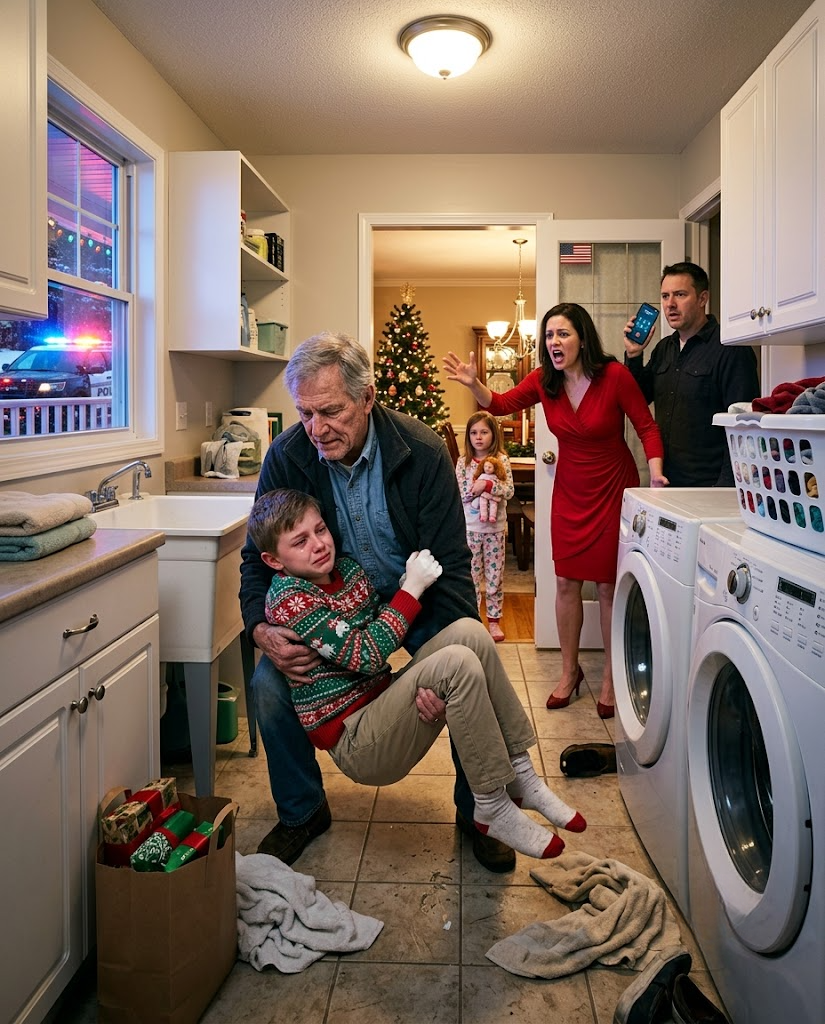
Jennifer stepped into the laundry room.
She did not see Joe at first.
She looked down at Tommy like he was a spill she had already decided not to clean.
“See?” she said softly. “Nobody is coming because nobody wants this behavior at Christmas.”
Joe stepped out from behind the washer.
“Let him go right now.”
Jennifer screamed.
The sound ripped through the house.
Robert came running with his phone already in his hand.
“My dad broke into my house,” he said into it. “He’s trying to take my son.”
Joe could hear sirens now.
Faint at first.
Then closer.
He lifted Tommy into his arms.
He knew exactly how it might look.
An old man inside a house that was not his.
A child in his arms.
The homeowners shouting.
The story Jennifer had prepared was still lying there, ready to be used.
Then Tommy leaned his mouth close to Joe’s ear.
His fingers clutched Joe’s blue sleeve so hard his knuckles turned white.
Red light washed across the laundry-room wall.
“Grandpa,” Tommy whispered, “don’t let her give me the medicine again.”
For one second, Joe did not understand the words.
Then he did.
He looked at Jennifer.
Her face had changed.
Not enough for a stranger to notice.
Enough for Joe.
Robert was still speaking into the phone, but his voice had lost its shape.
“What medicine?” Joe asked.
Jennifer reached for Tommy.
“Give him to me.”
Joe stepped back.
“What medicine?”
A small movement came from the hallway.
Sophie stood there in red Christmas pajamas, holding the doll Joe had brought her.
Her cheeks were wet.
In her other hand was a small plastic dosing cup.
She must have pulled it from the bathroom trash or found it near the sink.
“Mommy said Tommy was ruining Christmas,” Sophie whispered.
Robert stopped talking.
The phone stayed at his ear.
His mouth opened, then closed.
He looked at the cup in Sophie’s hand.
Then he looked at Jennifer.
For the first time all night, he did not know which story to tell.
Jennifer reached toward Sophie.
“Give that to me.”
Sophie stepped backward so fast her shoulder hit the hallway wall.
That was when the kitchen door opened wider.
The first officer stepped inside.
He looked at Joe.
He looked at Tommy.
He looked at Jennifer’s outstretched hand.
Then he saw Sophie holding the dosing cup.
His voice was calm.
Too calm.
“Whose child is on the laundry-room floor?”
Nobody answered at first.
The washer kept running.
Christmas music kept playing from the living room.
Somewhere on the coffee table, Robert’s beer bottle caught the red flash from outside and turned the color of warning.
Joe held Tommy tighter.
“His name is Tommy,” Joe said. “He is my grandson. He called me at 5:47 p.m. and told me not to come because he was told I wasn’t welcome. I found him locked in here. I called 911 at 6:52. I have photos of the window and the front porch.”
The officer’s eyes shifted.
Not with disbelief.
With focus.
“Sir,” he said to Robert, “put the phone down.”
Robert lowered the phone slowly.
Jennifer started speaking at once.
“This is a family matter. He forced his way in. Tommy was grounded. He’s dramatic, and Joe has been confused since his wife died.”
Joe felt the words hit exactly where she meant them to hit.
Mary.
Loneliness.
Age.
The easiest story to tell about an old man is that grief has made him unreliable.
The second officer entered behind the first.
A woman.
She went straight to Sophie and crouched to her level.
“Can I see what you’re holding, sweetheart?”
Sophie looked at Joe.
Joe nodded once.
Sophie handed over the dosing cup.
Jennifer’s lips pressed together so tightly they lost color.
The first officer radioed for medical.
Robert finally found words.
“Jennifer,” he said, very quietly, “what did you give him?”
Jennifer turned on him so fast Joe saw the marriage behind the performance.
Not love.
Control.
“Do not start,” she snapped.
That was the first honest thing she had said all night.
The paramedics arrived minutes later, though to Joe it felt like years.
They checked Tommy’s breathing.
They checked his pupils.
They asked what he had taken.
Jennifer said nothing useful.
Robert said he did not know.
Sophie whispered that there was a bottle in the upstairs bathroom.
The second officer went with Robert to find it.
Jennifer sat on the edge of the laundry-room counter, suddenly pale and furious.
She kept saying Joe had trespassed.
She kept saying Tommy needed discipline.
She kept saying Robert would explain.
Robert did not explain.
When the officer came back down with the bottle in a clear evidence bag, Robert looked like a man seeing his own house for the first time.
The label was not illegal.
That made it uglier in a way.
It was the kind of over-the-counter sleep aid people kept in cabinets and forgot about.
The kind of thing that sounded harmless until it was given to a child to make a holiday easier to stage.
The paramedic looked at the bottle.
Then he looked at Tommy.
“We need to take him in.”
Joe rode in the ambulance.
No one asked Robert’s permission after Tommy reached for Joe and would not let go.
At the hospital intake desk, the nurse asked Joe what happened.
He gave the timeline again.
5:47 p.m., the call.
6:38 p.m., arrival.
6:44 p.m., confrontation at the window.
6:52 p.m., 911 call.
6:55 p.m., photos.
He said the facts because facts were the only things in the room that did not shake.
A nurse placed a hospital wristband on Tommy.
The plastic looked too big on his thin wrist.
Tommy slept for a while under observation.
Joe sat beside him in the hard chair and watched every breath.
Across the hall, an officer spoke with Robert.
Another spoke with Sophie while a nurse sat nearby.
Jennifer was not allowed near the children.
At 9:16 p.m., Robert came into the waiting area.
He looked smaller than he had at the house.
His hair was messy.
His face was gray.
He stood in front of Joe like he had forgotten how to be a son.
“Dad,” he said.
Joe did not answer.
Robert looked through the glass toward Tommy’s room.
“I didn’t know.”
Joe believed him on one point.
He believed Robert had not known every detail.
He also knew ignorance can be built on purpose.
A man does not have to see everything to be responsible for what he refuses to notice.
“He called me,” Joe said.
Robert’s eyes filled.
“I know.”
“He told me you said I wasn’t welcome.”
Robert looked down.
That answer was enough.
Joe leaned back in the chair.
He suddenly felt every year in his knees, hands, and back.
“Your mother would have walked through fire for those kids,” he said.
Robert wiped his face with one hand.
“I’m sorry.”
Joe looked at him for a long time.
“Don’t say that to me first.”
Robert flinched.
Then he nodded.
At 10:03 p.m., Tommy woke up.
His first word was not Dad.
It was not Mom.
It was “Grandpa.”
Joe stood so fast the chair scraped backward.
He went to the bedside and took Tommy’s hand.
“I’m here.”
Tommy’s eyes were red and heavy.
“Are they mad?”
Joe swallowed.
A child should not wake up in a hospital and ask who is angry with him.
“No,” Joe said. “You are safe. That’s what matters tonight.”
Tommy stared at him.
“You came.”
“I told you,” Joe said. “I will always come for you.”
Sophie was brought in later with a nurse and the second officer nearby.
She climbed onto the chair beside Tommy’s bed and held the doll against her chest.
She did not speak for a long time.
Then she said, “I tried to tell Dad.”
Robert, standing near the doorway, covered his mouth.
That was the moment he broke.
Not loudly.
Not in a way that helped anyone.
He folded forward like something inside him had finally lost its frame.
Joe did not comfort him.
Some grief has to teach before it is allowed to be soothed.
There was a police report.
There was a hospital intake form.
There were photographs on Joe’s phone.
There were statements taken from a child who should have been eating Christmas cookies, not explaining dosing cups to adults in uniform.
By midnight, the perfect Christmas house was no longer perfect.
Its lights still glowed along the gutters.
The wreath still hung on the door.
The appetizers still sat on the coffee table.
But the story Jennifer had prepared had collapsed under the weight of one whispered sentence, one little plastic cup, and one grandfather who stopped himself from doing the loud thing so he could do the useful one.
In the weeks that followed, there were hearings.
There were temporary orders.
There were supervised visits and interviews and paperwork Robert had to read because looking away was no longer available to him.
Jennifer’s smile did not help her there.
Politeness sounds different when it is written down in a police report.
Joe did not become a hero.
He hated that word.
Heroes were clean in stories.
He had been terrified.
He had been angry.
He had almost made the wrong move because anger had offered him a simple answer.
But Tommy had needed more than anger.
Tommy had needed timing.
A phone call.
Photos.
A dispatcher.
A door opened before it could be locked again.
On New Year’s morning, Tommy and Sophie sat at Joe’s kitchen table eating pancakes from Mary’s old blue plates.
The radiator ticked beneath the window.
The same table was set again.
This time, people were actually sitting there.
Tommy had the little tool set beside his chair.
Sophie had her doll tucked under one arm.
Robert sat across from Joe, hollow-eyed and quiet, with a coffee cup he had not touched.
There were apologies still waiting.
There were consequences still moving through offices and courtrooms.
There were questions the children would ask for years.
Nothing was fixed because one night had ended.
But Tommy looked up from his pancakes and said, “Grandpa?”
“Yeah, buddy?”
“You really heard me.”
Joe looked at the boy’s face.
He thought about that first whisper on the phone.
He thought about the laundry-room window.
He thought about red light on the wall and a child’s fingers clamped white around his sleeve.
And he thought about how an entire house had tried to teach Tommy that nobody would come.
Joe reached across the table and squeezed his grandson’s hand.
“I heard you,” he said. “And I’ll keep hearing you.”
For the first time since Mary died, the kitchen did not feel like a room waiting for a family that might never return.
It felt like a place where somebody had made it back.