It hovered above her from the top of the staircase.
Brittany wore it like jewelry.

The engagement party had been loud, polished, and expensive enough to impress relatives who confused money with kindness.
Crystal lights hung over the rented ballroom.
White flowers lined the staircase.
Champagne glasses kept catching the light.
Claire had come because her mother said family showed up.
She had worn an ivory dress she bought on sale.
She had curled her hair herself in the bathroom mirror.
She had promised herself she would stay quiet.
That was usually how she survived family gatherings.
Brittany was the cousin everyone defended.
Claire was the cousin everyone corrected.
If Brittany teased, Claire was too sensitive.
If Brittany shoved, Claire had stumbled.
If Claire cried, the family called it a performance.
That night, Brittany floated through the ballroom in a champagne-colored dress.
Her fiance Daniel stayed close beside her.
Aunt Linda kept telling guests that Brittany had always been the family star.
Claire smiled when expected.
She made small talk near the staircase.
She held the railing because her heels felt unsteady.
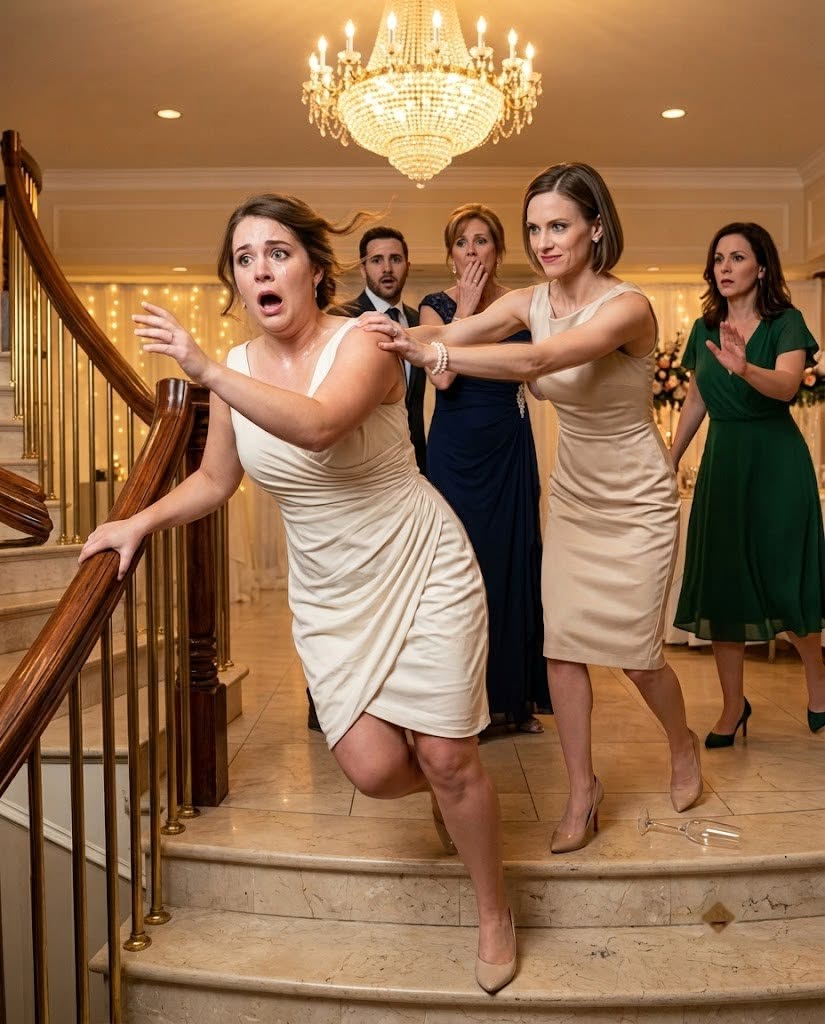
Then Brittany came up behind her.
“Oh my God, watch your step,” Brittany said.
Claire turned only halfway.
Both hands slammed into her shoulders.
The push was not playful.
It had force behind it.
Claire’s heel caught the edge of the top stair.
The ballroom tilted.
The chandelier became a white blur.
Her shoulder struck the railing first.
Her neck snapped sideways.
Her head hit the marble at the bottom.
For several seconds, no sound made sense.
There were screams above her.
There was a glass breaking somewhere.
There was her own breath, thin and wrong.
Warmth spread across the front of her dress.
She tried to move and could not.
Then Brittany laughed from the landing.
“It was just a prank,” she called.
A few relatives turned toward Brittany first.
Not Claire.
Brittany covered her mouth like she was embarrassed by the attention.
“Claire always overreacts,” she said.
The words moved through the room like permission.
Aunt Linda stepped between Claire and the nearest guest.
“Do not make this dramatic,” she snapped.
Claire tried to say Brittany had pushed her.
Her uncle spoke over her.
“She slipped.”
Another relative nodded too fast.
“She lost her balance.”
Daniel looked confused, but he did not move.
Claire stared at the ceiling and waited for someone familiar to kneel.
Her mother stayed back.
A stranger helped first.
The woman was one of Brittany’s coworkers.
Her name was Mara.
Mara crouched beside Claire without touching her.
“Do not move her,” Mara said.
Aunt Linda frowned.
“We do not need an ambulance.”
Mara looked at Claire’s neck and then at the blood on her dress.
“Yes, you do,” she said.
That was the first honest sentence Claire heard that night.
The paramedics arrived within minutes.
They fitted a collar around Claire’s neck.
One asked what had happened.
Claire opened her mouth.
Three relatives answered first.
“She slipped.”
“It was an accident.”
“She has always been clumsy.”
Brittany stood at the landing and watched.
Her smile had changed, but it had not disappeared.
It was smaller now.
It was private.
Claire knew that look.
It meant Brittany expected to win again.
The ambulance doors closed on the ballroom noise.
Claire tried to describe the shove.
The medic listened without correcting her.
That alone felt unreal.
At the hospital, the first scans came quickly.
Doctors asked where the pain was sharpest.
Claire said her neck felt unstable.
She said her shoulder burned.
She said her head felt full of light.
An emergency physician ordered an MRI before observation.
Claire drifted in and out while nurses checked her.
Morning came through the blinds in pale strips.
Her phone kept buzzing.
Brittany had posted engagement photos.
The caption called it the happiest night of her life.
Relatives commented with hearts and congratulations.
Nobody mentioned the stretcher.
Nobody mentioned the blood on Claire’s dress.
Nobody mentioned Mara.
The ER doctor entered after sunrise.
He was gray-haired and careful.
He introduced himself as Dr. Nolan.
He brought the MRI up on the screen.
Claire watched him study it.
He measured one area.
Then he measured another.
His expression shifted.
Concern replaced routine focus.
He leaned closer.
Then he stopped speaking.
“I’ll be right back,” he said.
He left with the tablet.
Claire stared at the blank space he left behind.
When he returned, two hospital security officers came with him.
They stood near the door.
Dr. Nolan closed it softly.
He picked up the phone on the wall.
“I need law enforcement in the emergency department immediately,” he said.
Claire’s stomach dropped.
“Am I dying?” she asked.
Dr. Nolan pulled his chair close.
“No,” he said.
Relief came and vanished.
“Then why are police coming?”
He folded his hands.
“Because this does not match one fall down one staircase.”
Claire looked at the gray images.
They meant nothing to her.
To him, they meant enough to call police.
He asked about older injuries.
Claire said she did not think there were any.
He asked about a collarbone fracture when she was twelve.
Claire remembered the horse.
She remembered Brittany slapping its side during a family visit.
The horse bolted.
Everyone laughed afterward.
Her uncle said Claire had startled it.
Claire had believed him.
Dr. Nolan asked about a lake accident when she was sixteen.
Claire remembered the dock.
Brittany came up behind her.
Then Claire was underwater.
When she climbed out, shaking, everyone laughed again.
“You should have seen your face,” Brittany had said.
Dr. Nolan asked about a wrist fracture in her twenties.
Claire remembered basement steps.
She remembered Brittany nearby.
She did not remember the moment before the fall.
That frightened her most.
Every memory had been edited by someone louder.
No, Claire, that is not what happened.
You imagined it.
You have always been dramatic.
Those sentences had trained her to distrust pain.
Two detectives arrived while the monitor beeped beside her bed.
Detective Alvarez introduced himself first.
Detective Morris stayed near the doorway.
Neither acted impatient.
Neither treated her like a problem.
Alvarez pulled up a chair.
“We are here to understand exactly what happened,” he said.
For the first time, Claire told the staircase story without interruption.
She described Brittany’s hands.
She described the laugh.
She described the relatives answering for her.
Morris wrote quietly.
Alvarez asked one question when she finished.
“Has she ever hurt you before?”
Claire looked down at her hands.
The answer she had rehearsed for years was no.
The answer inside her body was different.
My body had kept the record.
She told them about the horse.
She told them about the dock.
She told them about the basement steps.
She cried once and hated herself for it.
Nobody told her to stop.
That afternoon, Alvarez began interviewing party guests.
The family version sounded rehearsed.
Claire slipped.
Claire lost her balance.
Nobody saw anything.
It was unfortunate.
Outside guests told a different kind of story.
They were unsure, but not identical.
One neighbor remembered Brittany teasing Claire all evening.
One guest remembered Brittany saying Claire looked prettier than the bride-to-be.
One bridesmaid looked sick before she spoke.
“Brittany said Claire always stole attention,” she admitted.
Alvarez waited.
The bridesmaid swallowed hard.
“Then she said tonight she would finally teach her a lesson.”
That sentence changed the room.
Detectives requested camera footage from nearby homes.
Most cameras showed doors and driveways.
One camera across the street caught part of the venue staircase.
The image was not perfect.
It did not show Brittany’s hands clearly.
It showed enough.
Claire stood near the top landing.
Brittany stepped directly toward her.
There was a sudden forceful movement.
Claire vanished from the frame.
Less than a second later, people rushed toward the stairs.
Alvarez replayed it several times.
The family statements no longer fit.
Meanwhile, Brittany kept posting.
She shared a close-up of her ring.
She thanked everyone for protecting her peace.
She wrote that love always wins.
Claire saw the post from her hospital bed.
Her neck was locked in a brace.
Her dress was sealed in an evidence bag.
Love had never felt less like the right word.
The warrant for Brittany’s phone came after the camera and witness reports.
Detective Morris called it careful work.
Claire called it terrifying.
Deleted messages came back first.
One was from months earlier.
“She’s so easy to blame,” Brittany wrote.
Another followed.
“Everyone already thinks she’s clumsy.”
The message sent after the fall was shorter.
“Relax, they’ll all back me like always.”
Morris read it twice.
Then he set the phone down.
“She was not scared,” he said.
Alvarez nodded.
“Because history taught her she did not need to be.”
The medical records took longer.
Hospitals sent files from years of urgent visits.
Old X-rays arrived.
Clinic notes arrived.
Childhood records arrived.
The explanations repeated like a family script.
Accident.
Slip.
Fall.
Clumsy.
Dr. Nolan placed older images beside the new MRI.
He avoided frightening words.
He pointed to healed trauma.
He pointed to fresh injury.
He pointed to patterns.
“One injury can be random,” he said.
He looked at Claire gently.
“This many similar injuries are harder to explain that way.”
Claire felt grief before anger.
For years, she had thought her body was failing her.
It had been telling the truth in a language no one read.
A woman named Karen Mills called the detectives two days later.
She had once been close to Aunt Linda.
She had left the family circle years before.
Karen came to the precinct with a tissue twisted in her hands.
She described a Fourth of July picnic.
Claire and Brittany had stood near a small rocky hill.
Karen saw Brittany stick out her foot.
Claire fell face first.
The adults told Karen not to make a scene.
They said Claire tripped over her own feet.
Karen’s voice broke.
“I knew what I saw,” she said.
The prosecutor joined the case that week.
She did not promise easy justice.
She spoke in pieces of proof.
The staircase assault was the charge.
The MRI explained why it mattered.
The old records showed context.
The messages showed intent and cover.
The witnesses showed the family story was not independent.
Claire listened from a chair with a brace around her neck.
She did not feel brave.
She felt tired.
But nobody asked her to pretend anymore.
Police went to Aunt Linda’s house the next morning.
Brittany was there with Daniel and several relatives.
The knock sounded through the house.
Brittany opened the door with irritation already on her face.
“Brittany Dawson,” an officer said, “we need you to come with us.”
She laughed once.
“This is ridiculous.”
No one laughed back.
Daniel stepped into the hallway.
“What is happening?”
Detective Alvarez held up a folder.
“We are investigating the assault of Claire Dawson.”
Brittany crossed her arms.
“She slipped.”
Alvarez met her eyes.
“You have said that.”
He opened the folder.
“The evidence says otherwise.”
For the first time, Brittany’s confidence moved.
It did not vanish.
It flickered.
That was enough for Claire when she heard about it later.
The case went to court months after physical therapy began.
Claire wore a plain black dress and a soft brace under her collar.
She sat near the prosecutor.
Her mother sat across the aisle with Aunt Linda.
Nobody waved.
The surveillance clip played first.
The jury watched Brittany step toward Claire.
They watched Claire disappear.
They watched the family story fail in silence.
Then Mara testified.
She said Claire could not move.
She said the family argued against calling an ambulance.
She said Brittany laughed.
The bridesmaid testified next.
She repeated the line about teaching Claire a lesson.
Karen Mills testified after her.
She apologized to Claire from the stand.
Claire nodded once.
It was not forgiveness.
It was recognition.
The medical experts explained the MRI in plain language.
They did not claim every past accident was a crime.
They did not need to.
They showed repeated trauma in similar areas.
They showed a fresh injury from the staircase.
They showed older damage that fit a pattern.
Then the prosecutor displayed Brittany’s deleted texts.
Everyone already thinks she’s clumsy.
Relax, they’ll all back me like always.
The courtroom went still.
Even Aunt Linda looked down.
Brittany said the messages were taken out of context.
The prosecutor asked one question.
“If Claire simply slipped, why did you need everyone to back you?”
Brittany opened her mouth.
Nothing came out.
The silence did what Claire never could.
It made everyone wait.
Several relatives testified.
One admitted he had not seen Claire lose her balance.
Another admitted he repeated what Brittany told him.
Aunt Linda cried on the stand.
“We were trying to keep the family together,” she said.
The prosecutor’s voice stayed quiet.
“By asking the injured person to stay silent?”
Aunt Linda had no answer.
The jury found Brittany guilty of felony assault.
The judge said the evidence showed more than one angry moment.
It showed repeated danger toward someone conditioned not to fight back.
Brittany looked at Claire during sentencing.
There was no smile left.
Only disbelief.
Daniel ended the engagement before the hearing was over.
He later said he could not marry someone who treated another person that way.
Some relatives faced consequences for false statements.
Others avoided charges.
None avoided the truth.
The family group chat went quiet.
Holiday invitations stopped.
People who had demanded peace now complained about distance.
Claire did not argue with them.
She blocked the ones who asked her to move on.
Moving on did not mean returning to the room that hurt her.
Recovery was slower than court.
Her neck ached before rain.
Her shoulder stiffened in the morning.
Physical therapy made her cry from frustration.
Still, each week gave something back.
She drove herself again.
She slept without replaying the stairs every night.
She returned to work part time.
One young patient handed her a drawing.
It showed two women holding hands.
One wore a neck brace.
“You look stronger now,” the little girl said.
Claire smiled because the child meant it simply.
“I think I am,” she said.
Strength was no longer swallowing pain politely.
It was letting the evidence speak after everyone else stopped listening.
Years later, Claire still remembered the ballroom lights.
She remembered Brittany’s smile.
She remembered the way her family ran to the person standing, not the person bleeding.
But she remembered Dr. Nolan more.
He could have accepted the easy answer.
He could have treated the newest injury and sent her home.
Instead, he saw the pattern.
He called security.
He called police.
He gave Claire back the right to believe herself.
Everyone had called it a prank.
One MRI proved Claire had never been clumsy.
She had been surviving a family that called violence a joke.