“It’s time to stop being the family failure and get a real job,” Briar said while sliding a $15-an-hour data entry application into my lap at the reunion table. I sat frozen as thirty relatives watched, my emerald blazer pressed beneath her cold hand and humiliation burning through me. Then resort manager Elias Harrow arrived with the bill and revealed the truth Briar never saw coming. She thought she owned the moment. She had just embarrassed the woman who owned the entire resort.
Part 1
By the time my older sister slid the job application across the banquet table, I had already counted every chandelier in the room, every crystal wineglass, every linen napkin folded into a sharp white peak beside the plates.
That was what I did when I knew I was about to be humiliated. I counted things. It kept my face still.
The Sterling family reunion had taken over the private dining room of Cedarvale Ridge Resort, a five-star mountain property tucked into the kind of Connecticut landscape rich people liked to call “rustic” because the firewood was stacked by staff and the snow was swept off the stone steps before anyone could slip. Thirty relatives sat around the long mahogany table, dressed in cashmere, pearls, navy blazers, and polite cruelty.
My mother, Lenora Voss, sat near the head of the table with her hand wrapped around a glass of white wine she had not touched. She always held wine when she wanted to look relaxed. My father, Dr. Graham Voss, had spent the first half hour reminding everyone that the hospital board still called him “the hands of God,” which was not a joke when he said it.
And then there was my sister, Briar.
Briar had the golden-child shine down to an art form. Her blond hair fell in perfect waves over one shoulder. Her diamond tennis bracelet winked every time she lifted her glass. Her husband, Warren, a hedge fund man with soft hands and a loud watch, laughed at everything she said like she was a genius whose brilliance required applause.
I was seated at the far end of the table near the teenagers.
Not even beside them. Near them.
A cousin I barely recognized had left his phone propped against the bread basket, watching a basketball clip under the table. Another one was sneaking fries from the late-night bar menu because the duck confit on his plate scared him. I smiled at them because they were the only people in the room not pretending to be sophisticated.
I had been quiet through the toast. Quiet through my father’s speech about legacy. Quiet when he praised Briar’s real estate numbers, Warren’s “market instincts,” my mother’s corporate promotion, and my cousin Pierce’s acceptance to Princeton. Quiet when my name never came up, not even as an afterthought.
That was fine.
I had not come there to be remembered.
I had come there to let them finish the performance they had been rehearsing for eight years.
Briar stood just as dessert plates were being placed in front of us. The servers moved around the table with practiced calm, laying down glossy slices of chocolate torte beside little pools of raspberry sauce. I noticed one of the younger servers glance at me for half a second longer than necessary, then look away quickly. He knew. A few people in that building knew.
My family did not.
Briar tapped her knife lightly against her glass. “Before dessert, I want to say something.”
The table softened toward her. Of course it did. The room always leaned in when Briar spoke, the way sunflowers turned toward the sun.
She gave a small laugh, the kind she used when she wanted people to think she was kind. “Tonight has been such a beautiful reminder of what family means. Support. Responsibility. Helping each other when someone is struggling.”
My mother lowered her eyes. My aunt Maribel smirked into her wine.
I felt the first small shift in the room. A current moving under polished manners.
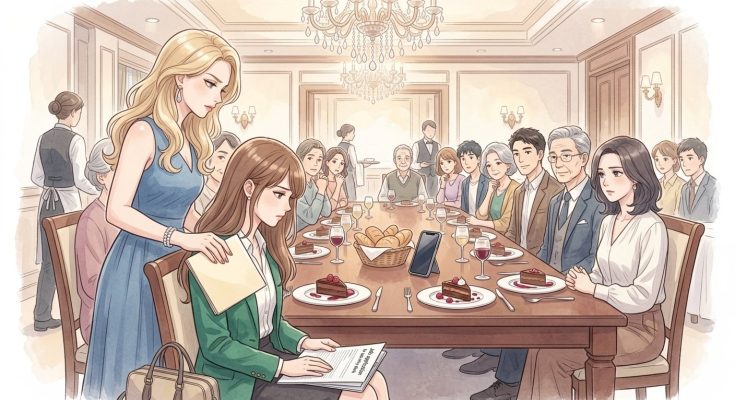
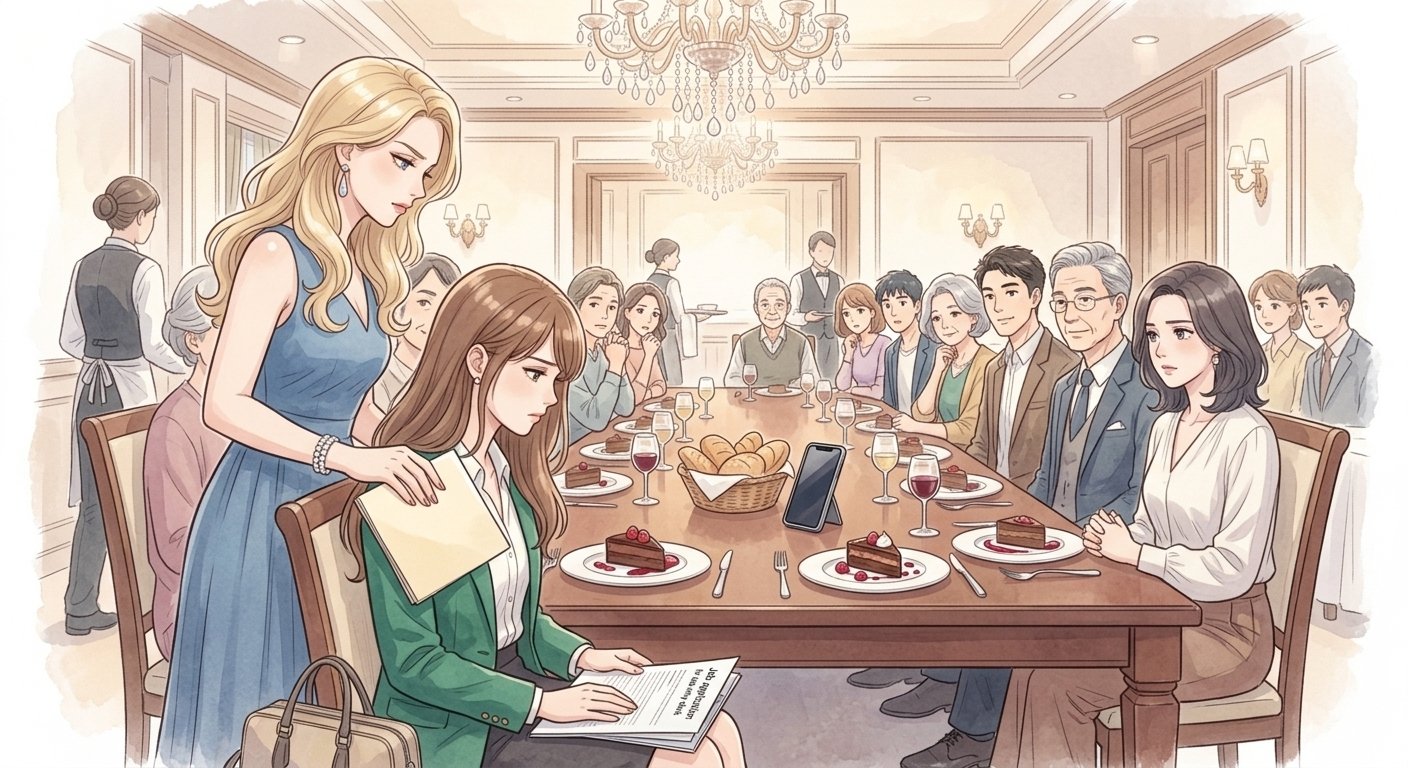
Briar bent down beside her chair and lifted a cream folder from her designer tote. She walked toward me slowly, heels clicking across the hardwood floor, every step measured for maximum attention. Conversations died one by one.
When she reached my chair, she sighed.
It was not a tired sigh. It was a performance sigh. A pity sigh.
Then she slid a printed piece of paper across the tablecloth directly into my lap.
It was a job application.
Not even a real offer. An application.
The logo at the top belonged to her luxury real estate firm. The position was data entry clerk. The starting pay was $15 an hour.
“I know your little internet hobby hasn’t really worked out, Arden,” Briar said, loud enough for every aunt, uncle, cousin, spouse, and server to hear. “Mom and Dad are worried about you. We all are. So I talked to my manager, and I convinced him to let you come in for a pity interview.”
Someone coughed. Someone else made a soft, delighted sound behind a napkin.
Briar placed one hand on my shoulder. Her palm felt cold through the fabric of my emerald blazer.
“It’s time to stop being the family failure and get a real job.”
The room went silent.
Not shocked silent.
Hungry silent.
They were waiting for my face to crumple. Waiting for me to shove back my chair and storm out. Waiting for proof that they had been right about me all along.
I looked down at the paper. The black ink was sharp against the white page. Name. Address. Employment history. References.
References.
That almost made me laugh.
Because one week earlier, I had sat in a glass conference room on the forty-second floor of a Manhattan office tower and signed away the cybersecurity company I had built from nothing. Because my “little internet hobby” had been acquired by one of the largest technology firms in Silicon Valley. Because after taxes, attorneys, investors, and all the complicated pieces of grown-up money had been settled, my personal liquid payout had landed in an account with more zeros than my father had ever seen outside a hospital budget.
And because three weeks before that, through a holding company nobody in my family had bothered to research, I had purchased Cedarvale Ridge Resort.
The wine they were sipping, the table they were sitting at, the chandeliers above their heads, the staff they were ordering around, the private suite my mother had bragged about booking six months in advance—every inch of it belonged to me.
But I did not say that yet.
I simply touched the edge of the job application with two fingers, lifted my eyes to Briar, and smiled.
That was the moment her expression flickered.
Just once.
For eight years, my family had mistaken silence for weakness. They were about to learn the difference.
Part 2
In the Voss family, success had a narrow doorway, and if you did not fit through it exactly, they locked you outside and called it love.
My father was a cardiovascular surgeon with a wall full of framed degrees and a habit of checking his reflection in dark windows. He believed every conversation was a courtroom where he was the expert witness. My mother had climbed the corporate ladder at a pharmaceutical company with the elegance of a woman stepping on throats in expensive heels. She did not raise her voice. She lowered it, which was worse.
Briar, three years older than me, had been born fluent in their language.
She knew how to perform achievement. She joined the right clubs, wore the right dresses, dated men with the right fathers, and learned early that my parents’ affection was not a feeling. It was a reward system.
I tried to earn it too.
For the first twenty years of my life, I was obedient in the specific, polished way unhappy daughters become obedient. I got straight A’s. I volunteered at hospitals because my father liked introducing me as “future Dr. Voss.” I wore navy dresses to charity dinners and laughed politely when old men asked whether I planned to follow in my father’s footsteps.
I said yes because yes made everyone relax.
The truth was that I hated the smell of hospitals. I hated the beige waiting rooms, the fluorescent lights, the cold metal trays. I hated the way my father’s friends looked at me as if my whole future had already been printed, laminated, and filed under “acceptable.”
What I loved was code.
Not in the cute way people say they love technology because they own the newest phone. I loved code the way some people love music. I loved the logic of it, the architecture, the clean satisfaction of finding a weakness and building something stronger around it. While my classmates at Cornell memorized anatomy diagrams, I stayed up all night writing encryption tools in my dorm room with vending machine coffee cooling beside my laptop.
Ransomware fascinated me and terrified me. Small businesses were being gutted by attacks they could not understand and could not afford to prevent. I kept thinking about the family dentist offices, the local law firms, the tiny accounting companies whose entire client histories could be held hostage overnight. I had an idea for a cloud-based security shield simple enough for them to use and sophisticated enough to matter.
I called the first rough version IronLatch.
It was ugly. It crashed constantly. The interface looked like it had been designed by a raccoon with a keyboard. But beneath the mess, the core worked.
By sophomore spring, I knew I had a choice. Stay at Cornell and become the daughter my parents could brag about, or leave and become myself.
I took a bus home on a rainy Thursday with one duffel bag and a laptop that overheated if I opened too many windows. My father was in the living room when I told them. He had just poured himself a drink. My mother stood near the fireplace, still wearing her work blouse, her earrings catching the lamplight.
“I’m leaving pre-med,” I said. “I’m leaving Cornell.”
My father stared at me like I had spoken another language.
“I’m starting a cybersecurity company.”
For three full seconds, no one moved.
Then my father laughed.
It was worse than yelling at first because the laugh was so certain. So dismissive. Like I had announced I was moving to the moon with a paper kite.
“A company,” he repeated. “You are twenty years old.”
“I know.”
“You have no degree.”
“I know.”
“You have no money.”
“I have some savings.”
My mother’s mouth tightened. “From the account we helped fund?”
“I earned some of it from tutoring.”
My father set his glass down so hard the ice jumped. “You are throwing away your life for a computer game.”
“It isn’t a game.”
“You think I worked my entire life so my daughter could become a college dropout playing on the internet?”
The word dropout landed like a slap. Briar appeared in the doorway, drawn by the noise. She wore yoga pants, a cashmere wrap, and the satisfied expression of someone arriving just in time for dinner theater.
My mother stepped closer to me. Her perfume was sharp and expensive. “Victoria closed her first million-dollar property last month,” she said, using Briar’s middle name because she thought it sounded more elegant. “Your sister is building something respectable. And you want to embarrass this family.”
“I’m not trying to embarrass anyone.”
“That makes it worse,” my mother said softly. “You do it naturally.”
Briar’s lips curved.
My father pointed toward the door. “If you leave Cornell, you leave this family’s support. No tuition. No rent. No emergency money. No calls asking us to rescue you when this fantasy collapses.”
“I’m not asking you to rescue me,” I said, though my throat had started to hurt. “I’m asking you to believe me.”
My father’s face hardened.
“Belief does not pay bills.”
Briar leaned against the doorframe and lifted one eyebrow. “Check back in five years when you’re bankrupt. Maybe I’ll let you answer phones at one of my open houses.”
My mother did not laugh. She did not have to. Her silence was approval.
I picked up my duffel bag.
The strangest thing about walking out of your parents’ house is how ordinary the door sounds when it closes behind you. No thunder. No dramatic music. Just the soft click of a lock, the wet smell of rain, and the realization that the people who raised you have decided you are only worth loving if you obey.
I stood on the porch for a moment with my bag cutting into my shoulder.
Then I walked to the bus stop.