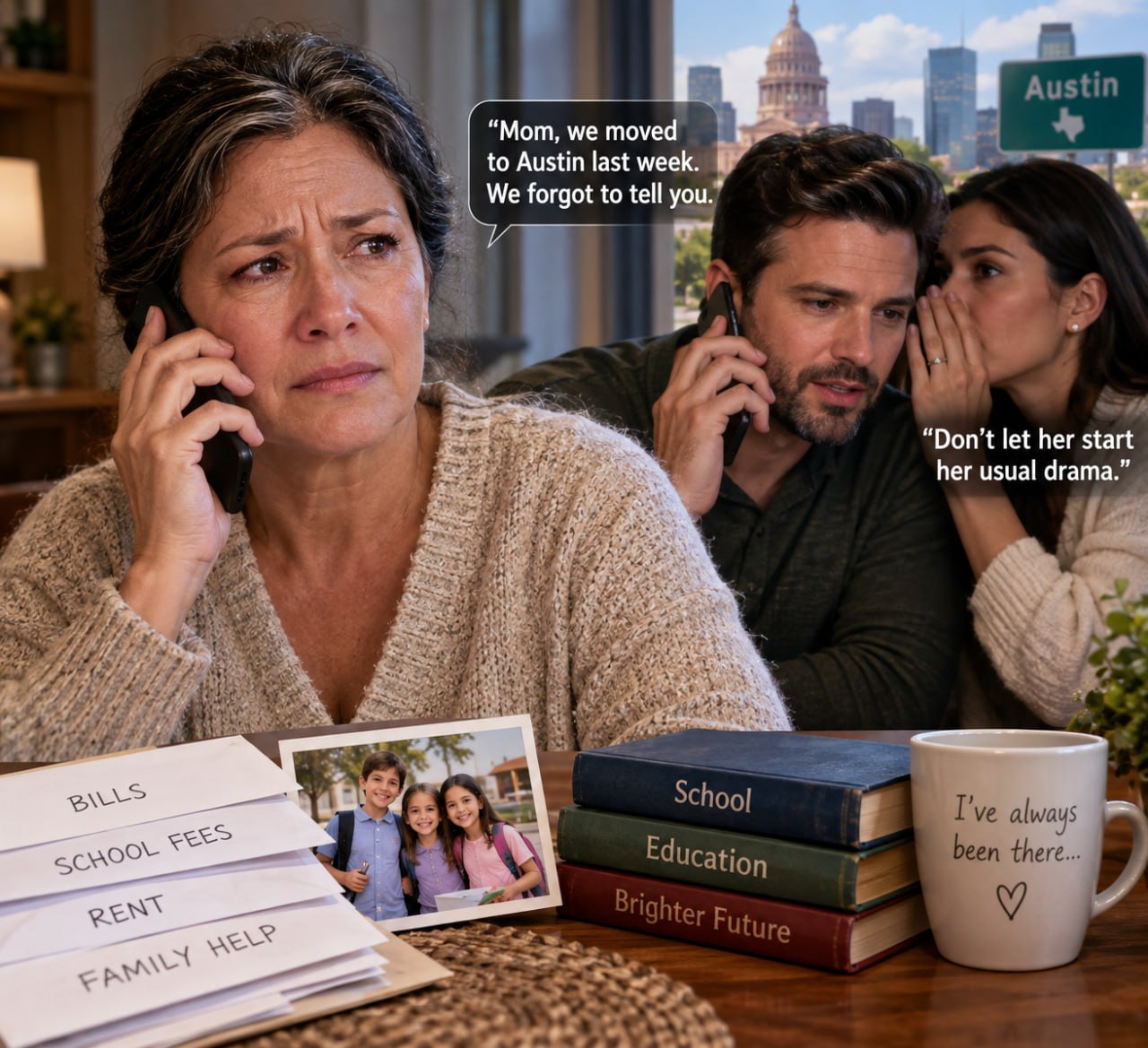
I could hear papers moving on his desk.
Then he said, “It appears to be a preliminary financing document associated with the property your son purchased in Austin.”
“Purchased?”
“Yes.”
I sat down slowly.
“David bought a house?”
“That is what the document indicates.”
“When?”
“The closing appears to have taken place recently.”
I looked toward the window.
Outside, a woman was walking her dog along the sidewalk.
Everything looked ordinary.
My life no longer did.
“Daniel, I never signed anything for a house in Texas.”
“I understand.”
“Then why is my name on the document?”
“That is what we are investigating.”
I wanted him to tell me immediately that it was a mistake.
A clerical error.
A misunderstanding.
Anything that would allow me to keep believing my son had simply made a terrible decision.
But Daniel had never been the kind of attorney who offered comfort before facts.
“Evelyn,” he continued, “the document may contain your name as a reference to the family company, a guarantor, or an authorized representative. We cannot determine which without examining the complete loan file.”
“Could David have signed for me?”
“I cannot accuse him of that without evidence.”
“But could he?”
“It is possible for someone to misuse another person’s identity or authority. We need to establish what actually happened.”
I closed my eyes.
For thirty years, Arthur had insisted that every important document be read carefully.
He used to say, “A signature is a promise, Evelyn. Never give one away just because someone you love is impatient.”
I had laughed at him.
“You think I’m going to sign something foolish?”
“No,” he would reply. “I think you’re going to trust someone who asks you not to read it.”
Now I remembered those words with painful clarity.
“Daniel,” I said, “what should I do?”
“Do not sign anything else. Do not transfer money. Do not agree to any request from David concerning the company until we have reviewed the records.”
“What about the children?”
“You can continue communicating with Lucas and Lily. But keep the financial issue separate from them.”
I promised I would.
Then I called David.
He answered quickly.
“Mom, what’s going on now?”
“Daniel found a document connected to your house.”
David was silent.
“What document?”
“I’m asking you.”
“Mom, I don’t know what you’re talking about.”
“Did you buy a house in Austin?”
“Yes.”
“You never told me.”
“We were going to tell you.”
“When?”
“Things happened quickly.”
I looked at the folder on my desk.
“Did you use the family company to finance it?”
“No.”
“Did you use any property connected to the company?”
“Mom, why are you interrogating me?”
“Because I found a document with my name on it.”
His voice became colder.
“Maybe you signed something and forgot.”
The words stunned me.
I had undergone cataract surgery that summer.
I had been tired.
I had trusted my son.
But I had not forgotten signing a document for a house in Texas.
“I did not authorize you to use my name.”
“Then talk to your lawyer.”
“I am talking to you.”
“Mom, we have a new home, new schools, and a lot to deal with. I cannot keep explaining every decision to you.”
“Every decision?” I repeated. “You mean the decision to move away without telling me?”
He sighed.
“You always make everything about yourself.”
I felt the familiar urge to apologize.
It rose automatically, like a reflex.
Then I remembered Martha sitting across from me at the kitchen table.
Do they know they’re being helped?
I had spent years worrying about whether David was comfortable.
I had rarely asked whether I was.
“No,” I said quietly. “This is about my name and my property.”
David did not respond.
Then he said, “We’ll talk later.”
The call ended.
I stared at the phone.
For the first time, I did not feel like a mother waiting for her son to calm down.
I felt like someone who had been given a warning.
The next morning, Daniel asked me to meet him at his office.
He had obtained preliminary records from the property company in Texas.
A lender had listed the family company as a potential supporting entity in connection with David’s mortgage application.
The documents did not prove that the loan had been approved using company property.
They did prove that the company’s name had appeared in the financing process.
And that was enough to make my stomach turn.
“Why would David do this?” I asked.
Daniel folded his hands.
“There are several possibilities. He may have misunderstood the company’s structure. He may have believed you would approve the arrangement. Or he may have knowingly represented that he had authority he did not possess.”
“What happens if he lied?”
“That depends on what he represented, what he signed, and whether anyone relied on those representations.”
I looked down at the documents.
There were names I recognized.
David Sterling.
Rachel Sterling.
The family company.
And my own name.
“Can I stop the loan?”
“We need to know whether any company asset was actually pledged. If it was, we can take appropriate legal steps.”
“What about the house?”
“If David purchased it in his own name, the house may be his property. That does not automatically mean he can use your company’s assets to support it.”
I nodded slowly.
That distinction mattered.
For years, I had treated David’s problems as if they were mine to solve.
Now I was learning that his decisions could have consequences without becoming my responsibility.
Daniel advised me to contact the lender through legal counsel.
He also recommended reviewing the company’s bank accounts and checking whether any money had moved without my authorization.
I gave him permission to obtain the relevant records.
Then I drove home.
The house felt different.
Not because anything had changed physically.
Because I had.
I walked past the living room and stopped beside Arthur’s old desk.
Lucas used to sit there pretending to prepare for court.
He would put on one of Arthur’s old ties and announce, “Ladies and gentlemen, I have evidence.”
Arthur had loved that game.
He would pretend to be the judge.
Lily would sit on the floor and clap whenever Lucas won.
I touched the back of the chair.
Then I noticed a small envelope beneath a stack of old photographs.
It was addressed to Arthur.
I opened it carefully.
Inside was a handwritten note from a former business partner.
Arthur, if anything happens to you, Evelyn understands the company better than anyone. Make sure she remains in control of the records.
I sat down.
Arthur had trusted me.
He had never expected me to hand everything over to David simply because he was our son.
I had done that gradually.
Not through one dramatic decision.
Through hundreds of small ones.
A signature here.
A payment there.
An exception.
A favor.
A promise.
Until David no longer needed to ask.
He simply expected.
That evening, I called Martha.
“I found out David bought a house.”
Martha was quiet.
“Did he use your money?”
“I don’t know yet.”
“Did he ask you?”
“No.”
She sighed.
“Evelyn, I’m sorry.”
“I keep thinking about the children.”
“I know.”
“What if Lucas thinks I don’t care about him?”
“Then you tell him you love him.”
“What if David tells them I’m angry because he moved?”
“Then you tell them the truth without making them choose sides.”
I looked at the blue blanket folded on the sofa.
“I don’t know how to do that.”
“You start by not lying to yourself.”
Her words hurt.
But they helped.
The next day, I sent Lucas and Lily a message.
Grandma loves you. I am so proud of you both. I hope your new school is going well.
Lucas replied first.
It is. We have a big backyard.
Lily sent a photograph of her room.
There was a pink lamp beside her bed.
The blue blanket was missing.
I stared at the photograph.
“Where is your special blanket?” I typed.
She replied:
Mom said we packed it in a box. Dad says we will find it soon.
I smiled despite myself.
I hope you do. Grandma made that blanket especially for you.
Then Lily sent another message.
Dad says you helped us get the house. Thank you, Grandma.
My smile disappeared.
I did not know what David had told them.
I did not know what he had promised.
But I knew I could not allow my grandchildren to believe I had willingly participated in something I did not understand.
I wrote back:
I love you very much, sweetheart. The grown-ups are sorting out some paperwork. None of that is your fault.
I put down the phone.
A few hours later, Daniel called.
“Evelyn, the lender has responded.”
My heart began pounding.
“What did they say?”
“They are reviewing the file.”
“Did they confirm my signature?”
“They have provided a copy of the document.”
“Is it mine?”
“Not necessarily. It contains a signature that resembles yours, but we need to compare it with verified samples.”
I felt cold.
“What does that mean?”
“It means we need to be careful. We cannot conclude that a signature was forged simply because you do not remember signing it.”
I understood.
But my fear did not disappear.
That evening, I opened a box containing old documents from Arthur’s law practice.
There were contracts, letters, and signed agreements.
My signature appeared on dozens of pages.
I placed several beside the document Daniel had sent.
Even without being an expert, I noticed differences.
The letters seemed heavier.
The spacing was wrong.
The final stroke looked unfamiliar.
But I knew that appearance alone could not establish anything.
Daniel arranged for a qualified document examiner to review the signatures.
He also began investigating how the document had entered the loan file.
Meanwhile, David stopped answering my calls.
Rachel sent a message instead.
David needs space. Please respect that.
I stared at the words.
Space.
They had taken seventeen hundred miles of it.
Now they wanted more.
I typed a response, deleted it, and finally wrote:
I will respect your space. But I will not authorize any use of my name or company property without my informed consent.
Rachel read the message.
She did not reply.
Three days later, Daniel called again.
“Evelyn, the examiner has completed an initial review.”
I held my breath.
“What did they find?”
“The signature on the document is not consistent with your verified signatures.”
I gripped the phone.
“Are you saying someone forged it?”
“The preliminary opinion is that it was not written by you. A final report will be needed.”
I could barely hear anything after that.
My son.
My only child.
The person I had protected for years.
Had someone signed my name?
I thought about the June paperwork.
The hurried conversation.
David’s hand pointing to the lines.
His insistence that I trust him.
And suddenly, I remembered something.
A sentence he had spoken that day.
You don’t need to worry about the details, Mom. I’m handling everything.
I had believed him.
Now those words felt like a door closing.
“Daniel,” I said, “what happens next?”
“We will notify the relevant parties that you dispute the signature and did not authorize the transaction.”
“Will David be arrested?”
“Evelyn, we are not at that stage. Our immediate goal is to protect your rights and establish the facts.”
I nodded.
I wanted justice.
But I also wanted my son to explain himself.
I wanted him to call and say he was sorry.
I wanted him to say he had made a terrible mistake.
Instead, he sent me a text.
Mom, stop making this bigger than it is. We needed a house. You have plenty of assets. We are family.
I read it twice.
Then I showed it to Daniel.
He looked at the message.
“Keep this,” he said.
I saved it.
For the first time in my life, I began keeping records of my son’s words.
Not because I wanted to hurt him.
Because I could no longer afford to forget them.
A week later, the lender confirmed that the company had not legally pledged ownership of the Boston apartment.
The mortgage was in David and Rachel’s names.
The disputed document had been used during the financing process, but the lender was now reviewing whether the supporting information had been properly authorized.
The apartment remained protected by the existing ownership structure.
I should have felt relieved.
Instead, I felt exhausted.
I had spent years believing that if I gave enough, my family would remain close.
Now I understood that money could make life easier.
It could not create honesty.
Daniel advised me to place stronger controls on the company accounts and to require written authorization for future transactions.
I agreed.
Then I made one more decision.
I would no longer pay David’s household expenses automatically.
The children’s essential needs would be handled through a transparent arrangement, if necessary.
But no more unlimited cards.
No more vague promises.
No more signing papers I had not read.
I called David one final time.
He answered.
“Mom, what now?”
“I want to see Lucas and Lily.”
“They’re adjusting.”
“I want to visit.”
Rachel spoke in the background.
“David, don’t encourage this.”
I heard him cover the phone.
Then he said, “Mom, we’re not ready for visitors.”
I swallowed.
“Fine. But I want you to understand something. I love your children. I love you. But I will not sign anything else without knowing exactly what it is.”
David was silent.
Then he said, “You’re choosing money over family.”
“No,” I replied. “I’m choosing honesty.”
He hung up.
I placed the phone on the table.
I expected to feel devastated.
Instead, I felt something unfamiliar.
A small, steady sense of self-respect.
But I did not know yet how far the damage went.
Because two days later, Daniel received a letter from a second financial institution.
And this time, the document did not concern the Texas house.
It concerned a line of credit connected to the family company.
A line of credit I had never requested.
A line of credit that had been opened months before David announced the move.
And the first transaction on that account had been made at a furniture store in Austin.



One Comment on “PART 3 — THE SIGNATURE THAT WASN’T MINE TO GIVE “Daniel, what does the document say?” My attorney did not answer immediately.”