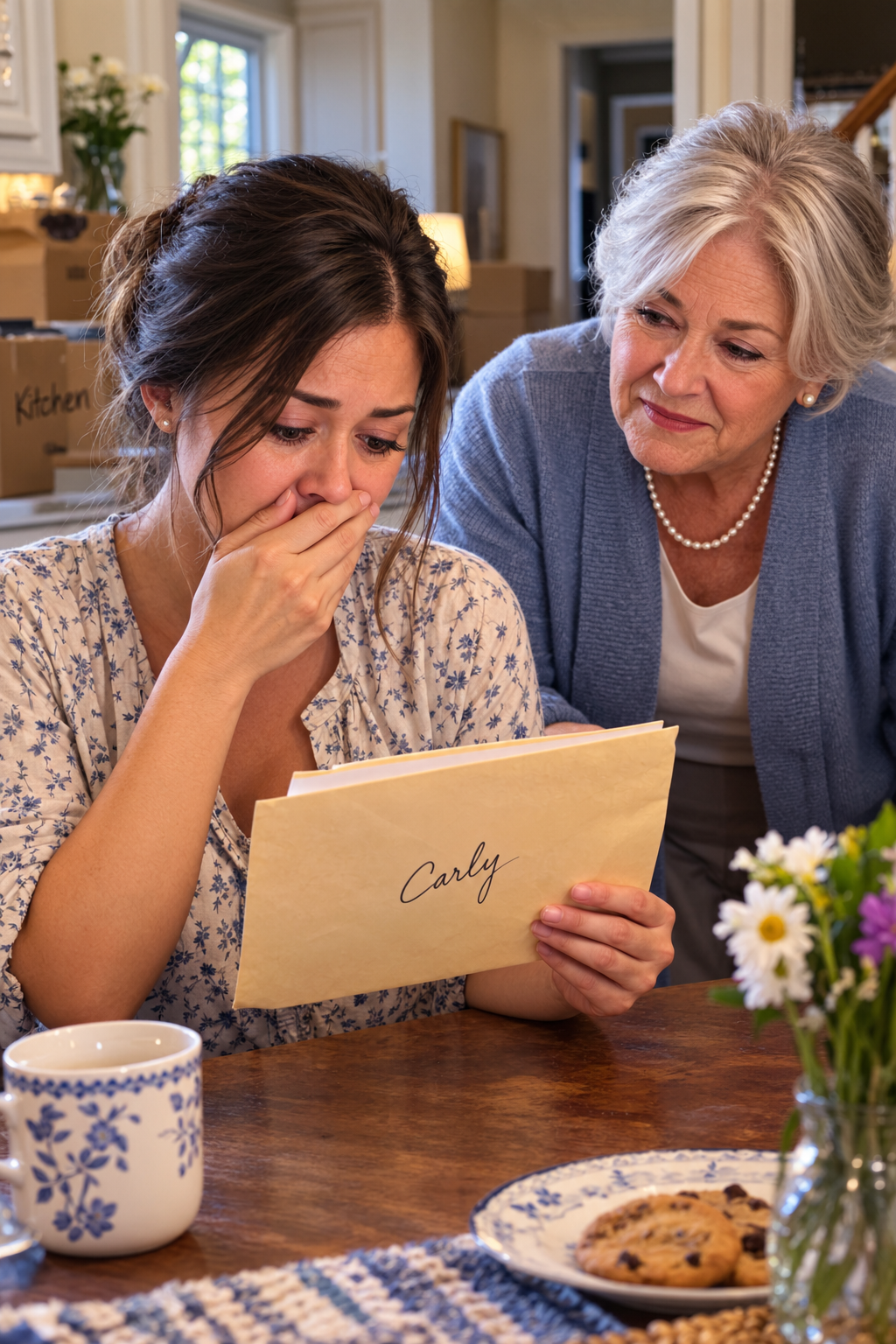
The words came out so quickly that I barely recognized my own voice.
I shoved the envelope back toward Mrs. Whitaker.
She didn’t reach for it.
Instead, she slowly returned to the kitchen table and sat across from me.
“Carly,” she said, “you haven’t even let me explain.”
“I don’t need an explanation.”
I glanced at the number again.
My chest tightened.
“This is too much money.”
Mrs. Whitaker folded her hands on the table.
“No,” she said quietly. “It isn’t.”
I stared at her.
There was something in her expression I had never seen before.
Not pity.
Not embarrassment.
Certainty.
I lowered my voice.
“How is my name on this account?”
She took a long breath.
“Do you remember your first Christmas working here?”
I blinked.
“Eight years ago?”
She nodded.
Of course I remembered.
Willa had been nine.
Her father had stopped sending child support regularly.
The transmission in my old Honda had failed two weeks before Christmas.
I had spent nights lying awake with a calculator, trying to decide which bills could survive another month unpaid.
That Christmas, Mrs. Whitaker had given me a card with five hundred dollars inside.
I’d cried in my car afterward.
“I remember,” I said.
“You tried to give half of it back.”
My cheeks warmed.
“I thought you’d made a mistake.”
“I hadn’t.”
She smiled faintly.
“And that was when I first started paying attention.”
“To what?”
“To you.”
I didn’t understand.
Mrs. Whitaker leaned back.
“You never asked me for advances. Never complained when life was obviously beating you half to death. You came into this house every Thursday no matter what was happening in yours.”
I looked away.
She continued.
“When Willa had pneumonia, you called me from the hospital to apologize because you couldn’t come clean my bathroom.”
I remembered that too.
Willa had been eleven.
I had spent three nights sleeping in a plastic chair beside her hospital bed.
“You were worried I’d replace you,” Mrs. Whitaker said.
“I needed the job.”
“I know.”
Her voice softened.
“That’s exactly the point.”
I looked down at the documents.
“What does any of that have to do with this account?”
Mrs. Whitaker tapped the envelope.
“Every Christmas after that first one, I wanted to give you more.”
I frowned.
“You already did.”
She shook her head.
“No. I gave you what I knew you would accept.”
I slowly looked at her.
“And the rest?”
“I saved it.”
My mouth fell open.
Mrs. Whitaker continued before I could interrupt.
“When I increased your pay, you argued with me.”
“You were paying me too much.”
“You thought twenty dollars more was too much.”
“It was.”
“No, Carly. It was twenty dollars.”
Despite everything, I almost laughed.
She didn’t.
“So I stopped trying to convince you.”
She reached toward the statements.
“I began putting money aside instead.”
My eyes dropped to the pages.
“You’ve been doing this for eight years?”
“Not exactly.”
She paused.
“For seven.”
I felt dizzy.
“How much?”
“Read the final page.”
“I already saw the balance.”
“Read it again.”
My fingers shook as I pulled the statement free.
I stared at the number.
$86,400.
I swallowed.
My vision blurred.
“Eighty-six thousand dollars?”
“Yes.”
I nearly dropped the paper.
“There’s no way.”
“There is.”
“You saved eighty-six thousand dollars for me?”
“For you and Willa.”
I stood so quickly that the chair scraped backward across the floor.
“No.”
Mrs. Whitaker stayed seated.
“No?”
“You don’t understand.”
“I think I do.”
“No, you don’t.”
My voice cracked.
“I clean houses, Mrs. Whitaker. That’s what you paid me for. I came here, I worked, and you paid me. We were even.”
Her eyes remained steady.
“Were we?”
“Yes.”
“Then why did you drive me to my cataract appointment three years ago without charging me?”
I froze.
“That was different.”
“Why?”
“Because you couldn’t drive.”
“And?”
“And you needed somebody.”
She nodded.
“Exactly.”
I opened my mouth.
Nothing came out.
She continued.
“Why did you stay until almost midnight when the pipe burst in my upstairs bathroom?”
“Because the plumber couldn’t come until morning.”
“You weren’t being paid.”
“That doesn’t matter.”
“Why not?”
“Because you were standing in six inches of water!”
“And why did you spend three hours helping me save the photographs from my husband’s old boxes?”
I stared at her.
Mrs. Whitaker’s husband, Thomas, had died before I ever started cleaning the house.
Those photographs had been practically sacred to her.
“I knew they mattered to you,” I whispered.
“And when my sister died?”
I closed my eyes.
I remembered that Thursday.
Mrs. Whitaker had opened the door and looked ten years older.
I had made coffee.
We had sat at the kitchen table.
I hadn’t cleaned anything for almost two hours.
“I listened,” I said.
“You stayed.”
“Anyone would have.”
“No.”
Her answer came instantly.
“They wouldn’t.”
Silence filled the empty kitchen.
Mrs. Whitaker stood.
“You keep describing yourself as my cleaning lady.”
“That’s what I was.”
“That was your job.”
She stepped closer.
“It was never the measure of what you meant inside this house.”
Something in my throat tightened.
I turned away because suddenly I couldn’t look at her.
For years, I had trained myself not to get attached to houses.
They weren’t mine.
The family photographs weren’t mine.
The birthday cards on refrigerators weren’t mine.
The Christmas trees weren’t mine.
I cleaned around other people’s memories and then drove back to an apartment where I was always calculating rent.
That was the rule.
Never confuse being trusted inside someone’s house with actually belonging there.
But Mrs. Whitaker was telling me I had misunderstood everything.
I wiped my eyes.
“You still can’t give me eighty-six thousand dollars.”
“Why?”
“Because people don’t do that.”
“Apparently one person does.”
I turned toward her.
“What about your daughter?”
Mrs. Whitaker smiled.
“Laura knows.”
That surprised me.
“She knows about this?”
“She helped me set up the account.”
I stared.
“Your daughter helped you give your cleaner eighty-six thousand dollars?”
Mrs. Whitaker’s eyebrow lifted.
“My daughter helped me give Carly eighty-six thousand dollars.”
I couldn’t speak.
Then Mrs. Whitaker reached into the envelope again.
“There’s another document.”
My stomach tightened.
“What?”
She handed me a folded letter.
Willa’s name was written across the top.
I stopped breathing for a second.
“What is this?”
“That,” Mrs. Whitaker said, “is why I asked about her college plans every year.”
I slowly opened the letter.
It wasn’t from Mrs. Whitaker.
It was from a scholarship foundation.
I skimmed the first few sentences.
Then I started over because my brain refused to understand them.
Willa Bennett had been awarded a private educational grant.
Tuition assistance.
Books.
Housing support.
Nursing program expenses.
My knees weakened.
I grabbed the back of the chair.
“No.”
Mrs. Whitaker said nothing.
I read the amount.
Then read it again.
“Thirty thousand dollars?”
“Up to thirty thousand each year.”
I looked at her so quickly that my neck hurt.
“Each year?”
“For four years.”
I dropped into the chair.
The room disappeared behind tears.
For months, Willa and I had been pretending college wasn’t terrifying.
She had applied for scholarships.
I had taken two extra houses on Tuesdays.
She had started working weekends at a grocery store.
Neither of us had said the truth aloud.
We didn’t know how we were going to afford it.
Willa had even started saying maybe community college would be “just as good.”
I knew my daughter.
I knew what that sentence really meant.
She was making her dream smaller because she didn’t want me to feel guilty.
I covered my mouth.
“How?”
Mrs. Whitaker sat beside me.
“My husband and I established the foundation years ago.”
I looked up.
“You own it?”
“No. Not anymore. It’s independent.”
She smiled.
“But I’m still allowed to recommend candidates.”
“You recommended Willa?”
“I recommended a hardworking student who wants to become a nurse and who happens to have been raised by one of the strongest women I’ve ever met.”
I started crying.
Not the quiet kind.
The ugly kind.
The kind I had avoided for eight years because crying didn’t pay electric bills.
Mrs. Whitaker moved closer.
For one strange second, I wondered if I was supposed to apologize.
Then she wrapped both arms around me.
And I broke.
“I don’t know what to say.”
“Then don’t say anything.”
“I can’t repay you.”
“I’m not lending it to you.”
“But why us?”
Mrs. Whitaker pulled back.
Her eyes were wet now too.
“Because someone once did something similar for me.”
I stared at her.
She looked toward the nearly empty living room.
“When I was twenty-three, Thomas and I had nothing.”
That surprised me.
Mrs. Whitaker’s house had always seemed like the kind of place owned by people who had never worried about money.
She gave a sad laugh.
“I know what you’re thinking.”
“I wasn’t—”
“You were.”
She wiped her cheek.
“When Thomas started his first business, we were close to losing everything. Our landlord, Mr. Ellis, gave us six months without rent.”
My mouth opened slightly.
“He did?”
“He said Thomas could repay him when the business survived.”
“And did he?”
Mrs. Whitaker smiled.
“Thomas tried.”
I waited.
“Mr. Ellis refused.”
“Why?”
“He told us something I never forgot.”
She looked directly at me.
“He said, ‘If life ever gives you enough, don’t pay me back. Find somebody else who needs the door opened.’”
A chill moved through me.
Mrs. Whitaker tapped the envelope.
“This is me opening the door.”
Before I could answer, the sound of a car door slamming came from outside.
Mrs. Whitaker glanced toward the window.
“Oh.”
“What?”
A strange smile appeared on her face.
“She’s early.”
“Who?”
Before she answered, footsteps crossed the porch.
Then the front door opened.
“Mom?”
A woman stepped inside.
I recognized her immediately from the photographs I had dusted for eight years.
Laura Whitaker.
Mrs. Whitaker’s daughter.
She smiled at me.
“Carly.”
I quickly wiped my face.
“Hi.”
Laura looked at the envelope in my hands.
“She told you.”
I stared.
“You knew?”
“Every bit of it.”
I looked between them.
“This is insane.”
Laura laughed softly.
“That’s exactly what I told her when she first explained the plan.”
Mrs. Whitaker crossed her arms.
“And then?”
“And then I helped you.”
Laura walked toward me.
“But there’s something my mother hasn’t told you.”
Mrs. Whitaker’s expression changed.
“Laura.”
“No.”
Laura shook her head.
“If Carly is taking that money, she deserves to know everything.”
My stomach tightened again.
“Everything about what?”
Mrs. Whitaker looked suddenly uncomfortable.
It was the first time that entire morning she seemed unsure.
Laura reached into her purse.
She pulled out an old photograph.
Then she handed it to me.
I looked down.
The picture had been taken decades earlier.
Mrs. Whitaker was much younger, standing beside a man I assumed was Thomas.
And next to them stood another woman.
A woman with curly brown hair and a smile that made my chest go cold.
Because I knew that face.
I had seen it in exactly one photograph my entire childhood.
My mother.
I slowly lifted my eyes.
“Why is my mother in this picture?”
Mrs. Whitaker went completely still.
Laura looked at her mother.
“Tell her.”
My heart began pounding.
“Mrs. Whitaker?”
She lowered herself into the chair.
For the first time since I had known her, the woman who always seemed to have an answer looked frightened.
“Carly,” she whispered.
“I didn’t find your cleaning advertisement by accident.”
The room seemed to tilt.
“What?”
She looked at the photograph in my hands.
“I knew exactly who you were before you ever stepped inside my house.”
And suddenly the eighty-six thousand dollars wasn’t the biggest secret inside that envelope anymore….
