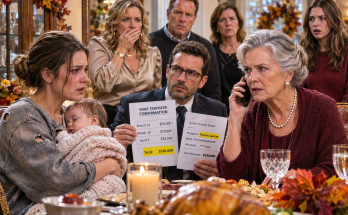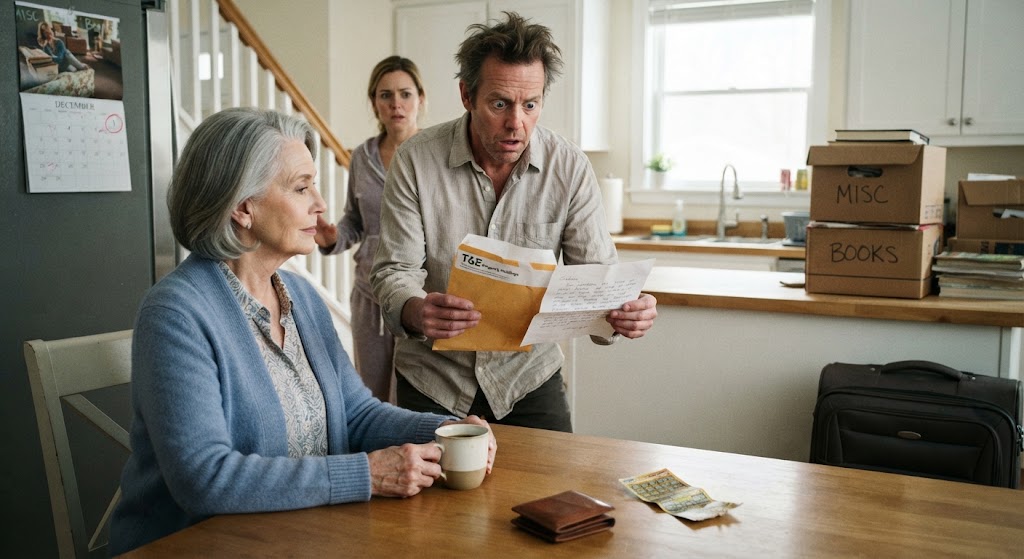
I thought my daughter-in-law wanted me out of the house because I was becoming inconvenient. But when she screamed, “Your mother has no idea what you’ve already signed!” I realized the senior-living brochure was only the beginning of a much darker plan.
My taxi was waiting outside.
My suitcase stood beside the front door.
And my seventy-three-year-old heart was beating so hard that I could hear it.
“Graham,” I said, keeping my voice steady, “what did you sign?”
My son looked at his wife.
“Paige, what are you talking about?”
She folded her arms.
“Nothing. I was upset.”
“You said I signed something.”
“You sign things all the time, Graham.”
“Paige!”
My son almost never raised his voice to his wife.
But that morning, he sounded like a man who had just discovered that the floor beneath him wasn’t solid.
I pulled out a chair.
“Sit down, both of you.”
Paige shook her head.
“I’m not participating in another interrogation.”
“Then you can listen while standing.”
She stared at me.
For years, I had apologized whenever my words displeased her.
That morning, I had no apology left.
Graham sat.
“Mom, I don’t understand what’s happening.”
“Neither do I,” I replied. “But we’re going to find out.”
I took out my phone and called Martin Hale.
He answered on the second ring.
“Evelyn? Has the courier arrived?”
“Yes. But something has happened.”
I explained what Paige had said.
There was a long silence.
Then Martin asked, “Is Graham there?”
“Yes.”
“Put me on speaker.”
I placed the phone in the middle of the table.
“Graham,” Martin said, “have you recently signed any documents concerning your mother’s care, finances, or legal decision-making?”
My son frowned.
“No.”
Paige turned toward the window.
Martin continued.
“Think carefully. Anything connected to Pine Harbor Senior Living?”
Graham rubbed his forehead.
“Well, Paige had me sign some forms.”
“What forms?”
“Application documents. A family contact form. Something about emergency decisions.”
My stomach tightened.
“Did you read them?”
Graham looked embarrassed.
“Not every page.”
Paige interrupted.
“They were ordinary paperwork!”
Martin’s voice became firm.
“Mrs. Mercer, please allow Graham to answer.”
I had never heard anyone silence Paige so effectively.
Graham swallowed.
“There was a packet. Maybe twenty pages. Paige said the facility needed signatures before they could reserve the apartment.”
“Where is it now?” Martin asked.
“In the study.”
“Please retrieve it.”
Graham stood.
Paige immediately stepped in front of him.
“Why are you making such a big deal out of this?”
“Move, Paige.”
“Graham—”
“Move.”
She stepped aside.
I watched my son disappear down the hallway.
For the first time that morning, Paige looked genuinely afraid.
Not angry.
Not offended.
Afraid.
“Evelyn,” she whispered, “you’re making this into something it isn’t.”
“Then you have nothing to worry about.”
She glanced toward my phone.
“Can we speak privately?”
“No.”
“Please.”
I shook my head.
“Whatever you have to say can be said in front of my son.”
Her lips pressed together.
A moment later, Graham returned carrying a blue folder.
He placed it on the table.
Martin asked him to read the titles of the documents.
“Pine Harbor preliminary application. Emergency contact designation. Resident financial questionnaire…”
He turned another page.
Then stopped.
“What is this?”
My heart sank.
“Read it, Graham.”
His voice became quieter.
“Petition for appointment of guardian…”
He stared at the page.
“Paige?”
She closed her eyes.
Graham looked at the next sheet.
“Statement of concern regarding financial judgment.”
He looked up.
“Why is Mom’s name on this?”
Paige didn’t answer.
Martin spoke carefully.
“Graham, has that petition been filed with a court?”
“I don’t know.”
“Look for a case number, filing stamp, or court acknowledgment.”
Graham flipped through the pages.
“No. There’s nothing like that.”
“Then it may only be a draft. Don’t sign or submit anything further. Send me copies immediately.”
I leaned back in my chair.
The kitchen suddenly felt very cold.
My daughter-in-law had been preparing paperwork to question my ability to manage my own life.
And my son had signed something without understanding what it was.
“Paige,” I whispered, “why?”
She stared at the floor.
Finally, she said, “Because you were acting strangely.”
I almost laughed.
“Strangely?”
“You were disappearing during the day. Taking taxis. Meeting with lawyers. Buying things without telling anyone.”
I looked at her.
“I’m seventy-three, Paige. Not seven.”
“You were hiding millions of dollars!”
“You didn’t know about the money until this morning.”
Her face changed.
And there it was.
A mistake.
A tiny mistake, but enough.
I leaned forward.
“Unless you knew earlier.”
Graham turned toward her.
“Paige?”
She looked trapped.
I remembered the night two months earlier when I had returned from Wilmington.
Paige had been standing in the hallway outside my bedroom.
She had claimed she was looking for spare pillowcases.
At the time, I believed her.
Now I wasn’t so sure.
“Did you go through my belongings?” I asked.
“No.”
“Paige.”
She stared at me.
Then Graham said, “Tell the truth.”
Her eyes filled with tears.
“I found a letter.”
“What letter?”
“One from Martin’s office. It was sticking out of your handbag.”
I felt sick.
The letter had contained information about the cottage purchase.
Not the full details of my winnings, but enough to reveal that I had substantial financial resources.
“You read my private mail?”
“I was concerned!”
“You were curious,” I replied.
She began crying.
“You have no idea how hard things have been for us!”
Graham stared at her.
“What does that have to do with Mom?”
Paige wiped her cheeks.
“We’re drowning, Graham!”
He went completely still.
“What?”
“We have debts!”
“What debts?”
She didn’t answer.
“Paige, what debts?”
She looked toward the children, who were still standing near the stairs.
I turned to my granddaughter.
“Lily, sweetheart, would you take your brothers upstairs for a little while?”
She nodded.
When the children were gone, Paige finally spoke.
“Credit cards. A personal loan. Some other things.”
Graham’s face drained of color.
“How much?”
“It’s complicated.”
“How much?”
She whispered a number.
“Eighty-six thousand.”
The silence was terrible.
Graham looked as though someone had struck him.
“Eighty-six thousand dollars?”
Paige nodded.
“Since when?”
“Over the last three years.”
He stared at her.
“You told me we had everything under control.”
“I thought I could fix it.”
“With what?”
She glanced at me.
And suddenly, I understood.
Not every detail.
But enough.
My daughter-in-law had discovered that I possessed money.
She had begun researching ways to influence my financial decisions.
And she had persuaded my son to sign documents he hadn’t properly read.
Martin’s voice came through the speaker.
“Evelyn, I strongly recommend that we continue this discussion privately in my office.”
I nodded.
“Agreed.”
Then I looked at Paige.
“Did you contact my lawyer?”
She said nothing.
“Did you pretend to represent my interests?”
Her silence answered more than words could.
Martin spoke.
“I can confirm that my office received an inquiry from a woman who identified herself as a concerned family member. We disclosed no confidential information.”
Paige covered her face.
Graham stood so suddenly that his chair scraped the floor.
“You tried to take control of Mom’s money?”
“I was trying to save us!”
“By declaring my mother incapable?”
“I never filed anything!”
“That’s not the point!”
I watched them argue.
For years, I had worked to prevent conflict in this house.
I had cooked favorite meals after disagreements.
I had distracted the grandchildren.
I had changed subjects when conversations became uncomfortable.
Now I understood that keeping the peace had sometimes meant keeping everyone from facing the truth.
“Enough,” I said.
Both of them stopped.
I turned to Graham.
“Your father once told me that love without respect becomes another form of control.”
Graham’s eyes filled.
“I remember him saying that.”
“I didn’t understand it then. I do now.”
I stood.
“My taxi is waiting.”
“Mom, please don’t leave yet.”
“I have an appointment with Martin this afternoon. We’ll review these papers properly.”
Paige stepped toward me.
“Evelyn, please. You don’t need to involve anyone else.”
I looked at her.
“You involved other people the moment you began preparing documents about my legal capacity without telling me.”
She started crying again.
But I didn’t move to comfort her.
I picked up my suitcase.
Graham hurried forward.
“Let me carry that.”
For a moment, I wanted to refuse.
Then I handed it to him.
He carried my suitcase to the waiting taxi.
Outside, the December air smelled of wet leaves and cold pavement.
The driver opened the trunk.
Graham stood beside me.
“Mom, I am so sorry.”
I touched his cheek.
“I know you’re sorry right now.”
He swallowed.
“But I need you to understand something. Being sorry because something has been discovered isn’t the same as changing the behavior that caused it.”
He nodded slowly.
“I understand.”
“I hope you will.”
He hugged me.
I held him tightly.
Then I got into the taxi.
As we drove away, I looked back.
My son was standing in the driveway.
Paige was watching from the front window.
And the house that had once felt like a prison grew smaller behind me.
For the first time in years, I was going somewhere I had chosen.
My yellow cottage.
My own front porch.
My own kitchen.
My own life.
But I didn’t yet know that Paige’s eighty-six-thousand-dollar confession was only part of the truth.
That afternoon, Martin reviewed the documents Graham had emailed.
At 4:16 p.m., he called me.
“Evelyn, are you sitting down?”
I was in my new kitchen, unpacking a box of teacups.
“Yes.”
“I’ve found something concerning.”
My hand tightened around the phone.
“What?”
“The guardianship draft isn’t the only document in that packet.”
He paused.
“There’s also a proposed agreement involving your late husband’s estate.”
I frowned.
“Thomas’s estate was settled years ago.”
“Exactly.”
“Then what agreement?”
Martin’s voice became very quiet.
“Someone appears to have been trying to reopen questions about assets your husband left you.”
I stared through the window at my rose bushes.
“Why?”
“Because the paperwork claims Graham may have an ownership interest in money and property that legally belongs to you.”
My heart began racing.
“Who prepared it?”
“We’re still determining that.”
Then Martin said something that made my blood run cold.
“Evelyn, there’s a signature on one of these documents that appears to be yours.”
I gripped the counter.
“But I never signed anything.”
“I know.”
“Martin…”
He interrupted gently.
“Don’t panic. We have the original estate records, and no one can simply take your assets because of a document like this.”
I closed my eyes.
“Then what happens now?”
“We investigate.”
He paused.
“And Evelyn?”
“Yes?”
“There’s one more thing.”
I waited.
“The signature is dated three months ago.”
I remembered exactly where I had been three months earlier.
In Wilmington.
Signing the papers for my cottage.
And I remembered who had been standing outside my bedroom when I returned.
Paige.
I looked down at my trembling hands.
Then I whispered:
“Martin, I think I know where she got a sample of my signature.”
But what I discovered next would force me to question something far more painful than Paige’s honesty.
It would force me to question how much my own son had known.
PART 4 — THE SECRET HIDDEN IN MY HUSBAND’S ESTATE
When my lawyer told me someone had copied my signature onto a document involving my late husband’s estate, I thought my daughter-in-law had finally crossed the worst possible line. But then Martin showed me a photograph of the document—and I recognized my son’s handwriting beside the signature.
I sat at my yellow kitchen table for nearly an hour after Martin’s telephone call.
Outside, the December sky was turning gray.
The roses along the fence had lost most of their petals.
My sister Ruth had left a pot of chicken soup on the stove.
Everything around me was peaceful.
But inside, I felt as though a storm had begun.
I kept thinking about Graham.
My only son.
The child I had carried for nine months.
The little boy who used to fall asleep with one hand wrapped around my finger.
Could he really have participated in something like this?
I wanted to believe the answer was no.
But I had spent too many years believing things simply because the alternative hurt.
At five o’clock, Ruth arrived.
She was seventy, three years younger than me, and had never learned how to enter a room quietly.
“Evelyn Mercer,” she announced, setting down a grocery bag, “you’ve been living in this house for less than one day, and you’re already forgetting to eat.”
I smiled weakly.
“Hello, Ruth.”
She studied my face.
“What happened?”
I told her.
Everything.
The guardianship draft.
The hidden debts.
The document bearing my signature.
And the handwriting that looked like Graham’s.
Ruth listened without interrupting.
When I finished, she pulled out a chair.
“Evelyn, do you remember what Mama used to say?”
I shook my head.
“She said the truth doesn’t become less true because it hurts.”
I looked away.
“I don’t want to lose my son.”
Ruth reached across the table.
“Then don’t confuse holding him accountable with losing him.”
I began crying.
Not loudly.
Just the quiet tears of a woman who had spent too many years swallowing disappointment.
Ruth moved beside me.
She put her arm around my shoulders.
And for the first time in a long while, I allowed someone else to take care of me.
The following morning, Martin arranged a meeting.
He had reviewed the estate documents and compared them with the original records from Thomas’s probate proceedings.
When I arrived, he placed three folders on his desk.
The first contained Thomas’s will.
The second held the papers from Graham’s house.
The third contained copies of correspondence connected to the disputed document.
“Before we begin,” Martin said, “I want you to understand that these papers haven’t changed your ownership rights.”
I nodded.
“Good.”
“The concern is that someone may have been preparing to use them to make a claim.”
He opened the second folder.
There it was.
A document titled Acknowledgment of Family Beneficial Interest.
The language was complicated.
But the meaning was not.
It asserted that some assets transferred to me after Thomas’s death were intended to be held for the benefit of Graham and his descendants.
There was a signature at the bottom.
Evelyn Mercer.
It looked enough like mine to fool someone unfamiliar with my handwriting.
But I immediately noticed something wrong.
My real signature had changed after arthritis began affecting my right hand.
The capital M in Mercer had become smaller.
The forged signature looked like the one I used fifteen years earlier.
“That’s from an old document,” I whispered.
Martin nodded.
“We noticed.”
I stared at it.
Then I saw the handwriting beside the witness line.
Graham Mercer.
My son’s signature.
“Did he witness this?”
“We don’t know yet. The document appears to have been prepared but not formally executed in a way that would establish the claimed ownership.”
I looked up.
“Could Paige have copied his signature too?”
“It’s possible.”
“Then I need to ask him.”
Martin hesitated.
“I would prefer that we preserve the documents and gather more information first.”
I nodded.
“Of course.”
He showed me the correspondence.
One email came from a financial consultant named Daniel Price.
Another referred to a meeting with someone who specialized in family wealth planning.
And one message contained a phrase that made me feel sick.
The mother’s unexpected assets may create an opportunity to resolve the family’s liquidity issues.
I read it three times.
“Liquidity issues,” I whispered.
Martin watched me carefully.
“That’s a business term for cash-flow problems.”
“I know what it means.”
My voice shook.
“They were discussing me as though I were a bank account.”
Martin didn’t contradict me.
I looked through the remaining pages.
There were references to my cottage.
To the rental property.
To a possible inheritance dispute.
And to something called a family restructuring proposal.
I felt exhausted.
“Martin, how much of this is real?”
“The financial difficulties appear real. The legal theories in these documents are questionable. But we need to distinguish between what someone proposed, what someone signed, and what anyone actually attempted to file.”
I appreciated that.
He wasn’t trying to frighten me.
He was trying to protect me from conclusions we couldn’t yet prove.
“Can I ask you something?” I said.
“Anything.”
“If Graham knew about this, what should I do?”
Martin leaned back.
“That’s a decision only you can make. But whatever you choose, you should protect yourself first.”
I nodded.
For most of my life, those two priorities had been reversed.
I protected Graham.
Then, if anything remained, I considered myself.
Now I had to learn another way.
That afternoon, Graham called.
I almost didn’t answer.
Then I saw his name again.
And I picked up.
“Hello, sweetheart.”
“Mom.”
His voice sounded terrible.
“Are you okay?”
“I’m safe.”
“I’m glad.”
A long silence followed.
Then he said, “Paige and I had a terrible fight.”
I closed my eyes.
“I’m sorry.”
“She told me more about the debts.”
“How much more?”
He swallowed.
“It’s not eighty-six thousand.”
I sat down.
“How much is it?”
“One hundred and forty-two thousand.”
I felt my stomach tighten.
“Graham…”
“She used two credit cards I didn’t know existed. And she took out a loan against her retirement account.”
“Why?”
“She says she was trying to keep up with everything.”
“Everything?”
“The house. The children’s activities. Vacations. Clothes. Things we couldn’t afford.”
I thought about the expensive handbag Paige had purchased the previous spring.
The weekend trips.
The new furniture.
The constant complaints about how difficult life had become.
“Did you know?”
“Not all of it.”
I stared at the wall.
“Graham, I need to ask you something.”
“Okay.”
“Did you sign a document about your father’s estate?”
He was silent.
Too silent.
“Graham?”
“I signed something.”
My heart sank.
“What did you think it was?”
“Paige said it was a family financial planning statement.”
“Did you read it?”
“Some of it.”
I closed my eyes.
“Did you know it claimed you had an interest in property your father left me?”
He hesitated.
Then whispered, “Yes.”
For a moment, I couldn’t breathe.
“You knew?”
“Mom, Paige said Dad might have intended some of the money for me.”
“And you believed her?”
“I didn’t know what to believe.”
“Why didn’t you ask me?”
He began crying.
“Because I was ashamed.”
I pressed my hand against my chest.
“Of what?”
“Of needing money.”
I sat quietly.
Then I asked the question that mattered most.
“Graham, did you know my signature was on that document?”
“No.”
“Did you ever see me sign it?”
“No.”
“Then why did you sign as a witness?”
He sounded confused.
“I didn’t sign as a witness. I signed a page saying I understood the proposal.”
My mind raced.
“Are you certain?”
“Yes.”
I looked at the copy Martin had given me.
The witness line contained Graham’s name.
But perhaps Paige had copied his signature too.
Or perhaps the pages had been rearranged.
I couldn’t know yet.
“Graham,” I said, “you need to tell Martin exactly what happened.”
“I will.”
“And you need your own lawyer.”
“Mom…”
“Not someone Paige chooses. Someone independent.”
He was quiet.
Then he said, “Okay.”
Before hanging up, he whispered something that stayed with me all night.
“Mom, I thought you were going to leave everything to me someday.”
I closed my eyes.
“And because you thought that, you believed you could claim it while I was still alive?”
He began crying harder.
“No. I just…”
He couldn’t finish.
I spoke gently.
“Graham, an inheritance is not something you collect in advance because your bills are overdue.”
“I know.”
“Do you?”
Silence.
Then he whispered, “I’m starting to.”
After we hung up, I walked onto my porch.
The air was cold.
The street was quiet.
For the first time, I understood how deeply money had changed the way my family looked at me.
But the lottery money hadn’t created their problems.
It had exposed them.
Three days later, Martin called with another discovery.
He had contacted the financial consultant whose name appeared in the correspondence.
Daniel Price agreed to speak with him.
The man claimed Paige had approached him seeking advice about resolving family debt through a possible future inheritance.
He said he had never advised forging signatures or taking control of my assets.
He also confirmed something important.
Paige had told him that I was becoming forgetful.
That I was confused about money.
That I could no longer reliably make decisions.
None of those claims had been supported by medical evidence.
When Martin told me, I felt a strange mixture of anger and sadness.
For months, Paige had been constructing a story about me.
A story in which I was weak.
Confused.
Dependent.
A woman whose money needed managing.
And the most painful part was that Graham had apparently allowed himself to believe pieces of it.
“Evelyn,” Martin said, “there’s another matter.”
I sighed.
“What now?”
“Daniel mentioned a loan application.”
I straightened.
“What loan?”
“He said Paige was trying to arrange financing based on a projected inheritance.”
I frowned.
“That doesn’t make sense.”
“It may not have been a viable arrangement. But he remembers her mentioning a lender.”
“Did she receive any money?”
“We’re checking.”
I closed my eyes.
Then Martin said:
“The application may have included a copy of your identification.”
My hand tightened around the phone.
“My identification?”
“Yes.”
I remembered the missing photocopy of my driver’s license.
Months earlier, Paige had asked for it, claiming Pine Harbor needed proof of my identity for the preliminary application.
I had given it to her without thinking.
“Martin,” I whispered, “she had a copy.”
He went silent.
Then he said, “We’ll need to investigate whether it was used improperly.”
I sat down slowly.
Outside, my new neighbors were hanging Christmas lights.
Children were laughing across the street.
The world continued as though nothing had happened.
But inside my cottage, I realized that the greatest threat to my independence might not have been the senior-living home.
It might have been the people who wanted the power to make decisions in my name.
And just when I thought the situation couldn’t become more painful, Graham called again.
This time, he wasn’t crying.
He sounded frightened.
“Mom, Paige is gone.”
I sat upright.
“What do you mean?”
“She left the house.”
“Where did she go?”
“I don’t know.”
“Did she take the children?”
“No. They’re here with me.”
I exhaled.
“Good.”
Then Graham said:
“Mom, she took the blue folder. And she emptied the joint savings account.”
I stared at the wall.
“How much was in it?”
“Almost twenty-three thousand dollars.”
He paused.
“And there’s something else.”
“What?”
“I found an email on our computer.”
His voice broke.
“Paige was planning to meet someone tomorrow.”
“Who?”
Graham swallowed.
“A man named Daniel Price.”
I frowned.
“The financial consultant?”
“Yes.”
“And what was the meeting about?”
My son began crying.
“Mom, the subject line says: FINAL TRANSFER BEFORE EVELYN DISCOVERS EVERYTHING.”