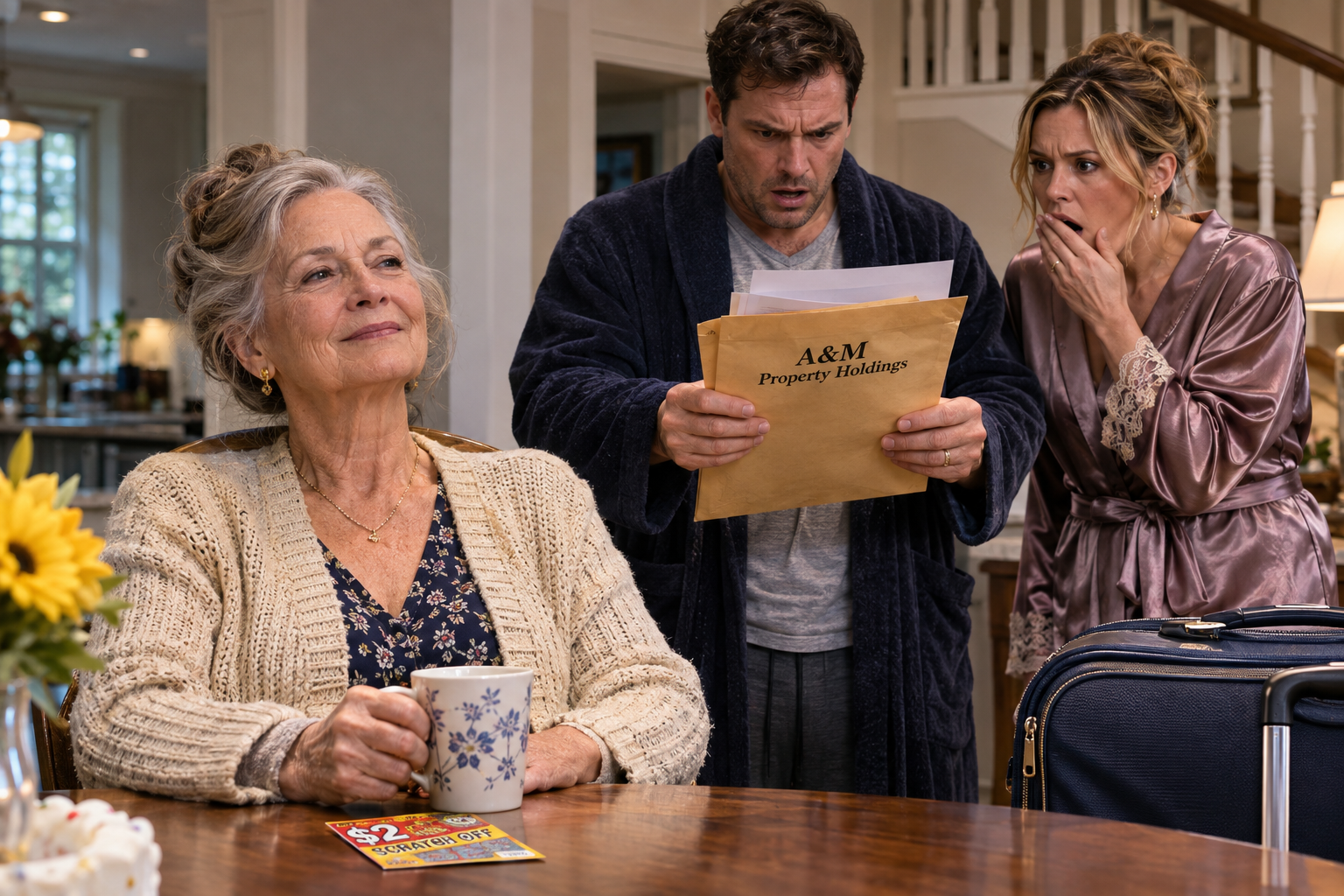
At seventy-three, I had learned that people rarely notice what you are carrying when they have already decided what you are worth.
That was the thought that crossed my mind while Jessica laughed across the kitchen table and told me I might finally have enough money to pay for a bus ride.
She had just handed me my birthday present.
It was a small card with a two-dollar scratch-off ticket tucked inside.
The price sticker was still attached to the back.
Jessica saw me looking at it and grinned. “Don’t spend the whole fortune at once, Margaret.”
Colin laughed.
The children laughed because their parents had.
I smiled too.
Then I scratched the silver coating away with the edge of my thumbnail.
The kitchen smelled of vanilla frosting, coffee, and the roast chicken I had cooked that afternoon. Sunlight fell through the window above the sink, catching the dust that floated above the table. Sophie was tapping her spoon against her glass. Lucas was arguing with her about whether he had eaten the last dinner roll.
Nobody was watching the ticket anymore.
That was useful.
Because underneath the final patch of silver were three matching symbols.
I stared at them.
Then I looked again.
The number printed beside them made my breath catch.
I folded the ticket in half.
“Nothing?” Colin asked.
I tucked it beneath the birthday card.
“Nothing useful.”
Jessica laughed.
“See? I told you. Maybe next year.”
I nodded.
“Maybe.”
I did not tell them that I had just won the advertised eleven-million-dollar prize.
I did not tell them when Colin cleared the plates.
I did not tell them when Jessica complained about the cake being too sweet.
And I certainly did not tell them when everyone went upstairs and left me alone with the dirty dishes.
I stood at the sink with my hands in warm water and watched the reflection of my own face in the dark window.
Seventy-three.
Widowed.
Living in my son’s house.
And apparently worth less to the people around me than a two-dollar joke.
Four years earlier, after Arthur died, Colin had insisted that I move in with him and Jessica.
“You shouldn’t be alone,” he had said.
I had believed him.
At first, their home felt like shelter. Then shelter became routine. Routine became expectation. Before long, I was preparing breakfast before anyone else woke, packing school lunches, collecting groceries, folding laundry, and making sure the children had everything they needed.
No one had ever sat me down and assigned those responsibilities.
That would have been easier.
Instead, each task arrived disguised as a small favor.
“Mom, could you pick Lucas up today?”
“Margaret, would you mind starting dinner?”
“Jessica has a late meeting. Can you keep Sophie until she gets home?”
Of course I could.
They were my family.
So I kept saying yes.
The trouble was that after enough years, people stop hearing yes as kindness.
They begin hearing it as availability.
I discovered that one evening while carrying a basket of folded towels down the hallway.
Jessica and Colin were talking in the kitchen.
I heard my name.
I stopped.
“She’s becoming a burden,” Jessica said.
There was no anger in her voice.
That made it worse.
Colin sighed.
“She’s my mother.”
“I know.”
“What do you want me to do?”
“I don’t know. Something.”
I stood there holding the towels against my stomach.
For a few seconds, I considered walking into the kitchen and asking them to repeat themselves.
Instead, I turned around.
I carried the towels upstairs.
I put them away.
Then I sat on the edge of my bed and looked at Arthur’s photograph on the dresser.
He had been gone for nearly four years.
I still sometimes woke expecting to hear him moving around downstairs.
Arthur would have hated the way I had learned to make myself smaller.
He would have told me I was allowed to want things.
He would have reminded me that being useful was not the same as being loved.
That night, I took the winning ticket from beneath my pillow.
I had put it inside a plastic sleeve.
Then I called a number my friend Helen had given me.
Richard Sterling answered.
“I need some advice,” I said.
He listened without interrupting.
When I told him about the ticket, there was a long silence.
“How certain are you that it’s genuine?”
“Certain enough that I haven’t slept properly since I scratched it.”
He gave a quiet laugh.
“That’s probably wise.”
I told him everything.
The prize.
The fact that nobody knew.
The house I was living in.
My son.
My daughter-in-law.
The conversation I had overheard.
When I finished, Richard asked one question.
“Margaret, what do you want?”
I looked toward Arthur’s photograph.
“I don’t know yet.”
“Then don’t decide today.”
That became the first piece of advice I followed.
Over the next several months, Richard helped me arrange everything quietly.
Taxes.
Accounts.
A trust for the children.
A new home.
Property paperwork.
A holding company.
I learned that having money did not make decisions easier.
It simply meant more decisions mattered.
I bought a small cottage near my sister Helen.
It had yellow siding, a narrow porch, and a kitchen with a window overlooking the garden.
The first time I stood inside it, I cried.
Not because it was grand.
It wasn’t.
It was simply mine.
Nobody had chosen my bedroom.
Nobody had decided which room I deserved.
Nobody had asked whether the house was practical for them.
For the first time in years, I had bought something because I liked it.
I kept the purchase quiet.
The same was true of another property.
When the house Colin and Jessica lived in came up for sale, I bought it through A&M Property Holdings.
The initials were Arthur and Margaret.
Colin had no idea.
Neither did Jessica.
Their lease continued exactly as before.
The property manager collected the rent.
Nothing changed outwardly.
That was the point.
I wanted to know whether they treated me differently because I was family or because I was useful.
For months, I watched.
I listened.
And I waited.
The answer came one morning in November.
Colin placed a glossy brochure beside my coffee.
I knew what it was before he said anything.
“We’ve been talking,” he said.
Jessica sat across from me.
She had that carefully pleasant expression she used when she had already made a decision and wanted me to believe I was being consulted.
“We found a lovely community,” she said.
I opened the brochure.
Oakridge.
Senior living.
The photographs showed smiling couples playing cards, walking beside fountains, and sitting beneath umbrellas.
“When did you visit?” I asked.
“Last week,” Colin said.
“You went without me.”
“We didn’t want to overwhelm you.”
I closed the brochure.
“When would you like me to move?”
Jessica glanced at Colin.
“January.”
The answer came too quickly.
I looked at my son.
“January first?”
“It would give everyone a clean start.”
There it was.
Everyone.
Not me.
Everyone.
I asked why.
Colin talked about space.
Jessica talked about independence.
Then Lucas’s room came into the conversation.
He was getting older.
He needed more privacy.
The downstairs bedroom would be perfect for him.
They had apparently discussed my future extensively.
I had simply been the last person to hear about it.
Jessica reached across the table and touched my hand.
“You’ll be happier around people your own age.”
I looked at her fingers resting on mine.
Then I looked at Colin.
He wouldn’t meet my eyes.
I smiled.
“All right.”
Their relief was immediate.
That hurt more than the brochure.
That evening, I closed my bedroom door.
My suitcase was already half packed.
Richard answered when I called.
“I’m ready,” I said.
He knew what I meant.
“Then we’ll proceed tomorrow.”
I sat on the edge of the bed and looked at Arthur’s photograph.
“I wish you were here.”
The room was silent.
Then my phone vibrated.
A message from Helen.
You coming to me soon?
I smiled.
Soon.
The next morning, the first step of my plan arrived before breakfast.
At 8:34, the doorbell rang.
Colin answered.
A certified envelope was waiting on the porch.
He carried it into the kitchen and opened it while Jessica stood behind him.
I watched from my chair.
He pulled out the first page.
His expression changed.
Jessica leaned over his shoulder.
“What is it?”
Colin read the heading again.
Then he looked toward me.
For the first time in four years, my son looked at his mother as though he had no idea who was sitting across from him.
“Mom,” he said slowly.
I lifted my coffee.
“Yes?”
His fingers tightened around the paper.
“I think there’s been a mistake.”
There hadn’t.
PART 2 – The House They Thought Was Theirs Came With a Notice, a Letter, and One Question Neither of Them Was Ready to Ask
Colin read the first page again.
Jessica snatched it from his hands.
“What does it say?”
He didn’t answer immediately.
She scanned the page herself.
Then her face changed.
“They’re terminating the lease?”
“Yes.”
“When?”
“Thirty days.”
Her eyes widened.
“Thirty days?”
I set my coffee cup down.
The small click against the saucer seemed to make the whole kitchen quieter.
Colin looked at me.
“Did you know about this?”
“Yes.”
Jessica stared.
“You knew?”
“I knew a notice was coming.”
“Why didn’t you tell us?”
I folded my hands.
“You were planning to move me on January first.”
“That isn’t the same thing.”
“No,” I said. “It isn’t.”
Colin kept staring at the document.
“This says the property owner intends to sell.”
“Yes.”
“But we’ve never missed a payment.”
“I know.”
“Then why?”
I looked toward the window.
“Because the owner has decided to.”
Jessica turned back to the paperwork.
“This doesn’t make sense.”
Another sheet slipped from the envelope.
It landed faceup on the floor.
Colin bent to retrieve it.
I saw recognition before he said anything.
The envelope was cream-colored.
The handwriting was mine.
His eyes moved across the first line.
Then stopped.
“Mom?”
“Yes?”
“Why is there a letter from you in this envelope?”
Jessica looked over his shoulder.
I took another sip of coffee.
“Read it.”
He unfolded the page.
His voice was cautious.
“Dear Colin and Jessica.”
Jessica folded her arms.
“This is dramatic.”
Colin kept reading.
“For nearly four years, I have lived in your home and tried to convince myself that being needed was the same thing as being welcome.”
He stopped.
“Mom…”
“Continue.”
His eyes moved lower.
“I cooked, cleaned, drove, organized, watched the children, and changed my plans whenever the household required it. I did those things because I loved my family. I never considered them debts.”
Jessica’s jaw tightened.
“Margaret, really?”
“Keep reading.”
Colin obeyed.
“But I began to understand that my place in the house had changed. Decisions about my future were made without me. My room became a problem to solve. My presence became something to manage.”
His voice became quieter.
“Eventually, I realized that the life I was expected to leave behind had been planned by everyone except me.”
Jessica looked at me.
“You’re blaming us because we found a retirement community?”
“No.”
“Then what is this?”
“Keep reading.”
Colin swallowed.
“So I made arrangements of my own.”
His eyes moved to the next paragraph.
He stopped.
Jessica noticed.
“What?”
He didn’t answer.
“Colin.”
He looked at me.
“What does A&M Property Holdings have to do with this?”
I waited.
Then I said, “Everything.”
His face drained of color.
“You own the company?”
“Yes.”
Jessica laughed.
It was a short, startled sound.
“You?”
“Yes.”
“You can’t be serious.”
“I am.”
Colin sat down.
He looked back at the notice.
Then at me.
“You own this house?”
“I own the property your family has been renting.”
Jessica’s mouth opened.
“You bought it?”
“Earlier this year.”
“With what?”
I held her gaze.
She realized her mistake a second too late.
“With my money.”
Colin’s voice was barely audible.
“Where did you get that kind of money?”
I did not answer.
Jessica suddenly looked at the birthday card sitting on the counter.
Her eyes widened.
“No.”
Colin followed her gaze.
“What?”
“The ticket.”
He frowned.
“What ticket?”
“The birthday ticket.”
Recognition spread slowly across his face.
The cheap little scratch-off.
The laughter.
The bus fare joke.
His eyes returned to mine.
“You won.”
I nodded.
“How much?”
I could have told him.
I could have watched both of them calculate what eleven million dollars meant.
Instead, I said, “Enough.”
Jessica stood.
“Margaret, how much?”
“Enough to buy this house.”
Colin rubbed his forehead.
“You’ve known for months?”
“Yes.”
“And you never told us?”
“No.”
“Why?”
I looked directly at him.
“Because I needed to see whether you treated me differently when you believed I had nothing.”
He flinched.
Jessica crossed her arms.
“So this was a test?”
“No.”
“Then what was it?”
“A way to make decisions without being surrounded by people who wanted something from me.”
Colin looked hurt.
“I never wanted your money.”
I remembered the brochure.
The retirement facility.
The sentence about January first.
I also remembered him asking me months earlier whether I could help cover an unexpected home repair.
I had.
I remembered the groceries.
The bills.
The nine hundred dollars I contributed every month.
The hours of childcare.
None of those things had been presented as payment.
But together they had become the structure of our relationship.
“I believed you,” I said.
His eyes lifted.
“Then why are you doing this?”
“Because I don’t want to be your landlord.”
“That doesn’t explain why you’re throwing us out.”
“You aren’t being thrown out.”
Jessica gave a sharp laugh.
“Thirty days?”
“You have a valid notice. You have time to make arrangements. Your security deposit will be handled according to the lease.”
“You’re our family.”
“Yes.”
“Then act like it.”
I looked at her.
“I have been acting like family for four years.”
That silenced her.
A sound came from the staircase.
We turned.
Lucas stood there in his school uniform.
His backpack hung from one shoulder.
“What happened?”
Jessica straightened.
“Go get ready.”
“Why is Grandma leaving?”
Nobody answered.
Lucas looked at me.
“Are you moving?”
I stood.
“I’m going to my own house.”
He looked confused.
“You have a house?”
“Yes.”
“Since when?”
I smiled.
“Since before you knew about it.”
His eyes filled with worry.
“Did we make you leave?”
“No.”
He glanced at his parents.
“They said you wanted to go somewhere with people your age.”
I looked at Colin.
He looked down.
Lucas’s voice became smaller.
“I didn’t know they meant you wouldn’t live here anymore.”
I crossed the kitchen and knelt beside him.
“You didn’t do anything wrong.”
“But I wanted the downstairs room.”
“I know.”
“I’m sorry.”
I touched his cheek.
“You don’t need to apologize for growing up.”
His shoulders relaxed slightly.
“Can I visit you?”
“Whenever we arrange it.”
“Does your house have Wi-Fi?”
I laughed despite myself.
“Yes.”
“Then I want to see it.”
“Deal.”
Sophie appeared behind him.
“What did I miss?”
Lucas whispered something to her.
Her eyes grew wide.
“Grandma’s moving?”
I held out my arms.
She ran to me.
For a few minutes, the adults disappeared.
There were no millions.
No property company.
No notice.
Only two grandchildren clinging to me in a kitchen that had never really been mine.
When they went upstairs, Colin remained at the table.
“Why didn’t you tell me?” he asked again.
I knew he meant the money.
But I also knew he meant everything.
“I didn’t know what you would do with the information.”
“You could have trusted me.”
I looked at him.
“You could have asked me to stay.”
He had no answer.
After a while, he said, “What about Oakridge?”
“I won’t be going.”
“Then stay here.”
I almost said yes.
That old instinct was still alive.
The one that wanted to repair the discomfort immediately.
Then Colin added, “We can move Lucas upstairs and figure out something else.”
Something inside me went quiet.
“You’re still talking about the room.”
His expression changed.
“No, Mom. That’s not what I meant.”
“It is what you meant.”
He looked toward the hallway.
“I’m sorry.”
“I believe you.”
“Then stay.”
“I can’t.”
“Why?”
“Because I have already learned what happens when I stay somewhere simply because leaving would inconvenience other people.”
He stared at the floor.
My taxi was scheduled for 9:15.
I went upstairs.
My suitcase waited beside the bed.
I had packed everything except Arthur’s photograph.
I took it from the dresser.
The pale rectangle where it had stood was visible in the dust.
For four years, that photograph had been the one piece of our old life I refused to put away.
I slipped it carefully into my handbag.
When I returned downstairs, Colin was holding my suitcase.
“I’ll carry it.”
“Thank you.”
Jessica stood by the door.
She looked frightened now.
Not angry.
Frightened.
“Margaret,” she said, “where are you going?”
“Near Helen.”
“You bought another house?”
“Yes.”
“How many properties do you own?”
I smiled faintly.
“Enough.”
She looked away.
Colin carried my suitcase outside.
The morning air smelled of wet leaves.
The taxi driver opened the trunk.
Colin placed the suitcase inside.
Then he stood beside the car.
“Call me when you get there.”
“I will.”
He leaned down and kissed my cheek.
The gesture was so familiar that tears filled my eyes.
For a second, I saw the little boy he had been.
Then his gaze moved toward the house.
“Please talk to Richard about the notice.”
I nodded.
“I will.”
The taxi pulled away.
I cried quietly for the first few minutes.
Helen was waiting when I arrived.
She hugged me hard.
“You actually did it.”
“I almost didn’t.”
“But you did.”
That evening, after soup and fresh bread, I walked through my cottage.
My books were on my shelves.
Arthur’s photograph stood beside the lamp.
The bedroom window looked onto rose bushes.
No one had chosen the room for me.
No one had measured its usefulness.
I sat on the edge of the bed.
My phone rang.
Richard.
“Are you settled?”
“Yes.”
“Colin has already contacted me.”
“About the house?”
“Partly.”
“What else?”
There was a pause.
“Jessica is questioning whether you had independent advice when you purchased the property.”
I closed my eyes.
“For four years I was competent enough to run their household.”
“I know.”
“Now my judgment is suddenly questionable.”
“Don’t engage with that tonight.”
“I won’t.”
After we hung up, I looked at Arthur’s photograph.
I thought I was finished with the past.
Then, at 10:17, my phone vibrated.
Lucas.
Grandma are you awake?
I answered immediately.
Yes, sweetheart. Everything okay?
Three dots appeared.
Then disappeared.
Then returned.
A photograph arrived.
It showed a cardboard storage box on Colin’s dining table.
I recognized the contents.
Arthur’s records.
The documents Colin had taken after the funeral.
Another message arrived.
Dad and Mom are looking through Grandpa’s papers.
My stomach tightened.
Then another.
Mom said if you talk to your lawyer about the old house they could lose everything.
I stared at the words.
Old house.
Arthur’s old house.
The one I had sold after his death.
The one Colin had handled almost entirely because I had been too broken to manage the paperwork.
I opened the photograph again.
An envelope lay beside the box.
The top page showed the name of the company that had handled the sale.
Below it was my name.
And beside it was a signature.
It looked like mine.
Almost.
I enlarged the photograph.
The final stroke was wrong.
I knew because Arthur had teased me about that stroke for thirty-eight years.
My phone vibrated again.
Dad told Mom, “I thought she would never ask.”
I stopped breathing.
I called Richard.
When he answered, I said only one thing.
“I need you to investigate the sale of my old house.”
