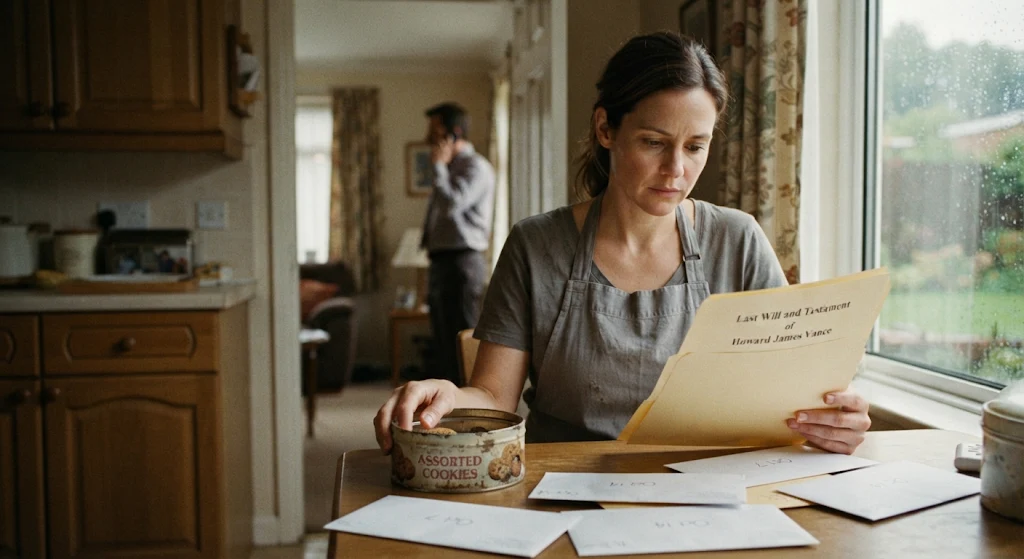
- Every Monday, my husband left cash on the kitchen table for a caregiver to keep his sick mother “clean, fed, and quiet.” He never knew the caregiver was me, wearing an old gray apron and using another name. I saved every envelope in a cookie tin under the sink — until I heard him tell his sister, “Once Mom signs over the house, the maid and my wife are both gone.” He didn’t know the “maid” had already found the will under his mother’s mattress. The first envelope appeared on a rainy Monday morning. I was standing at the sink, washing oatmeal from a small blue bowl while my mother-in-law called my name from the back bedroom. “Lena?” “I’m coming, Adelaide,” I called. Advertisements My hands were raw from soap. My back ached from lifting her twice during the night. Adelaide was seventy-nine, diabetic, weak in one leg, and too proud to admit how scared she was of becoming useless to her own children. My husband, Marcus, walked into the kitchen in his work shirt, placed a white envelope on the table, and tapped it with two fingers. “I found help,” he said. I turned around slowly. “Help?” “A caregiver,” he said. “For the afternoons. You look exhausted, and frankly, I’m tired of hearing about how much you do.” For one foolish second, I almost cried from relief. For three years, Adelaide had lived with us. I gave her medication, checked her blood sugar, cooked separate meals, washed sheets, changed bandages, and helped her to the bathroom while Marcus said he was too busy, too tired, or “not good with that kind of thing.” So when he said caregiver, I thought maybe he had finally seen me. I should have known better. I picked up the envelope. There was cash inside. Not much, but enough for a few hours of help. “When is she coming?” I asked. Marcus shrugged. “You arrange it. I don’t care who it is as long as Mom is handled.” Handled. Like she was a broken chair. Still, I nodded. I didn’t want a fight at seven in the morning. Three days later, I learned the truth. I was carrying Adelaide’s medicine tray down the hall when I heard Marcus laughing in the living room. He was on the phone with his sister, Janice. “I’m already giving Lena money for the caregiver,” he said. “Let’s see if she still wants to play the suffering wife.” Janice laughed loud enough for me to hear from the hallway. “You think she’ll actually hire someone?” “No,” Marcus said. “That’s the point. She’ll probably do it herself and keep the money, or waste it on something stupid. Either way, I win. If she spends it, I can call her irresponsible. If she does the work herself, I save money.” My body went cold. It was never help. It was a trap. That night, I didn’t confront him. The next Monday, when Marcus left another envelope on the table, he asked, “Did the caregiver come?” I looked him straight in the eye. “Yes.” “What’s her name?” “Rose,” I said. It was my grandmother’s name. From that day on, every afternoon, I tied my hair differently, put on an old gray apron, and walked into Adelaide’s room as if I were starting a shift. Not because Marcus would see me. He barely looked in Adelaide’s direction. I did it because I needed to remind myself that this was work. Real work. Work he had mocked for years. The first time I said, “Rose is here,” Adelaide looked at me for a long moment. Then her eyes filled with sad understanding. “She takes better care of me than my own children,” she whispered. I didn’t answer. I just tucked the blanket around her legs. Every week, Marcus left the money. Every week, I put the sealed envelope into a cookie tin and hid it under the sink. I wrote the date on each one. I kept receipts for Adelaide’s medicine, soft food, test strips, doctor visits, and the little things no one counts until they need proof: gloves, wipes, ointment, bed pads, broth, batteries for her blood pressure machine. I thought I was only protecting myself from being called a thief.
- I didn’t know I was preparing for something much worse.
- One afternoon, Adelaide gripped my wrist while I was changing her sheets.
- “Lena,” she whispered. “Don’t trust Marcus.”
- I looked at her face.
- “What happened?”
- Her lips trembled.
- “I heard him and Janice last night. They want me to sign the house over.”
- My stomach tightened.
- The house.
- The house Marcus always called “family property.”
- The house I had painted, repaired, cleaned, and kept alive for twelve years. The house where I had replaced broken pipes with my savings while Marcus told people he was “carrying the household.”
- “Adelaide,” I said carefully, “did they ask you to sign something?”
- She nodded.
- “They said it would make things easier. Then Janice said they could finally put me somewhere cheaper.”
- Her voice broke on the word cheaper.
- That night, I told Marcus I was going to the grocery store.
- I didn’t leave.
- I stood outside near the back patio, close enough to hear through the cracked kitchen window.
- Marcus was inside with Janice.
- “Mom’s getting weaker,” Janice said. “You need to do this before she changes her mind.”
- “She won’t,” Marcus said. “The notary is coming Friday. Once the house is in my name, we put her in a nursing home.”
- “And Lena?”
- Marcus laughed.
- “Lena can go with her apron. I’m not keeping a wife who acts like a servant and still expects respect.”
- Janice snorted.
- “What about the caregiver?”
- “What caregiver?” Marcus said. “Some made-up woman Lena invented. Once Mom signs, I’ll kick out the maid and my wife in the same week.”
- I stood there with rain dripping from the roof onto my shoulder.
- For a moment, I couldn’t breathe.
- Then something inside me went quiet.
- Not weak quiet.
- Dangerous quiet.
- The next morning, Adelaide asked me to close her bedroom door.
- Then she pointed to the mattress.
- “Lift it.”
- I hesitated.
- “Adelaide?”
- “Please.”
- I lifted the mattress with both hands. Underneath, wrapped in a plastic bag, was a yellow folder.
- Adelaide touched it like it was the last thing she owned.
- “Howard made me promise to keep this hidden,” she said.
- Howard was Marcus’s father. He had died two years earlier. He had been quiet, serious, and kinder to me than his son ever was.
- I opened the folder.
- Inside was his will.
- My hands shook as I read it.
- The house had not been left to Marcus.
- It had not been left to Janice.
- It had been left to me.
- Lena Whitaker.
- The document said Howard had made that decision because I had provided years of care for Adelaide and had maintained the home when his own children refused responsibility.
- I read the paragraph three times.
- Adelaide watched my face.
- “He knew,” she said softly. “He knew what they were.”
- Before I could answer, the front door opened.
- Marcus’s voice carried down the hall.
- “Mom? Lena? We’re here.”
- We.
- I looked out.
- Marcus had come home with Janice and a notary.
- He was holding a folder of his own.
- Adelaide straightened in her wheelchair.
- “Bring me the yellow folder,” she said.
- “Adelaide, maybe we should call a lawyer first.”
- “No,” she said. “I have been silent too long.”
- I took off the gray apron.
- Then I picked up the cookie tin from under the sink and walked into the dining room.
- Marcus stopped when he saw me.
- “Where is the caregiver?” he asked.
- I set the tin on the table.
- “Right here.”
- I opened it and poured out every sealed envelope.
- One by one, they landed in front of him.
- Dated.
- Untouched.
- His face changed.
- Janice stepped back.
- The notary looked from the envelopes to me.
- “What is this?” Marcus snapped.
- “The money you gave Rose,” I said. “The caregiver you laughed about. The woman you thought didn’t exist.”
- Marcus’s jaw tightened.
- “You lied to me.”
- I looked at him.
- “No. You finally paid for a little of the work you pretended wasn’t work.”
- Before he could answer, Adelaide rolled herself into the dining room. Her hands trembled, but her voice did not.
- “Before my son steals from me,” she said to the notary, holding up the yellow folder, “I want you to read this.”
- Janice rushed toward her.
- “Mom, stop. You’re confused.”
- Adelaide pulled the folder against her chest.
- “I was confused when I believed my children loved me more than they loved this house.”
- The room went silent.
- The notary took the folder. He checked the pages, the stamps, the signatures.
- Marcus laughed, but it sounded thin.
- “That’s probably some old paper. Dad would never leave my house to Lena.”
- The notary looked up.
- “This appears to be valid.”
- Janice’s mouth fell open.
- Marcus turned red.
- “What?”
- The notary read the main section aloud.
- Howard Whitaker had legally left the house to me, in recognition of my care for Adelaide and my financial contributions to the property.
- For the first time in years, Marcus had nothing to say.
- Then he exploded.
- “This is my family’s house!”
- Adelaide looked at him with tears in her eyes.
- “Then you should have acted like family lived here.”
- That hurt him more than yelling would have.
- Janice pointed at me.
- “She manipulated you. She dressed up like a caregiver and tricked Marcus out of money.”
- I picked up one envelope.
- “Every dollar is here. Sealed. Dated. Untouched.”
- Then I placed my notebooks on the table.
- Medication logs.
- Meal plans.
- Blood sugar readings.
- Receipts.
- Doctor appointments.
- Fall reports.
- Nights when Adelaide had a fever.
- Times Marcus had promised to come home early and didn’t.
- The notary slowly closed Marcus’s folder.
- “I cannot proceed with any transfer today,” he said. “Mrs. Whitaker is expressing concern about coercion. There is also a prior legal document affecting this property.”
- Marcus turned on him.
- “You were hired to notarize a signature.”
- “I was not hired to ignore possible elder coercion,” the notary replied.
- Adelaide lifted her chin.
- “I am not signing anything.”
- Marcus stared at his mother as if she had betrayed him.
- But the betrayal had never been hers.
- That night, Marcus left with Janice.
- Not because he wanted to.
- Because Adelaide told him to.
- “This house is no longer a place for you to plan my disappearance,” she said.
- He sent me a text before sunrise.
- If you don’t give me back my house, I’ll tell everyone you manipulated my mother and stole caregiver money.
- I read it twice.
- Then Adelaide, sitting by the window with the yellow folder on her lap, said, “Let him talk.”
- So we did.
- We let him talk.
- And then we let the lawyer answer.
- Adelaide’s lawyer was Ellis Mercer, a calm man with silver hair and a small office downtown. He reviewed the will, the envelopes, Marcus’s texts, my notebooks, the receipts, and Adelaide’s medical records.
- When he finished, he leaned back and said, “Lena, this is not only about a house. This is about years of unpaid care, pressure, and a plan to remove two women who became inconvenient.”
- Marcus sued.
- Of course he did.
- He claimed I had tricked Adelaide.
- He claimed the caregiver money proved I was dishonest.
- He claimed his mother was too weak to understand anything.
- But Adelaide insisted on testifying.
- She arrived at court in a pale blue dress, with her hair pinned neatly and the yellow folder resting on her lap.
- When Marcus’s lawyer asked if she understood why she was there, Adelaide looked at the judge and said, “I understand better now than I did when I trusted my children.”
- The courtroom went quiet.
- Marcus’s lawyer tried to make me look like a schemer.
- He talked about the gray apron.
- The fake name.
- The envelopes.
- Then Ellis opened the cookie tin.
- Every envelope was still sealed.
- Every date matched.
- Every amount was accounted for.
- Then he placed my notebooks in front of the judge.
- Page after page showed what I had done while Marcus called me dramatic, useless, and expensive.
- Adelaide asked to speak.
- The judge allowed it.
- “Rose was not a lie to steal money,” Adelaide said. “Rose was the name Lena used so my son would pay, even without knowing it, for the work he had been insulting for years.”
- Marcus looked down.
- Adelaide continued.
- “My children wanted my house. Lena wanted me clean, fed, safe, and not alone. That is the difference.”
- Janice began to cry.
- No one moved to comfort her.
- In the end, the will stood.
- The house remained in my name.
- A protective order was granted for Adelaide.
- Marcus was allowed to collect his belongings under supervision. Janice was not allowed inside without permission.
- For the first time in twelve years, I walked through that hallway and did not feel like I was living in someone else’s mercy.
- A few weeks later, Marcus came back with cheap flowers.
- He stood on the porch like a man auditioning for regret.
- “Lena,” he said, “I let Janice get in my head.”
- I looked at him through the half-open door.
- “Janice didn’t make you call me a maid.”
- He swallowed.
- “She didn’t make you ignore your mother. She didn’t make you plan to put her away. She didn’t make you laugh about throwing me out with nothing.”
- His face fell.
- “So that’s it?”
- Behind me, Adelaide was asleep in a clean room with a warm lamp on. On the kitchen counter sat the cookie tin, empty of envelopes now, but full of receipts I no longer had to hide.
- “No,” I said. “It’s not it. It just stopped being on your terms.”
- The divorce took time.
- It did not turn me into a rich woman overnight.
- The house still needed repairs. Adelaide was still sick. I was still tired.
- But my tiredness no longer came with humiliation.
- With some of the saved money, I hired a real afternoon nurse. Her name was Maribel. The first day she came, Adelaide watched her take off her coat and smiled at me.
- “Rose can rest now,” she said.
- I laughed.
- Then I went into the kitchen and cried quietly where no one could see.
- Months passed.
- I turned the back sunroom into a small meal service for seniors. Unsalted soup. Soft rice. Sugar-free pudding. Stewed apples. Food for people like Adelaide, people who needed care that didn’t make them feel like a burden.
- The neighbors ordered first.
- Then their friends.
- Then Maribel helped me deliver meals twice a week.
- On good days, Adelaide sat at the table and checked labels.
- “Mr. Walsh needs less salt,” she would say.
- “Mrs. Carter likes carrots soft.”
- The house Marcus wanted as a prize became something else.
- A roof.
- A business.
- A place where care had a name and a price and dignity.
- Janice came once, months later.
- She asked to see her mother.
- Adelaide agreed, but only if I stayed in the room.
- Janice cried. She apologized. Maybe she meant some of it. Maybe defeat sounds a lot like remorse when people run out of options.
- Adelaide held her daughter’s hand and said, “I forgive you as my child. But I will never again trust you with my home or my old age.”
- No yelling.
- No drama.
- Just a door closing.
- Marcus changed in small ways, or maybe life simply forced him to do the things I used to do for free. He rented a small apartment. He learned to cook badly. He washed his own shirts. Sometimes he asked about Adelaide.
- She saw him when she wanted.
- She never signed anything for him again.
- As for me, I learned something I should have known much earlier.
- Being a wife does not mean being erased.
- Being a daughter-in-law does not mean giving up your sleep, your back, your money, and your life without thanks.
- And caring for someone does not mean letting everyone else use your kindness as a doormat.
- I was Lena, the invisible wife.
- I was Rose, the caregiver my husband thought he had invented.
- I was the “maid” they planned to throw away.
- But in the end, I was also the woman who kept every bill, every envelope, every receipt, and every truth until the day came to put them all on the table.
- And when Marcus asked where the caregiver was, I finally answered him without fear.
- “Right here.”
- I was the caregiver.
- And the house was mine.
PART-3: THE YELLOW FOLDER CHANGED EVERYTHING Inside was his will. My hands shook as I read it. The house had not been left to Marcus. It had not been left to Janice. It had been left to me. Lena Whitaker. Adelaide watched my face carefully. “He knew,” she whispered. “He knew everything.” I looked up at her. “Adelaide…”
- She raised one trembling hand. “Read the letter.” There was a second paper tucked behind the will. It was folded twice. My name was written on the front in Howard’s careful handwriting. For several seconds, I couldn’t make myself touch it. The paper looked ordinary. Just another yellowed sheet that had spent years hidden beneath an old mattress. Yet somehow it felt heavier than the folder itself. “He wrote that six months before he died,” Adelaide whispered. “He never stopped adding little notes.” “I only read it once.” “Then I hid everything exactly where he told me.” I swallowed hard. “Why didn’t he give it to me himself?” Her eyes drifted toward the bedroom window. “He wanted to.” “He tried.” “But by then…” Her voice cracked. “…Marcus had already begun watching everything.” A chill crept across my shoulders. “What do you mean?” Adelaide closed her eyes. “You think your husband became greedy after Howard died.” She slowly shook her head. “No.” “It started years before.” I stared at her. She looked smaller than she had only minutes ago. Not because she was weak. Because she was finally carrying a truth she had hidden for far too long. “Read it,” she repeated softly. My fingers slipped beneath the fold. The paper crackled. Howard’s familiar handwriting filled both sides. His letters leaned slightly to the right, neat and patient, exactly the way he spoke. I began reading.
- Dear Lena, If you are holding this letter, then two things have happened. The first is that I am no longer here to protect you. The second is that Marcus has become exactly the man I feared he would become. If I am wrong, burn this letter. If I am right, read every word. By the second sentence, my vision blurred. I blinked hard. Howard had always been quiet. He rarely interfered. He preferred fixing things with actions instead of arguments. I never imagined he had been watching everything. The letter continued. You probably believe nobody noticed how much you sacrificed. You are wrong. I noticed every skipped meal. Every hospital visit. Every repair you quietly paid for. Every apology you made after someone else hurt you. I noticed because I often wanted to apologize for my own son. A tear landed on the paper. I wiped it away immediately. “I don’t want to ruin it,” I whispered. Adelaide reached across the bed and squeezed my wrist.
- “He’d be happy you’re crying.” I laughed weakly through my tears. “I don’t think anyone has ever said that before.” “He would.” “He always said tears meant the truth had finally reached someone’s heart.” I smiled despite myself. Then I kept reading. Marcus believes responsibility is something people owe him. He has believed that since he was twelve years old. That sentence stopped me. I looked at Adelaide. “Twelve?” She nodded slowly. “There are things you don’t know.” “What things?” She looked toward the hallway as though expecting Marcus to walk through it. “When Marcus was twelve…” “…Howard caught him stealing.” I frowned. “Stealing?” She nodded. “Money.” “From you?” “No.” “From his grandmother.” I blinked. “What happened?” Adelaide sighed deeply. “My mother lived with us for two years.” “She was already beginning to forget things.” “One afternoon Howard counted the grocery money.”
- “It was missing.” “He thought he’d made a mistake.” “So he counted again.” “It kept happening.” “For nearly three months.” I listened without breathing. “One day he stayed home from work.” “He pretended to leave.” “Instead…” “…he watched.” She closed her eyes. “He found Marcus inside Grandma Eleanor’s room.” “He was taking money from her purse.” I could hardly picture it. Marcus had always acted entitled. But stealing from his own grandmother as a child… That was different. “What did Howard do?” “He cried.” My eyebrows lifted. “Cried?” “He didn’t yell.” “He didn’t hit him.” “He sat Marcus down and cried.” “He asked him why.” “What did Marcus say?” Adelaide’s shoulders slumped. “He said…” “…because nobody would notice.” Silence filled the room. Outside, rain tapped softly against the windows. Inside, I suddenly felt cold. Adelaide continued. “Howard spent years trying to teach him empathy.” “He volunteered.” “He donated.” “He brought Marcus with him.” “But every act of kindness became another opportunity for Marcus to ask…”
- “‘What do I get?’”
- I looked back at the letter.
- Howard had written exactly that.
- I tried to change him.
- Perhaps I failed.
- Perhaps I simply waited too long.
- A father always believes tomorrow will be the day his son understands.
- Sometimes tomorrow never comes.
- I covered my mouth.
- Everything suddenly made sense.
- Marcus never forgot birthdays because he was busy.
- He forgot because they weren’t useful.
- He never skipped Adelaide’s appointments because work demanded it.
- He skipped because someone else would go.
- He never ignored my exhaustion because he couldn’t see it.
- He ignored it because it benefited him.
- Howard had seen all of it.
- Years before I ever admitted it to myself.
- Adelaide looked at me quietly.
- “You understand now.”
- “I think I do.”
- “No.”
- She shook her head gently.
- “I don’t think you do.”
- “There is more.”
- My heart sank.
- “More?”
- She nodded.
- “A lot more.”
- I looked back at the letter.
- The next paragraph began differently.
- Howard had underlined the first sentence.
- If Marcus ever pressures your mother-in-law to sign anything…
- …do not let her.
- My heartbeat quickened.
- He knew.
- Years before he died…
- …Howard had predicted exactly what Marcus would do.
- I hurried to the next lines.
- I have already spoken to Ellis Mercer.
- He has copies of certain documents.
- If the originals disappear…
- …the truth will not.
- I stopped reading.
- “Ellis?”
- Adelaide smiled faintly.
- “Our lawyer.”
- “He still has everything.”
- “Howard trusted almost no one.”
- “But he trusted Ellis.”
- A strange feeling spread through my chest.
- For the first time in years…
- I wasn’t alone.
- Howard had planned for this.
- Ellis knew.
- Adelaide knew.
- The will existed.
- The letter existed.
- Somewhere beyond this room…
- there were copies.
- Marcus couldn’t simply make everything disappear.
- That realization gave me something I hadn’t felt in years.
- Hope.
- Real hope.
- Not the fragile kind that depends on someone changing.
- The solid kind built on truth.
- Then another sentence caught my eye.
- If you are reading this, Marcus has almost certainly underestimated you.
- Despite everything…
- …do not underestimate him.
- My stomach tightened.
- The letter continued.
- Marcus becomes most dangerous…
- …when he believes he is losing.
- I looked toward the bedroom door.
- The house was quiet.
- Too quiet.
- Then—
- The front door slammed.
- Adelaide’s eyes snapped toward the hallway.
- A car door closed outside.
- Then another.
- Voices.
- Marcus.
- Janice.
- And someone neither of us recognized.
- Adelaide whispered only three words.
- “They’re early today.”
- I folded the letter carefully.
- My pulse hammered in my ears.
- Footsteps echoed through the hallway.
- Closer.
- Closer.
- Then Marcus laughed.
- “Mom?”
- “We’ve got wonderful news.”
- Adelaide looked directly into my eyes.
- For the first time since I had known her…
- …there was no fear in her expression.
- Only resolve.
- “Bring me the cookie tin.”
- The bedroom door handle slowly began to turn…