We met in a public location.
Bruno looked different.
Older.
Tired.
The confidence was gone.
He sat across from me.
For several seconds, neither of us spoke.
Finally he said:
“You look well.”
I nodded.
“I am.”
He looked down.
“I’ve made mistakes.”
I said nothing.
“I know you don’t believe me.”
“I don’t.”
He swallowed.
“I lost everything.”
“No.”
He looked up.
“You lost control.”
His eyes filled with anger for a moment.
Then the anger disappeared.
“You always were stubborn.”
I almost smiled.
“That was never the problem.”
“What was?”
“You thought my willingness to forgive meant I would forgive anything.”
He looked away.
“I loved you.”
I answered quietly.
“Love doesn’t require fear.”
He had no response.
He reached into his coat.
“I brought something.”
He placed an envelope on the table.
I didn’t touch it.
“What is it?”
“A copy of the first agreement we signed when we bought the house.”
I looked at him.
“Why?”
“Because I want you to see something.”
I opened it.
At the bottom was my signature.
Beside it was Bruno’s.
But underneath the signatures was a handwritten note.
My grandmother’s handwriting.
I stared at it.
She had apparently reviewed the agreement years earlier.
The note said:
Jade, if you ever feel trapped, remember that a signature is not a promise to suffer.
I closed my eyes.
Bruno whispered:
“She was always suspicious of me.”
“Yes.”
“I hated that.”
“I know.”
He looked at me.
“Do you hate me?”
I thought about the question.
“No.”
His face softened.
“Then maybe—”
“I don’t hate you.”
I interrupted him.
“But I don’t want you in my life.”
He nodded slowly.
That was the first boundary he had ever accepted without an argument.
We sat in silence.
Finally, he said:
“Do you ever think about what would have happened if I had just asked you for help?”
I looked at him.
“Yes.”
“And?”
“I would have listened.”
He lowered his head.
“You really would have?”
“Yes.”
His eyes filled with tears.
“But you didn’t ask.”
He nodded.
“I know.”
I stood.
“I hope you get the help you need.”
He looked up.
“Is that forgiveness?”
I thought for a moment.
“No.”
His expression fell.
“It’s closure.”
I walked away.
I never saw him again.
The divorce was finalized months later.
The investigation continued.
The house was sold.
The proceeds were handled according to the court’s orders.
Bruno’s business empire disappeared.
Richard faced his own financial consequences.
Linda eventually moved away.
And me?
I finally learned how quiet life could be.
No shouting.
No footsteps behind me.
No checking someone’s mood before speaking.
No wondering whether dinner would become an argument.
No fear.
Just peace.
But there was one final thing I had to do.
I returned to my grandmother’s grave.
I placed the original letter beside the flowers.
Then I whispered:
“You were right.”
The wind moved through the trees.
For the first time, I didn’t feel like the woman who had survived something.
I felt like the woman who had finally begun living.
PART 10 — THE END
One year later, I stood outside a renovated Victorian house on a quiet street.
A small sign stood near the front door.
ELEANOR THOMPSON FREEDOM HOUSE
Inside were six bedrooms.
A counseling room.
A small legal office.
A kitchen.
A children’s playroom.
And a library filled with books about rebuilding your life.
The house was funded by the foundation I had created with my grandmother’s money.
I had expected to feel proud.
Instead, I felt grateful.
Because every person who walked through that door reminded me why I had survived.
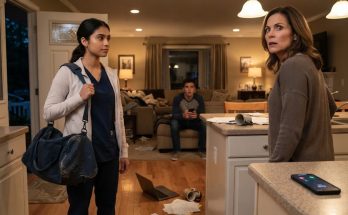
That afternoon, a young woman arrived carrying two bags.
She looked frightened.
She kept apologizing.
“I’m sorry,” she said.
“You don’t have to apologize.”
“I don’t have anywhere to go.”
“You do now.”
Her eyes filled with tears.
I handed her a key.
“This is yours while you need it.”
She looked at me.
“Why are you helping me?”
I thought about my grandmother.
Then I smiled.
“Someone helped me find my way out.”
She hugged me.
I closed my eyes.
For years, I had believed my grandmother left me $3.8 million.
I eventually realized she had left me something much more valuable.
A choice.
The choice to leave.
The choice to say no.
The choice to rebuild.
The choice to turn pain into something useful.
The choice to stop explaining my boundaries to people who benefited from crossing them.
That night, I returned home.
Not to the gated mansion.
Not to the house Bruno had called a family legacy.
I lived in a modest home overlooking a park.
It wasn’t the biggest house I’d ever owned.
It was the safest.
I made tea.
Opened the windows.
And sat quietly.
My phone rang.
It was Melissa.
“How are you?”
I smiled.
“Happy.”
There was a pause.
“Really?”
I looked around my living room.
At the photographs.
At the books.
At the sunlight coming through the windows.
“Yes.”
She laughed.
“Your grandmother would be proud.”
“I hope so.”
After we hung up, I walked to my desk.
On it sat the final letter from my grandmother.
I had read it hundreds of times.
But one sentence still felt new every time.
Never confuse someone’s demand for your money with a claim on your life.
I finally understood.
Bruno hadn’t wanted three million dollars.
He wanted control.
His parents hadn’t wanted a family legacy.
They wanted access.
And I hadn’t been weak.
I had simply been trained to believe that saying no made me a bad wife.
It didn’t.
Saying no saved my life.
My inheritance didn’t save me because it made me rich.
It saved me because it gave me the ability to choose myself.
And when everything was finally over, I realized something else.
The greatest revenge wasn’t watching Bruno lose his money.
It wasn’t seeing his parents exposed.
It wasn’t selling the house.
It wasn’t winning the court battle.
The greatest victory was waking up one morning and realizing I wasn’t afraid anymore.
I could walk into a room without wondering who might be angry.
I could spend my own money without asking permission.
I could make plans without explaining them.
I could say no.
I could say yes.
I could leave.
I could stay.
I could love people.
And I could love myself.
My grandmother had been right.
Money wasn’t freedom.
Having the courage to choose your own life was.
And after ten years of surviving someone else’s idea of what my life should be…
I finally chose mine.
THE END.


One Comment on “PART 9 — THE LAST CONVERSATION”