The house was finally quiet.
For the first time in three years, there was no television murmuring downstairs.
There were no footsteps crossing my kitchen at midnight.
There was no Sarah opening the refrigerator and sighing because I had bought the “wrong” kind of sparkling water.
There was no Greg laughing in the living room as though the house belonged to him.
There was only the ticking of the hallway clock.
I stood at the bottom of the staircase and listened.
It was strange how loud silence could become when you had spent years learning to live around other people’s voices.
My hand rested against the banister.
The wood was smooth beneath my fingers.
Michael had chosen that wood himself.
He had spent two weekends sanding it before the carpenter installed it.
I could still remember him standing in the unfinished hallway, rubbing his thumb over the surface and saying, “A house should feel like somebody cared enough to touch every part of it.”
I closed my eyes.
For years, I had allowed other people to touch everything.
My kitchen.
My business.
My finances.
My marriage memories.
My confidence.
Even my sense of whether I had the right to say no.
And somehow, I had convinced myself that this was what motherhood looked like.
Giving.
Forgiving.
Providing.
Absorbing.
Remaining quiet.
Then my son had slammed his hand against my dining table and told me I had no right to correct his wife.
That sentence had broken something.
But it had also released something.
I walked into the dining room.
The plates from dinner were still on the table.
One of the crystal glasses had tipped slightly when Greg struck the wood.
A thin line of wine had dried beside it.
I picked up the glass.
I remembered buying that set with Michael on our twenty-fifth anniversary.
We had driven two hours to a small town because someone had told him there was a shop there that sold handmade crystal.
Michael hated shopping.
He had lasted twelve minutes before announcing that every glass looked exactly the same.
I had laughed.
He had eventually bought the set anyway.
“Twenty-five years,” he had said.
“You deserve something that breaks if somebody treats it carelessly.”
I smiled at the memory.
Then I looked at the dining table.
Greg had treated it carelessly.
So had I.
Not because I had damaged it physically.
Because I had allowed my own son to make me feel like a guest in my own home.
I carried the glass into the kitchen and washed it.
Then I washed every plate.
Slowly.
Deliberately.
When I finished, I dried my hands and walked upstairs.
I opened the door to my bedroom.
Michael’s photograph was still on the dresser.
I had moved it there after Sarah complained that the larger photograph in the living room made the house feel “like a memorial.”
At the time, I had said nothing.
That night, I picked up the frame.
I carried it downstairs.
I placed it on the mantel.
Then I stood there looking at him.
“I’m sorry,” I whispered.
The words surprised me.
“I should have stopped them sooner.”
The photograph, of course, gave me no answer.
But in the quiet of that room, I almost heard Michael’s voice.
Not angry.
Not disappointed.
Just steady.
The same way he had sounded whenever I was trying to solve a problem that had no simple solution.
“Then stop them now.”
I took a breath.
And for the first time in three years, I believed I could.
The next morning began before sunrise.
I woke at 4:31.
I did not feel tired.
I felt strangely clear.
There are moments in life when fear disappears so completely that what remains feels almost like peace.
I dressed quietly.
I took my purse.
I walked downstairs.
Greg and Sarah were still asleep.
I stood outside their bedroom door for several seconds.
I thought about waking Greg.
I thought about telling him what I was going to do.
Then I realized something important.
I had spent years explaining myself to people who benefited from pretending not to understand.
I didn’t owe them another explanation.
I took the spare SUV key from the drawer.
Then I left.
By sunrise, the vehicle was inside Clara’s barn.
By seven o’clock, my attorney had received copies of the documents.
By eight, Daniel had begun reviewing every questionable transaction connected to Willow & Hart.
And by nine, I had changed the locks.
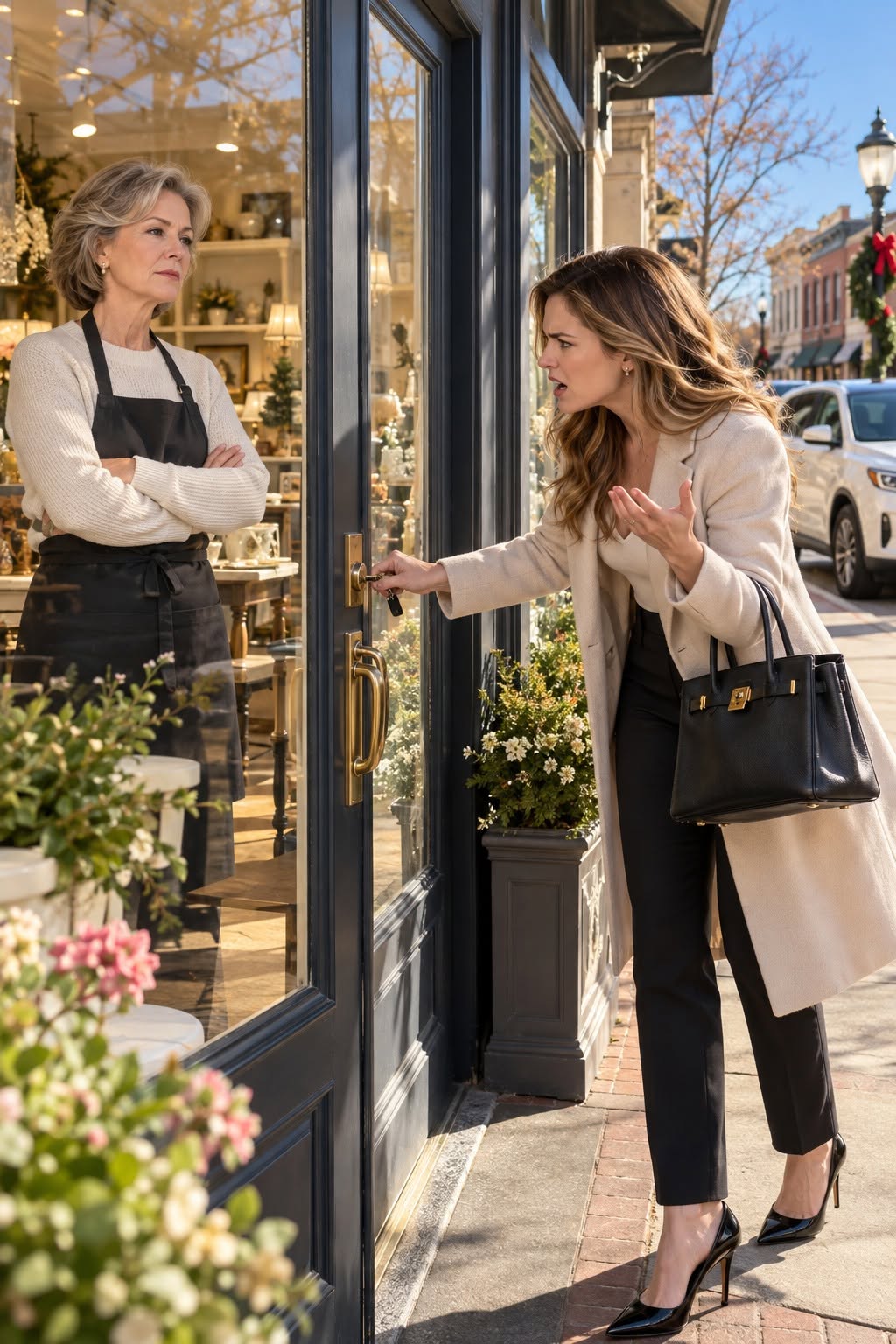
The woman who had walked into that boutique that morning was not the same woman who had gone to bed the night before.
I was still Beth.
I was still a mother.
I still loved my son.
But I was no longer confusing love with surrender.
THE ACCOUNT THAT MADE MY HANDS SHAKE
Daniel arrived with two folders.
One contained the boutique’s financial records.
The other contained transactions I had never seen.
He placed them on my desk.
“I want you to breathe before you read these,” he said.
I looked at him.
“Are they that bad?”
He hesitated.
“They’re worse than I expected.”
I opened the first folder.
There were transfers from the business reserve account.
Some were small.
Some were several thousand dollars.
Some had descriptions that looked legitimate.
Marketing.
Consulting.
Equipment.
Digital services.
But when Daniel traced the receiving companies, they led back to accounts connected to Greg.
My son.
My only son.
The child I had once carried through the emergency room because he had swallowed a toy.
The teenager who used to leave his baseball glove beside my front door.
The young man who had once called me from college at two in the morning because he was homesick and didn’t want his roommates to know.
That same man had quietly taken money from my company.
“How much?” I asked.
Daniel didn’t answer immediately.
“How much, Daniel?”
“Approximately seventy-four thousand dollars that we can currently document.”
I stared at the number.
Seventy-four thousand.
It wasn’t the amount that hurt most.
It was the casualness of it.
The money hadn’t disappeared in one dramatic theft.
It had disappeared in pieces.
Four thousand here.
Six thousand there.
A payment labeled as consulting.
Another labeled as advertising.
Another hidden behind a company name I didn’t recognize.
That was how betrayal worked sometimes.
It didn’t always arrive like a thief breaking a window.
Sometimes it came through the front door.
Sometimes it hugged you.
Sometimes it called you Mom.
Daniel leaned forward.
“There is another issue.”
I looked up.
“The credit application.”
He pushed the document toward me.
I already knew what it contained.
But seeing my name at the bottom made my stomach turn.
Someone had copied my signature.
Someone had written that I was experiencing memory problems.
Someone had described me as increasingly unable to manage complex financial matters.
Someone had been preparing the ground for a future in which my own decisions could be questioned.
I whispered, “Who gave them this information?”
Daniel shook his head.
“We don’t know yet.”
I looked at the document again.
Then I saw the date.
Six weeks earlier.
Six weeks before the dinner.
Six weeks before Greg shouted at me.
Six weeks before I understood what was happening.
And suddenly, several memories returned.
Greg asking whether I had been sleeping well.
Sarah asking whether I sometimes forgot appointments.
Greg telling Clara that I had seemed “confused lately.”
Sarah telling one of the boutique employees that I was “starting to struggle with numbers.”
At the time, I had dismissed all of it.
I thought they were concerned about me.
They weren’t.
They were constructing evidence.
A story.
A story in which I was becoming incapable.
A story in which Greg could eventually step in as the responsible son.
A story in which my assets could slowly become his responsibility.
And perhaps, eventually, his property.
I closed the folder.
“Call Margaret.”
Daniel nodded.
“She already knows.”
I looked at him.
“What?”
“She called me before you did.”
My heart stopped for a moment.
“Why?”
Daniel’s expression changed.
“Because your husband left instructions.”
THE ENVELOPE MICHAEL HID FOR YEARS
Margaret arrived twenty minutes later.
She carried no briefcase.
Only a small leather folder and one sealed envelope.
The moment I saw the handwriting, I knew it was Michael.
I had seen that handwriting on grocery lists.
Birthday cards.
Receipts.
Notes stuck to the refrigerator.
Letters he wrote me when he traveled for work.
My hands began shaking.
“Why didn’t you give me this before?” I asked.
Margaret sat down.
“Because Michael told me not to.”
“When?”
“Seven years ago.”
I looked at her.
“Seven years?”
She nodded.
“He told me there was a possibility that Greg might someday try to take control of the business.”
I felt something tighten in my chest.
“Did Michael know Greg was stealing?”
Margaret lowered her eyes.
“He suspected financial misconduct.”
I looked at the envelope.
“What did he know?”
“Enough to be worried.”
I opened it.
Inside was a letter several pages long.
Michael’s first sentence made my throat close.
“Beth, if you’re reading this, then something happened that I hoped never would.”
I read slowly.
He explained that Greg had worked for him during the final years of Michael’s construction business.
At first, Michael had been proud.
He thought Greg would eventually take over part of the company.
He imagined teaching him everything.
Contracts.
Suppliers.
Payroll.
Negotiations.
He imagined father and son sitting across from each other in an office someday.
But then Michael noticed irregularities.
Checks that didn’t match invoices.
Payments to vendors that did not exist.
Withdrawals that Greg couldn’t explain.
Michael confronted him.
Greg confessed.
Not everything.
But enough.
The amount was more than thirty-one thousand dollars.
Michael had been furious.
But he had also been devastated.
According to the letter, Greg cried.
He apologized.
He promised to repay every dollar.
He begged his father not to tell me.
Michael agreed.
But only because he believed consequences could still teach his son something.
He gave Greg seven years.
Seven years to repay the money.
Seven years to rebuild trust.
Seven years to become the man Michael believed he could become.
He never did.
Instead, Greg learned something much more dangerous.
He learned that his mother would forgive almost anything.
Michael wrote:
“Beth, I know you think protecting Greg is love.”
I stopped reading.
I pressed my fingers against my lips.
Then I continued.
“But protection without accountability eventually becomes permission.”
Tears blurred the page.
Michael had known me too well.
He knew exactly what I would do.
He knew I would defend Greg.
He knew I would tell myself that a mistake did not define my child.
He knew I would pay a bill rather than watch Greg struggle.
He knew I would forgive an apology even when there was no change behind it.
He knew I would keep giving.
And so he had created something I could not easily undo.
A trust.
A safeguard.
A boundary written into law.
I read the final pages.
The boutique could never simply become Greg’s property.
The house could never simply become Greg’s property.
And if Greg tried to seize either through deception, the protections became active.
I stared at Margaret.
“He knew.”
“Yes.”
“He knew this might happen.”
“Yes.”
I looked toward Michael’s photograph.
For four years, I had believed I was alone.
I had believed that when he died, every difficult decision became mine.
But he had left me something more important than money.
He had left me protection.
He had left me a boundary.
He had left me permission to say no.
THE LIE SARAH DIDN’T KNOW SHE WAS LIVING IN
Sarah arrived that afternoon.
She did not come screaming this time.
She walked through the door carrying a handbag in both hands.
Her face was pale.
Her eyes were swollen.
She looked exhausted.
“I didn’t know,” she said.
I didn’t answer.
“I know that sounds impossible.”
“It does.”
She nodded.
“I deserve that.”
She sat down.
For several seconds, neither of us spoke.
Then she said something I hadn’t expected.
“Greg told me you wanted us to take over.”
I looked at her.
“He told me the boutique would eventually be ours.”
I said nothing.
“He told me Michael had always intended for him to inherit it.”
I folded my hands.
“Did you believe him?”
“Yes.”
She looked down.
“I wanted to.”
That answer was honest.
And honesty, even late honesty, sounded different from manipulation.
“Why?” I asked.
“Because I thought I had married into a family that wanted me.”
Her voice cracked.
“I know how awful that sounds after everything I did.”
I looked at her.
“You weren’t treated unfairly because you were my daughter-in-law.”
“I know.”
“You were treated generously.”
“I know.”
“And you abused that generosity.”
Tears rolled down her face.
“I know.”
She wiped them away.
“I thought I was finally getting the life I had always wanted.”
“What life?”
She hesitated.
“A stable one.”
I listened.
“My parents divorced when I was eleven,” she said.
“My mother worked two jobs.”
“My father disappeared.”
“I learned very young that money meant safety.”
She laughed sadly.
“So when Greg told me the house and business would eventually be ours, I thought I had finally found safety.”
“That doesn’t excuse what you did.”
“No.”
She looked directly at me.
“But it explains why I was so desperate to believe him.”
I nodded.
“Explanation isn’t absolution.”
“I know.”
That became the first honest conversation we had ever had.
She told me about every time Greg had reassured her that the business was “basically already his.”
She told me how he had encouraged her to make changes.
How he told her my generation didn’t understand online marketing.
How he had said I would eventually retire.
How he had told her that the SUV was “an early inheritance.”
How he had laughed when she worried that I might object.
“He said you loved me too much to ever throw us out.”
I looked at her.
“That part was true.”
She began crying harder.
“That makes it worse.”
“Yes.”
She nodded.
“I understand.”
Before she left, she stopped at the door.
“Beth?”
“Yes?”
“I am sorry.”
I looked at her.
“I believe that you are sorry.”
She waited.
“But forgiveness will take time.”
“I understand.”
“And trust may never return.”
She nodded.
“That is fair.”
Then she left.
For the first time, I realized something important.
Sometimes the end of a relationship does not require hatred.
Sometimes it requires clarity.
WHAT HAPPENED TO GREG
Greg did not leave immediately.
For two days, he remained in the guest room.
He barely spoke.
He stopped eating with us.
He stopped asking for money.
He spent hours on his phone.
Then, on the third morning, he came downstairs.
“I need to talk to you.”
I was drinking coffee.
“Sit.”
He sat across from me.
He looked like a different man.
Not because his clothes had changed.
Because his certainty had disappeared.
“Dad gave me seven years,” he said.
I nodded.
“I thought he hated me.”
“He didn’t.”
“He trusted me.”
“Yes.”
“I wasted it.”
“Yes.”
He looked at me.
“Why didn’t you tell me?”
“Tell you what?”
“That you knew.”
“I didn’t know until Margaret showed me the letter.”
He looked confused.
“You really didn’t know?”
“No.”
He lowered his head.
“I thought Dad had forgiven me.”
“He had.”
Greg’s eyes filled with tears.
“Then why did he change the trust?”
“Because forgiveness isn’t the same as trust.”
He stared at the table.
I let him sit with that.
After several minutes, he whispered, “I wanted everything.”
I didn’t answer.
“I wanted the house.”
Silence.
“The business.”
Silence.
“I wanted people to look at me and think I had built something.”
I finally spoke.
“You could have built something.”
He looked up.
“You had years.”
“I know.”
“You had a mother who would have helped you.”
“I know.”
“You had a father who would have taught you.”
“I know.”
“So why steal?”
His face crumpled.
“I thought I deserved it.”
That sentence hurt more than the money.
Because it explained everything.
Greg had stopped seeing inheritance as a gift.
He had started seeing it as a debt.
He believed my years of work belonged to him because he was my son.
He believed Michael’s success belonged to him because he was Michael’s son.
He believed my kindness was proof that I owed him.
And when reality didn’t match his expectations, he began manipulating reality.
“I was afraid,” he said.
“Of what?”
“That I’d never become anyone.”
I looked at him.
“You already were someone.”
He shook his head.
“Not enough.”
“You were my son.”
He cried.
“I know.”
“No, Greg.”
I leaned forward.
“You don’t understand.”
He looked at me.
“You were enough before you ever earned a dollar.”
He closed his eyes.
“But you didn’t believe it.”
“No.”
“And neither did I.”
That was the saddest part.
For years, I had believed my job was to make sure my son never experienced failure.
I had protected him from consequences.
I had paid debts.
Covered mistakes.
Provided housing.
Provided transportation.
Provided employment.
Provided excuses.
And every time I removed a consequence, I thought I was helping.
Instead, I was teaching him that someone else would always clean up his choices.
“I can’t fix this for you,” I said.
He nodded.
“I know.”
“You have to repay what you took.”
“I will.”
“You have to face the legal consequences.”
He looked terrified.
“I know.”
“You have to rebuild your life without my money.”
He swallowed.
“I know.”
“And if you ever become successful, it has to be because you built something honestly.”
He nodded.
“I want to.”
I believed him.
But believing someone wants to change is not the same as believing they have changed.
So I said only one thing.
“Then start.”