The moment my daughter’s fiancé looked me in the eye and said,
“If you don’t like my mother’s comments, pay the bill and leave,”
I knew something inside my family had already broken long before that dinner.
What I didn’t know was that the house they were fighting over had been hiding a secret for nearly twenty years.
And when that secret finally came out, it didn’t just destroy their plans.
It changed everything I thought I knew about my husband, my daughter, and the life I had spent decades protecting.
I was sixty-one years old that Friday night.
For most of my adult life, I had believed family harmony depended on the person mature enough to stay quiet.
Usually, that person was me.
After my husband, David, died six years earlier, I became even more determined to hold our small family together.
Natalie was our only child.
She was twenty-nine now, engaged to Preston Hale, a thirty-two-year-old commercial real estate broker with perfect teeth, expensive watches, and the kind of confidence that made every sentence sound like a conclusion.
At first, I liked him.
He remembered birthdays.
He carried groceries without being asked.
He called me “Mrs.
Bennett” until I told him to call me Claire.
Then he started spending more time at my house.
And slowly, I began noticing something.
Preston never looked at my home like a guest.
He looked at it like a project.
The house sat on almost an acre in a quiet Connecticut suburb outside Stamford, surrounded by mature maple trees and a stone wall David had repaired by hand.
It had four bedrooms, a wide dining room, a study, a large backyard, and a kitchen David and I remodeled in 2003.
It wasn’t a mansion.
But the neighborhood had become expensive.
Very expensive.
One afternoon, nearly a year before the wedding, I heard Natalie and Preston talking at my kitchen island.
They thought I was outside watering the hydrangeas.
I had stepped inside for my gardening gloves when Preston said, “If we open this wall, the whole downstairs changes.”
I froze in the hallway.
Natalie laughed.
“I know.
And Mom barely uses the dining room anyway.”
“What about the study?”
“Nursery.”
He paused.
“Eventually.”
Eventually.
That word stayed with me.
Neither of them had ever asked whether I wanted to sell.
Neither had asked whether I wanted to move.
Neither had even asked what my plans were.
I told myself they were simply imagining things.
Young couples dreamed.
People talked.
No reason to create conflict.
That was what I always told myself.
Then came dinner.
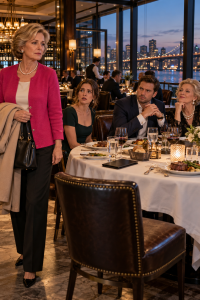
Natalie had chosen an upscale steakhouse overlooking the river.
She said she wanted me to spend more time with Preston’s mother, Deborah, before the wedding.
“We’re going to be family,” Natalie told me.
Within ten minutes, Deborah made it clear what kind of family she imagined.
She looked at my bright raspberry cardigan and smiled.
“That’s a confident color.”
“I like it,” I said.
Natalie stared at her menu.
Later Deborah asked what I did with my days now that I lived alone.
Then she mentioned my age.
Then she asked how often I called Natalie.
Finally, she arrived at my house.
“Four bedrooms, right?”
“Yes.”
“For one person?”
“Yes.”
She lifted her wineglass.
“Seems like an awful lot of space.”
Preston looked down.
Natalie said nothing.
My stomach tightened.
Deborah continued.
“I suppose some mothers have trouble knowing when their children need room to build lives of their own.”
That was when I put my fork down.
Natalie immediately sighed.
“Mom, she doesn’t mean anything by it.”
I stared at my daughter.
She knew exactly what Deborah meant.
More importantly, she expected me to absorb it quietly.
Just like always.
Before I could answer, Preston leaned forward.
“If you don’t like my mother’s comments, pay the bill and leave.”
The table went silent.
I looked at Natalie.
I waited.
She could have said one sentence.
Don’t speak to my mother that way.
She didn’t.
So I smiled.
“That sounds reasonable.”
I raised my hand.
“I’ll take the whole check.”
Natalie looked startled.
“Mom, seriously?”
“Yes.”
When the waiter brought the black folder, I slid in my credit card.
I paid for four steaks, two bottles of wine, appetizers, dessert Deborah had ordered before our entrées arrived, and a generous tip.
Then I stood.
No tears.
No shouting.
I slipped on my coat, picked up my purse, and walked away.
Outside, the cold evening air felt cleaner than anything I had breathed in months.
But during the drive home, my anger changed into clarity.
Natalie had once needed temporary help with a car payment.
That had been three years ago.
I was still paying it.
Then there was Preston’s storage unit.
“A couple of months,” Natalie had said.
My card had been charged for eighteen months.
I realized something uncomfortable.
My generosity had stopped being appreciated because it had stopped being considered optional.
When I got home, I opened my laptop.
I removed my payment method from Preston’s storage account.
The next morning, I stopped the automatic transfer for Natalie’s car.
At 7:40, she called.
“Mom, what was last night about?”
“You told me to leave.”
“That’s not what I meant.”
“I understand.”
Silence.
She waited for an apology.
I didn’t give one.
“Have a good morning, Natalie.”
Three days later, Preston showed up at my house.
He held his phone like evidence.
“Something changed with the storage account.”
“Yes.”
“And Natalie’s car?”
“Yes.”
He stared at me.
“You actually changed them?”
“I did.”
“Over one dinner?”
“No.”
I looked straight at him.
“Dinner just made me notice what I had stopped noticing.”
His mouth tightened.
He walked away.
After he drove off, I stood on my porch staring at my house.
I remembered the nursery.
The removed wall.
The plans they had made.
That morning, I called a real estate attorney named Margaret Ellis.
Not to sell.
To protect myself.
Margaret arrived at my house two days later carrying a leather briefcase and a yellow legal pad.
She was around my age, with silver hair and the calm voice of someone who had spent thirty years listening to people discover how complicated their families really were.
I explained everything.
The dinner.
The bills.
The conversations about the house.
Margaret asked one question.
“Do you have an updated will?”
“Yes.”
“Trust?”
“No.”
“Any agreement promising this property to Natalie?”
“Absolutely not.”
She made a note.
“Then nobody has a claim while you’re alive.”
I nodded.
“But I want that made completely clear.”
Margaret studied me.
“Are you thinking of changing your estate plan?”
“I think I’m realizing I never really had one.”
We spent almost two hours discussing options.
A living trust.
Healthcare directives.
Power of attorney.
Restrictions preventing anyone from selling the house while I remained alive.
By the time she closed her folder, I felt lighter.
Then she asked something unexpected.
“Did your husband leave any separate estate documents?”
“David?”
“Yes.”
“No.
Everything came to me.”
“Was the house always jointly owned?”
I hesitated.
“I assumed so.”
Margaret frowned.
“You assumed?”
That question bothered me.
I walked upstairs to the filing cabinet where David had kept financial records.
Most of it was ordinary.
Insurance.
Taxes.
Old mortgage statements.
But in the back of one drawer, I found a thin blue folder I had never noticed.
Inside was a deed from 1998.
And one name appeared on it.
David Bennett.
Not David and Claire Bennett.
Just David.
I stared at the page.
That couldn’t be right.
David had always called it “our house.”
We had paid the mortgage together.
We had raised Natalie there.
I carried the folder downstairs.
Margaret read the deed twice.
“Was ownership ever transferred later?”
“I don’t know.”
She flipped through the remaining papers.
Then she stopped.
“What is this?”
It was an envelope.
Yellowed around the edges.
My name was written across the front in David’s handwriting.
CLAIRE — ONLY IF SOMETHING HAPPENS WITH THE HOUSE.
My hands went cold.
I had never seen it.
Margaret looked at me.
“You should open it.”
I couldn’t.
Not yet.
Six years after David’s death, seeing his handwriting felt like hearing his voice behind a closed door.
I placed the envelope on the kitchen table.
Then my phone rang.
Natalie.
I almost ignored it.
Instead, I answered.
“Mom, are you talking to a lawyer?”
My eyes snapped toward Margaret.
“How do you know that?”
“Preston saw a car here.”
Of course he had.
I walked toward the window.
“Why does it matter?”
“Because this is getting ridiculous.”
“What is?”
“You know exactly what.”
“No, Natalie.
I don’t.”
She exhaled sharply.
“We’re getting married in four months.
Everything is stressful.
Preston’s storage bill jumped.
I have the car.
And now you’re talking to attorneys like we’re trying to steal from you.”
I said nothing.
Then she made a mistake.
She said,
“Nobody is trying to take the house away from you before you’re ready.”
Before you’re ready.
My stomach dropped.
“Natalie.”
“What?”
“What exactly do you think happens to my house?”
Silence.
“Mom—”
“Answer me.”
Another pause.
Then she said quietly, “Eventually it comes to me.”
There it was.
Not maybe.
Not if.
It comes to me.
“Who told you that?”
“Dad.”
The room seemed to tilt.
My eyes went to the unopened envelope.
“Your father told you that?”
“Yes.”
“When?”
“A long time ago.”
“How long?”
She became defensive.
“I don’t remember.”
“Natalie.”
“I was in college.”
My chest tightened.
David had died when Natalie was twenty-three.
“When you were in college, your father told you this house would become yours?”
“He said I’d always have it.”
“And Preston knows?”
“Of course he knows.”
Of course.
Suddenly the conversations made sense.
The wall.
The nursery.
Deborah’s comments.
The entitlement.
They hadn’t been dreaming.
They believed they were waiting.
I ended the call.
Margaret was watching me.
“What did she say?”
I pointed at the envelope.
“My husband told her the house would eventually be hers.”
Margaret looked at the handwriting again.
“Open it.”
This time, I did.
The paper inside shook in my hands.
David’s letter began simply.
Claire, if you’re reading this, something has gone wrong with the house, or with Natalie.
Possibly both.
I stopped breathing.
Margaret leaned forward.
I continued.
David explained that the house had originally been purchased with money inherited from his father.
He had kept it in his name because of a legal dispute involving another family member.
But that wasn’t the secret.
The next paragraph was.
Natalie knows something about this property that I have never told you.
I made a mistake telling her before I told you.
I felt dizzy.
The letter continued.
Years earlier, David had told Natalie that the house would someday be hers.
But he regretted it.
Not because he didn’t love her.
Because of something that happened afterward.
During Natalie’s senior year of college, David discovered she had secretly taken out more than $40,000 in private loans.
Not student loans.
Personal loans.
Credit cards.
Money borrowed from friends.
David had paid several of them off.
He had told me none of it.
My eyes burned.
I read on.
Natalie promised him she would never hide financial problems again.
Two years later, he discovered she had done exactly that.
This time, Preston was involved.
They had invested in what David called
“a speculative property arrangement.”
I looked at Margaret.
She looked concerned.
I kept reading.
David wrote that he had confronted Preston.
Preston insisted the investment would eventually make them wealthy.
David didn’t trust him.
Then came the sentence that changed everything.
I told Natalie the house would be hers because I thought security might stop her from chasing dangerous promises.
Instead, Preston began treating the promise like collateral.
Collateral.
My hands started trembling.
Margaret reached across the table.
“Claire, keep going.”
The final paragraph was shorter.
If Natalie ever begins planning around this house while you are still living in it, do not ignore it.
I know you.
You will want to keep peace.
Please don’t.
Tears blurred the words.
Then the last line.
The house was never meant to cost you your dignity.
I pressed the page to my chest.
For six years, I had missed David.
That morning, for the first time, I was furious with him.
He had known.
He had hidden it from me.
He had tried to fix everything quietly.
Just like I had.
And by doing that, both of us had helped create the same problem.
Margaret gave me a few minutes.
Then she said, “There’s something else.”
She had been examining the deed.
“What?”
“This property has an unusual restriction attached to it.”
She showed me a reference number.
“I need to pull the older records.”
“What kind of restriction?”
“I don’t know yet.”
For the next week, nobody in my family knew what I knew.
Natalie called twice.
Preston texted once.
Deborah sent me a message saying she hoped “everyone could move forward maturely.”
I didn’t respond.
Margaret eventually called me back.
Her voice sounded different.
“Claire, I found the original property agreement.”
“And?”
“This house came from David’s father?”
“Yes.”
“Not exactly.”
I sat down.
“What do you mean?”
“The land belonged to David’s mother.”
I frowned.
David rarely talked about her.
She had died before Natalie was born.
Margaret continued.
“Her name was Eleanor Bennett.
Before she died, she placed the property in a private family trust.”
“So David didn’t own it?”
“He controlled it.”
My pulse quickened.
“What’s the difference?”
“A significant one.”
Margaret took a breath.
“The trust had conditions.”
One condition allowed David to live there.
Another allowed his spouse to remain there for life.
That was me.
But inheritance after my death was not automatic.
The trust named another beneficiary.
“Who?”
Margaret hesitated.
“Not Natalie.”
I gripped the phone.
“Then who?”
“A woman named Rebecca Dawson.”
I had never heard the name.
Margaret said, “Claire, according to the original documents, Rebecca Dawson is David’s daughter.”
Everything inside me stopped.
“That’s impossible.”
“The trust identifies her as Eleanor Bennett’s granddaughter and David Bennett’s biological child.”
“No.”
“Claire—”
“We were married thirty-eight years.”
“I understand.”
“David never had another daughter.”
But even as I said it, something old surfaced in my memory.
A photograph.
David at nineteen.
A girl beside him.
He once told me she was a high school friend.
I had never asked her name.
Margaret arranged a meeting.
Rebecca Dawson was fifty-seven.
Four years younger than me.
When she walked into Margaret’s office, I nearly cried.
She had David’s eyes.
Not similar eyes.
His eyes.
Same hazel color.
Same crease at the corners.
She sat across from me nervously.
“I didn’t know whether I should come.”
I couldn’t stop staring.
“You’re David’s daughter?”
She nodded.
“He was nineteen.”
Her mother had been seventeen.
Their families separated them.
Rebecca was raised by her mother and stepfather.
David had contact with her occasionally as an adult, but not often.
“Why didn’t he tell me?”
“I asked him that once.”
“What did he say?”
Rebecca looked down.
“He said he was ashamed he had waited so long that he no longer knew how to begin.”

That sounded exactly like David.
He could repair anything except the conversation he feared having.
“Did Natalie know about you?”
Rebecca’s expression changed.
“I thought she did.”
My throat tightened.
“What?”
“She contacted me after David died.”
I stared at her.
“When?”
“About five years ago.”
“Why?”
“She asked me to sign something.”
Margaret slowly turned toward Rebecca.
“What?”
“A waiver.”
Rebecca opened her purse and removed folded copies.
“She said it was paperwork related to David’s estate.
She told me the house had always been intended for her, and that signing would prevent complications.”
“Did you sign it?”
“No.”
“Why not?”
“Because David once told me never to sign anything involving that property without an attorney.”
The room became silent.
Natalie knew.
She knew about Rebecca.
She knew there might be another claim to the house.
And she had never told me.
That evening, I called my daughter.
“Come over tomorrow.”
She sounded relieved.
“Can Preston come?”
“No.”
“Mom—”
“Just you.”
She arrived at eleven.
The moment she walked into the kitchen, she saw the blue folder.
Her face changed.
That was all the confirmation I needed.
“You know this folder.”
She sat slowly.
“Where did you find it?”
“Your father’s files.”
She looked pale.
I placed David’s letter on the table.
Then Rebecca’s unsigned waiver.
Natalie stared at it.
I asked, “Who is Rebecca Dawson?”
Her eyes filled with tears.
“Mom.”
“Who is she?”
“You already know.”
“How long have you known?”
“Since Dad got sick.”
My heart broke all over again.
David had died from pancreatic cancer eight months after his diagnosis.
“You knew while he was dying?”
She nodded.
“Why didn’t you tell me?”
“He asked me not to.”
I laughed once, bitterly.
“And after he died?”
She began crying.
“I didn’t know how.”
“Apparently you knew how to contact Rebecca and ask her to sign away her rights.”
Natalie covered her face.
“Preston said we needed to protect everything.”
There it was again.
Preston.
Always Preston.
“What exactly did he tell you?”
“That if Rebecca appeared later, everything could get tied up.
The house, the trust, all of it.”
“So you tried to get rid of her claim.”
“I was scared.”
“You were planning renovations to a house that legally may not even become yours.”
Natalie wiped her tears.
“Dad promised me.”
“Your father made a mistake.”
Her expression hardened.
“You don’t understand.”
“Then explain.”
She stood suddenly.
“We have debt.”
“How much?”
Silence.
“Natalie.”
She whispered, “A lot.”
“How much?”
“Almost three hundred thousand.”
I felt the blood leave my face.
“What?”
Preston’s property deals had failed.
They had borrowed money privately.
Refinanced vehicles.
Used credit cards.
And then, three months before our steakhouse dinner, Preston had borrowed against his expectation of a future inheritance.
My house.
“He used my house as part of a financial statement?”
Natalie shook her head quickly.
“Not exactly.”
“What does not exactly mean?”
“He listed expected family assets.”
I stood.
“You need to leave.”
“Mom—”
“Leave.”
She began sobbing.
“What are we supposed to do?”
I looked at my daughter—the little girl I once carried upstairs when she fell asleep watching Disney movies, the teenager whose prom dress I had hemmed by hand, the young woman I had helped every time she called.
And I finally understood the difference between helping someone and preventing them from ever facing consequences.
“I don’t know,” I said.
“But you are not going to solve it by burying me early.”
She flinched.
I hated saying it.
But I meant it.
The wedding was postponed two weeks later.
Not because of me.
Because Preston’s business collapsed.
One of his partners sued him.
Then another creditor came forward.
Deborah called me furious.
“You’ve destroyed their future.”
“No,” I said.
“Their debts did.”
“You could help them.”
“I have.”
“Then help again.”
“No.”
She hung up.
Three months passed.
Natalie moved into a small apartment.
Preston moved back with Deborah.
Then Natalie did something I never expected.
She ended the engagement.
Not dramatically.
No screaming.
No revenge.
She simply called me one Sunday morning and said, “I gave the ring back.”
I sat silently.
“I kept thinking about Dad,” she said.
“And Rebecca.
And the waiver.
And dinner.”
Her voice cracked.
“I became someone I don’t like.”
That sentence mattered more to me than any apology.
But the story wasn’t over.
Because Margaret had finally resolved the trust.
According to Eleanor Bennett’s original instructions, Rebecca had a claim after my death.
But there was another clause.
If Rebecca declined the property, the house would pass not to Natalie personally—
but to
any living descendants of David Bennett in equal shares.
At the time the trust was written, nobody imagined what that wording would eventually mean.
Rebecca came to my house one afternoon.
We sat at the kitchen island.
The same one.
She ran her fingertips across the wood.
“Dad described this kitchen.”
I smiled sadly.
“He remodeled it twice.”
“He said you hated the first cabinets.”
I laughed.
“They were orange.”
Rebecca laughed too.
For one strange second, it felt like David was in the room.
Then she said, “I don’t want the house.”
I looked at her.
“You’re entitled to it.”
“I have a home.”
She paused.
“And I don’t want my first real connection to you to be a fight over something after you die.”
My eyes filled.
“Then what do you want?”
She smiled.
“Maybe coffee sometimes.”
So Rebecca formally declined her future claim.
Margaret prepared the paperwork.
I assumed that meant Natalie would eventually inherit everything.
I was wrong.
There was one final surprise.
Margaret called us into her office.
Natalie came too.
She and I were speaking again, carefully.
Not pretending.
Building.
Margaret opened the trust.
“Because Rebecca declined her claim, the property transfers under the descendant clause.”
Natalie nodded.
“So eventually it comes to me.”
Margaret looked at her.
“Not entirely.”
Natalie frowned.
“What?”
Margaret turned one page.
“Your father had two daughters.”
Natalie looked at Rebecca.
“Yes.”
“Rebecca has a child.”
Rebecca suddenly smiled.
Natalie stared.
“A child?”
“A son,” Rebecca said.
“His name is Aaron.”
Aaron was thirty-three.
Almost Preston’s age.
He was married.
His wife was pregnant.
The trust meant that after my death, Natalie and Aaron would ultimately share the property interest according to the descendant provisions.
Natalie sat speechless.
Then something extraordinary happened.
She laughed.
Not angrily.
Not bitterly.
She simply leaned back and laughed until tears came.
“All that planning,” she whispered.
“The nursery.”
“The wall.”
“Preston measured the backyard.”
She covered her eyes.
“All that time, we were acting like we owned something we didn’t even understand.”
I reached across the table.
She took my hand.
A year later, I made a decision nobody expected.
I didn’t sell the house.
I didn’t leave it untouched like a museum.
I used part of my savings to convert the upstairs into a comfortable separate suite.
Rebecca visited often.
Aaron and his wife brought their baby girl.
Natalie started rebuilding her finances.
She got a smaller car.
Paid her own bills.
Moved into a modest condo.
And slowly, our relationship became something it had never really been before.
Honest.
One evening, Natalie and I sat in the backyard watching Aaron’s daughter chase fireflies.
She was two years old by then.
Natalie looked at the house.
“Do you know what’s funny?”
“What?”
“I don’t want it anymore.”
I smiled.
“Good.”
She laughed.
“I knew you’d say that.”
Then she became quiet.
“I spent years thinking Dad’s promise meant he loved me.”
I looked at her.
“And when I thought you might change everything, it felt like you were taking that love away.”
I squeezed her hand.
“A house is a terrible place to store proof that somebody loved you.”
She nodded.
After a moment, she asked, “Do you ever wish you never found the letter?”
I looked toward the kitchen window.
For a long time, I had thought David’s letter had exposed the worst thing about our family.
His secrecy.
Natalie’s entitlement.
Preston’s greed.
My habit of staying quiet.
But eventually I understood something else.
The letter had not destroyed our family.
The silence had nearly destroyed us.
The letter only ended it.
Two summers later, I invited everyone to dinner.
Natalie.
Rebecca.
Aaron.
His wife.
Their daughter.
Even Margaret came.
We ate at the long dining room table Deborah once suggested was wasted space for one person.
Halfway through dessert, the doorbell rang.
Natalie offered to answer it.
She returned holding an envelope.
“Mom, this is for you.”
There was no return address.
Inside was a short note.
It was from Preston.
He wrote that he was living in Arizona now.
Working for a construction company.
Paying off debt.
He didn’t ask for forgiveness.
He didn’t blame me.
He wrote only one sentence about the past.
I thought your house was our future because I was too afraid to build one myself.
I folded the note.
Natalie asked, “What did he say?”
I handed it to her.
She read it.
Then she quietly folded it again.
“Do you want me to throw it away?”
I looked around the table.
At Rebecca laughing with Aaron.
At the little girl feeding strawberries to the dog.
At Natalie sitting beside me.
At the house I once feared people valued more than they valued me.
“No,” I said.
“Put it in the blue folder.”
Natalie smiled.
That folder eventually became something else.
I added David’s letter.
The trust documents.
Rebecca’s waiver.
Preston’s note.
And one letter of my own.
Years later, when my granddaughter—yes, I call Aaron’s daughter my granddaughter—asked why the folder was locked in my desk, I told her she could read it when she was older.
“What’s inside?” she asked.
I thought about that steakhouse.
About Preston telling me to pay the bill and leave.
About Natalie remaining silent.
About the night I came home and finally stopped paying for everybody else’s choices.
I thought about David’s secrets.
Rebecca’s existence.
The house.
The debts.
The plans people had made for my life without including me.
Then I looked at the little girl.
“A family story.”
“Is it happy?”
I smiled.
“Eventually.”
Years earlier, I thought peace meant staying quiet.
I thought love meant helping.
I thought generosity meant never keeping score.
I had been wrong about all three.
Peace without honesty becomes resentment.
Help without boundaries becomes dependence.
And generosity without respect eventually becomes expectation.
The most important thing I changed after that dinner wasn’t a car payment, a storage account, a will, or even the future of a house.
It was the rule I had lived by for most of my life.
I stopped believing I had to accept disrespect simply because it came from someone I loved.
And strangely enough, once I stopped being afraid of losing my family, I finally discovered which parts of my family were worth keeping.
The house is still standing.
The kitchen wall is still there.
My study never became the nursery Preston planned.
But there are children’s toys in that room now.
Photographs of Rebecca hang beside photographs of Natalie.
David’s picture remains on the mantel.
I still talk to him sometimes.
Mostly when I’m angry.
Sometimes when I miss him.
Once, standing alone in the kitchen, I looked at his photograph and said, “You should have told me.”
Of course he didn’t answer.
But I imagined what he would have said.
I know.
And I imagined what I would have told him.
“Keeping the peace nearly cost us everything.”
Then I smiled.
Because in the end, the house didn’t belong to Preston.
It didn’t belong to Deborah.
It didn’t even belong to Natalie, Rebecca, Aaron, or some future grandchild.
Not while I was alive.
For the first time in years, I understood that completely.
It was my home.
And the future inside it would be decided by the people who actually lived long enough to love one another properly—not by the people who had already begun dividing rooms before I was gone.