Then we started talking about David.
She knew things about him I had never known.
I knew things about him she had never known.
One afternoon, she asked,
“What was he like when he was angry?”
I laughed.
“He went silent.”
Rebecca smiled.
“That sounds familiar.”
“He also hated being wrong.”
“Very familiar.”
We laughed.
Then she became quiet.
“Did he love you?”
The question caught me off guard.
“Yes.”
“Did he love my mother?”
“I don’t know.”
Rebecca nodded.
“I think I spent years being angry because I thought one love meant the other one had to be fake.”
I looked at her.
“People can love imperfectly.”
She looked toward the window.
“That’s a painful answer.”
“It is.”
“Do you hate him?”
I thought about the letter.
The secret.
The years.
The trust.
Natalie.
Then I shook my head.
“No.”
“Why?”
“Because hating him wouldn’t change what happened.”
Rebecca nodded slowly.
“I don’t hate him either.”
She paused.
“I just wish he had been brave sooner.”
“So do I.”
For the first time, we held hands.
Not because everything was healed.
But because two women who had been hurt by the same man’s silence had finally found each other.
PART NINE — THE SECOND SURPRISE
Margaret eventually resolved the trust.
According to Eleanor Bennett’s original instructions, Rebecca had a future claim to the property.
But there was another clause.
If Rebecca declined the property, it would pass under the descendant provisions.
I assumed that meant Natalie would eventually inherit everything.
I was wrong.
Margaret called us into her office.
Natalie came.
Rebecca came.
I sat between them.
Margaret opened the trust document.
“Because Rebecca has chosen not to claim the property directly, we have to follow the descendant clause.”
Natalie nodded.
“So eventually it comes to me?”
Margaret looked at her.
“Not entirely.”
Natalie frowned.
“What?”
“Your father had two daughters.”
Natalie looked at Rebecca.
“Yes.”
“Rebecca has a child.”
Natalie’s mouth fell open.
“A child?”
Rebecca smiled.
“A son.”
“What’s his name?”
“Aaron.”
Aaron was thirty-three.
He was married.
And his wife was pregnant.
The legal structure meant that after my lifetime, the property interests would ultimately be divided according to the trust’s descendant provisions.
Natalie sat there in silence.
Then she started laughing.
Not because it was funny.
Because suddenly the absurdity of everything became impossible to ignore.
“All that planning,” she whispered.
“The nursery.”
“The wall.”
“Preston measured the backyard.”
She covered her eyes.
“All that time, we were acting like we owned something we didn’t even understand.”
I reached across the table.
She took my hand.
For once, neither of us said anything.
PART TEN — THE HOUSE BECOMES A HOME AGAIN
A year later, I made a decision nobody expected.
I didn’t sell the house.
I didn’t abandon it.
I didn’t turn it into a monument to the past.
Instead, I changed it.
Not for Preston.
Not for Deborah.
Not because Natalie expected it.
Because I wanted to.
I renovated the upstairs.
I created a comfortable separate suite.
I repaired the old floors.
I repainted the study.
I replaced the curtains David had hated.
I kept the kitchen exactly where it was.
The orange cabinets were still gone.
Rebecca visited often.
Aaron and his wife came with their baby girl.
Natalie started rebuilding her finances.
She bought a smaller car.
She paid her own bills.
She moved into a modest condo.
And slowly, our relationship became something it had never really been before.
Honest.
One evening, Natalie and I sat in the backyard.
Aaron’s daughter was running through the grass.
She was two years old.
Natalie watched her for a long time.
Then she looked at the house.
“Do you know what’s funny?”
“What?”
“I don’t want it anymore.”
I smiled.
“Good.”
She laughed.
“I knew you’d say that.”
Then she became quiet.
“I spent years thinking Dad’s promise meant he loved me.”
I looked at her.
“And when I thought you might change everything, it felt like you were taking that love away.”
I squeezed her hand.
“A house is a terrible place to store proof that somebody loved you.”
She nodded.
Then she asked,
“Do you ever wish you never found the letter?”
I looked toward the kitchen window.
For a long time, I had believed the letter had exposed the worst things about our family.
David’s secrecy.
Natalie’s entitlement.
Preston’s greed.
My own habit of staying silent.
But eventually I understood something different.
The letter hadn’t destroyed our family.
The silence had nearly destroyed us.
The letter simply ended the silence.
PART ELEVEN — THE DINNER
Two summers later, I invited everyone to dinner.
Natalie.
Rebecca.
Aaron.
Aaron’s wife.
Their daughter.
Margaret.
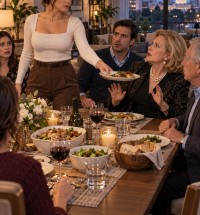
We sat around the long dining room table.
The same table Deborah had once implied was wasted space.
There were flowers in the center.
A roast chicken.
Mashed potatoes.
Fresh bread.
A pie Natalie had baked herself.
The little girl was more interested in feeding pieces of strawberry to the dog than eating dinner.
At one point, Rebecca laughed so loudly that everyone turned toward her.
“What?”
Aaron asked.
“I was remembering your grandfather.”
“What did he do?”
“He once spent three hours repairing a chair that was worth twenty dollars.”
I laughed.
“He refused to admit it was cheaper to buy a new one.”
Natalie smiled.
“That sounds like Dad.”
For a moment, the room felt full of him.
Not the secretive David.
Not the dying David.
Not the man from the letter.
Just Dad.
Then the doorbell rang.
Natalie stood.
“I’ll get it.”
She returned holding an envelope.
“Mom, this is for you.”
There was no return address.
I opened it.
It was from Preston.
He was living in Arizona.
He was working for a construction company.
He was paying off his debts.
He didn’t ask for forgiveness.
He didn’t blame me.
He didn’t ask about the house.
He wrote one sentence about the past.
I thought your house was our future because I was too afraid to build one myself.
I folded the letter.
Natalie watched me.
“Do you want me to throw it away?”
I looked around the table.
Rebecca was laughing with Aaron.
The little girl was trying to convince the dog that another strawberry was necessary.
Natalie was sitting beside me.
The house I had once feared people valued more than they valued me was full of people who were finally learning how to value one another.
“No,” I said.
“Put it in the blue folder.”
Natalie smiled.
PART TWELVE — THE BLUE FOLDER
The blue folder eventually became something different.
I added David’s original letter.
The trust documents.
Rebecca’s unsigned waiver.
The property records.
Preston’s note.
And one letter of my own.
I didn’t write it for Natalie.
I didn’t write it for Rebecca.
I wrote it for the little girl who would someday inherit a family history she couldn’t yet understand.
Years later, when she was old enough to ask questions, she found me at the kitchen table.
“Grandma?”
“Yes?”
“What’s inside that blue folder?”
I smiled.
“A family story.”
“Is it secret?”
“Not anymore.”
“Is it sad?”
“Some of it.”
“Is it scary?”
“Sometimes.”
She thought about that.
“Does it have a happy ending?”
I looked around the kitchen.
At the photographs.
At David’s picture on the mantel.
At the photographs of Rebecca and Natalie.
At the toys scattered across the floor.
Then I smiled.
“Eventually.”
She laughed.
“That’s not an answer.”
“It is the most honest answer I know.”
She climbed into the chair beside me.
“Tell me.”
I opened the folder.
And I realized that the story wasn’t really about a house.
It wasn’t even about money.
It was about what happens when people confuse love with ownership.
It was about what happens when parents make promises they don’t fully understand.
It was about what happens when children grow up believing inheritance is the same thing as security.
It was about what happens when someone becomes so afraid of conflict that silence begins making decisions for them.
And it was about what happens when one person finally says,
“No.”
PART THIRTEEN — WHAT I FINALLY LEARNED
For most of my life, I thought peace meant staying quiet.
I thought love meant helping.
I thought generosity meant never keeping score.
I was wrong.
Peace without honesty becomes resentment.
Help without boundaries becomes dependence.
And generosity without respect eventually becomes expectation.
The most important thing I changed after that dinner wasn’t a car payment.
It wasn’t a storage account.
It wasn’t a will.
It wasn’t even the future of the house.
It was the rule I had lived by for most of my life.
I stopped believing I had to accept disrespect simply because it came from someone I loved.
That didn’t make me cruel.
It didn’t make me selfish.
It didn’t make me less of a mother.
It simply meant I finally understood that love and boundaries can exist in the same room.
Natalie eventually understood that too.
Rebecca understood it in a different way.
Aaron grew up watching two branches of a family slowly learn how to speak to each other.
And I learned something I wish I had understood when I was thirty.
You can love someone without financing every decision they make.
You can forgive someone without giving them unlimited access to hurt you again.
You can protect your family without protecting every bad choice made by your family.
And sometimes saying no is the most loving thing you can do.
PART FOURTEEN — THE HOUSE
The house is still standing.
The kitchen wall is still there.
My study never became the nursery Preston planned.
But there are children’s toys in that room now.
Photographs of Rebecca hang beside photographs of Natalie.
Aaron’s daughter has her own little drawer.
David’s photograph remains on the mantel.
Sometimes I still talk to him.
Mostly when I’m angry.
Sometimes when I miss him.
Once, I stood alone in the kitchen late at night.
The house was quiet.
The refrigerator hummed.
The old clock above the doorway ticked softly.
I looked at David’s photograph.
“You should have told me,” I said.
Of course he didn’t answer.
But I imagined what he would have said.
I know.
And then I imagined what I would have told him.
“Keeping the peace nearly cost us everything.”
I stood there for a long time.
Then I smiled.
Because eventually I understood something that had taken me sixty-one years to learn.
The house wasn’t the inheritance.
The house was the lesson.
It taught me that walls don’t belong to memories.
They belong to the people living inside them.
A dining room isn’t wasted space because one person lives there.
A study isn’t a future nursery because someone else imagines it that way.
A kitchen isn’t an inheritance.
A backyard isn’t collateral.
A house is a home only when the people inside it feel safe enough to be themselves.
And for the first time in years, I felt completely at home in mine.
THE FINAL LETTER
I kept David’s original letter.
I kept it because it hurt.
And because it mattered.
I kept it because there are some truths you wish had arrived earlier.
But there are also truths that arrive exactly when you finally have the courage to face them.
The letter had been hidden for twenty years.
Twenty years of secrets.
Twenty years of assumptions.
Twenty years of promises.
Twenty years of people believing they knew what would happen next.
And yet, when I finally opened it, the future wasn’t what anyone had expected.
Natalie didn’t get the immediate inheritance she thought she had been promised.
Rebecca didn’t take my home.
Aaron didn’t demand anything.
Preston didn’t get the property he had mentally spent.
Deborah didn’t get to decide what happened to me.
And I didn’t lose my family.
I lost the version of my family that depended on my silence.
That was different.
And, strangely enough, it was better.
Because the family that remained had to be built on something stronger.
Truth.
Respect.
Boundaries.
Choice.
Love that wasn’t measured in dollars.
Love that wasn’t attached to deeds.
Love that didn’t require someone else to disappear before somebody could finally have what they wanted.
YEARS LATER
One autumn afternoon, my granddaughter found me sitting on the porch.
The maple trees were turning gold.
She climbed the steps and sat beside me.
“Grandma?”
“Yes?”
“Why didn’t you sell the house?”
I looked at the yard.
“Because I didn’t want to run away from what happened.”
She frowned.
“What do you mean?”
“I thought if I sold the house, everything would become easier.”
“Would it?”
“Maybe.”
“Then why didn’t you?”
I smiled.
“Because sometimes leaving is easier than healing.”
She thought about that.
“Did you heal?”
I looked through the window.
Natalie was in the kitchen with Rebecca.
Aaron was outside fixing a loose fence board.
His wife was helping their daughter with a puzzle.
Margaret was sitting at the table drinking tea.
The house was noisy.
The way homes are supposed to be.
“Yes,” I said.
“But not by forgetting.”
“Then how?”
“By telling the truth.”
She leaned against me.
I put my arm around her.
And we watched the sun lower behind the trees.
I thought about that dinner.
The black folder.
The credit card.
Preston’s words.
The drive home.
The blue folder.
The letter.
Rebecca’s eyes.
Natalie’s confession.
The debts.
The wedding that never happened.
The trust.
The little girl running through the grass.
All of it had started because one man told me to pay the bill and leave.
At the time, I thought he was humiliating me.
Years later, I realized he had accidentally given me something far more valuable.
He gave me the moment when I finally stopped pretending.
THE END
My name is Claire Bennett.
I am still sixty-one in the beginning of this story, but by the time I write these final words, many years have passed.
The house is still here.
The stone wall David repaired is still standing.
The maple trees still cover the driveway every autumn.
The kitchen still carries the marks of decades of family dinners.
And the blue folder is still locked in my desk.
But the thing I once feared most never happened.
My family didn’t disappear.
It changed.
Natalie became independent.
Rebecca became family.
Aaron became part of a history he never knew existed.
A little girl grew up hearing stories about a grandfather she never met.
And I finally became a woman who could say no without believing that love would disappear.
The house never belonged to Preston.
It never belonged to Deborah.
It never belonged to the future plans Natalie made with someone who didn’t understand what he was asking for.
And while I was alive, it didn’t belong to any of them.
It belonged to me.
Not because I was selfish.
Not because I wanted control.
But because it was my home.
And the future inside it would be decided by the people who actually lived long enough to love one another properly.
That was the secret hidden inside David’s letter.
Not who would inherit the house.
Not who had the stronger claim.
Not who would get the bigger room.
The real secret was that we had spent years treating love like something that could be inherited, transferred, promised, or protected with paperwork.
But love doesn’t work that way.
You can’t inherit someone’s sacrifice.
You can’t use a parent’s love as collateral.
You can’t demand a future from someone simply because they once promised it.
And you can’t build a healthy family by asking one person to stay silent forever.
The letter didn’t save my house.
It saved something much more important.
It gave me back my voice.
And once I found my voice, I finally understood that protecting your family doesn’t always mean keeping everyone comfortable.
Sometimes it means telling the truth.
Sometimes it means saying no.
Sometimes it means letting people face the consequences of their choices.
And sometimes, when you finally stop being afraid of losing everyone, you discover who was worth keeping all along.
The house is still standing.
The kitchen wall is still there.
The photographs are still on the mantel.
The blue folder is still locked away.
But the doors are open.
The lights are on.
Children laugh in the hallway.
Family gathers around the table.
And when I look at the home David and I built all those years ago, I no longer see the secret he kept.
I see the family that survived it.
And that, more than any inheritance, is what I choose to leave behind.
THE END.


One Comment on “PART EIGHT — REBECCA Rebecca began visiting occasionally. At first, we sat across from each other like strangers.”