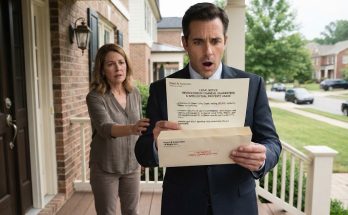
I couldn’t speak.
My mother had just admitted that she had helped Trevor gain access to my house.
Years ago.
Before I even knew there was a problem.
“Why?”
She cried softly.
“Trevor said he needed somewhere to store equipment.”
“He lied.”
“I know.”
“You knew?”
“Not at first.”
“What happened?”
Mom told me the story.
Trevor had approached her after I bought the beach house.
He told her I was becoming selfish.
He said I had changed.
He complained that I had a house sitting empty for weeks while everyone else struggled to find affordable vacation rentals.
Mom believed him.
So when I gave her the spare key for emergencies, she secretly gave it to Trevor.
He copied it.
She never told me.
I felt something break inside me.
“That was the key he used to enter the house.”
“Yes.”
“And you knew about the parties?”
“Yes.”
“You knew about the strangers?”
“Yes.”
I looked down.
“Why didn’t you ever tell me?”
“Because I was afraid you’d stop speaking to me.”
I laughed sadly.
“You were afraid I’d stop speaking to you, so you helped him betray me?”
“I thought I was keeping the family together.”
“No, Mom.”
I looked toward the ocean.
“You were keeping the family comfortable.”
She began crying harder.
I didn’t comfort her.
For the first time, I let someone else’s tears belong to them.
My attorney arrived later that day.
She listened to everything.
Then she said something simple.
“You don’t have to decide what happens to your mother today.”
I nodded.
“But you do have to protect yourself.”
She was right.
The next week became a blur.
I changed every password.
Updated the security system.
Changed my insurance information.
Added legal restrictions to the property records.
And filed a formal notice disputing the fraudulent document.
Trevor hired an attorney.
Then he stopped calling.
My mother stopped calling too.
For the first time in years, the family group chat was silent.
I thought that meant things were over.
They weren’t.
Three days before the hearing, Caroline called me.
“Can we talk?”
“Yes.”
“I found another file.”
My stomach tightened.
“What kind?”
“It concerns your father.”
We met at a coffee shop.
Caroline handed me a folder.
“I shouldn’t have taken it.”
“What is it?”
“A letter Trevor received from your father.”
I opened it.
It was dated six months before Dad died.
The letter said:
Trevor,
I love you.
But love does not mean I will allow you to destroy your sister’s future.
The beach property is hers.
Do not ask her to sell it.
Do not ask her to mortgage it.
Do not use Mom to pressure her.
If you cannot respect that, you will lose more than the property.
You’ll lose my trust.
I read the final sentence.
I will not leave you without support.
But I will not reward entitlement.
I looked at Caroline.
“Why did Trevor have this?”
“He kept it.”
“Why?”
“I think he wanted proof that your father had considered giving him something.”
“But Dad clearly said the opposite.”
“Yes.”
I folded the letter.
Then I saw another page.
A handwritten note.
It wasn’t from Dad.
It was from Trevor.
It said:
He’ll change his mind. Mom will make her do it.
I stared at it.
That sentence explained years of my life.
Trevor had believed my mother could force me.
And my mother had believed she should.
That was the family system.
Trevor demanded.
Mom pressured.
I surrendered.
And everyone called it peace.
The hearing arrived.
I sat beside my attorney.
Trevor sat across the room.
He looked exhausted.
His attorney argued that the property dispute was a family misunderstanding.
My attorney presented the documents.
The forged filing.
The unauthorized loan application.
The emails.
The business proposal.
The copied-key history.
The trust amendment.
The judge listened carefully.
Then the county representative confirmed that the signature on the filing did not match my verified signature.
The fraudulent filing was invalidated.
The loan application was suspended.
The court ordered that no transaction involving the property could proceed without my authorization.
Trevor sat motionless.
Then the judge looked toward me.
“Ms. Mercer, do you wish to pursue additional civil remedies?”
My attorney leaned toward me.
I thought about revenge.
I thought about my father’s letter.
I thought about all the years I had swallowed my anger.
Then I said:
“I want my property protected.”
The judge nodded.
That was enough.
Outside the courthouse, Trevor approached me.
“I lost everything.”
I looked at him.
“No.”
He frowned.
“You lost the thing you were trying to take.”
“I was trying to build a life.”
“You could have built one without taking mine.”
He looked down.
“I thought you would help me.”
“I would have.”
He looked surprised.
“If you had asked.”
He started crying.
For a second, I saw my little brother again.
The boy who used to steal cookies from my plate.
The teenager who borrowed my car.
The man who had somehow convinced himself that my boundaries were obstacles.
I felt sadness.
But not responsibility.
“You still have a chance to rebuild,” I said.
“How?”
“By accepting that my answer can be no.”
He nodded slowly.
Then he walked away.
My mother remained across the parking lot.
She didn’t approach.
I didn’t approach her either.
Some distances aren’t created by anger.
They’re created by truth.
And sometimes truth needs room to settle.
A month later, the beach house was quiet again.
I sat on the deck with my laptop.
The ocean moved beyond the dunes.
My surgery recovery was going well.
My body was getting stronger.
But something else had changed.
I had stopped apologizing for needing peace.
One afternoon, a package arrived.
It was from my father’s attorney.
Inside was a final envelope.
The attorney’s letter said:
Your father asked that this be delivered only after the property dispute was resolved.
I opened it.
Inside was one final note.
Allison,
If you’ve reached this point, you probably understand something I wish I could have taught you while I was alive.
Family is not an excuse.
Family is a responsibility.
People who love you may ask things from you.
They may even disappoint you.
But love should never require you to surrender your dignity.
Your mother may someday understand this.
Your brother may someday understand it too.
But whether they do or don’t is not your responsibility.
Protect your peace.
Build a life you don’t need permission to live.
And never confuse guilt with love.
I cried.
Not because the letter was sad.
Because for the first time, I understood what Dad had been trying to tell me.
My house had never been the real inheritance.
My real inheritance was permission to choose my own life.
And I had finally accepted it.
PART 6 — WHAT HAPPENED TO THE FAMILY
The months after the hearing were strangely quiet.
At first, I didn’t know how to handle it.
For years, my phone had been filled with family demands.
Can we stay Friday?
Can Trevor borrow this?
Mom needs help.
Can you bring food?
We’re coming to the beach.
Now there was almost nothing.
The silence felt uncomfortable.
Then it began to feel peaceful.
I returned to work slowly.
My doctor cleared me for normal activity.
I started walking along the beach every morning.
I learned how to cook simple meals again.
I planted flowers near the deck.
And for the first time, I invited people to my house because I actually wanted them there.
Rachel came first.
She brought pizza.
We sat outside until sunset.
She looked around.
“This feels different.”
“It is.”
“You’re not waiting for someone to arrive.”
I smiled.
“No.”
That was freedom.
Meanwhile, Trevor’s business collapsed.
The investors withdrew.
The loan application disappeared.
Caroline ended their relationship.
Her parents refused to speak with him.
But something unexpected happened.
Trevor didn’t blame me publicly.
He didn’t attack me online.
He didn’t try to manipulate relatives.
Instead, he started working at a construction company.
He began paying back debts.
He moved into a small apartment.
And six months later, he sent me a letter.
I almost threw it away.
Instead, I opened it.
Allison,
I don’t expect you to forgive me.
I don’t expect anything.
I just want you to know that I finally understand what I did.
I thought because we were siblings, your success belonged partly to me.
I thought because Mom supported me, I was entitled to ask more.
I was wrong.
I crossed every line.
I’m sorry.
I don’t know whether we’ll ever have a relationship again.
But I won’t contact you unless you want me to.
I put the letter down.
Rachel was visiting that weekend.
I showed it to her.
“What do you think?”
She smiled.
“I think he finally said something without asking for anything.”
That was exactly what struck me.
There was no request.
No guilt.
No “after everything we’ve been through.”
No mention of the house.
Just an apology.
I didn’t answer immediately.
I waited two weeks.
Then I sent one sentence.
Thank you for apologizing.
Nothing more.
He didn’t respond.
And somehow, that made the apology feel more genuine.
My relationship with Mom was different.
She struggled.
She called twice.
I didn’t answer.
Then she sent a long letter.
She admitted things I’d never known.
She admitted that after Dad died, she became afraid.
Afraid of losing the family.
Afraid Trevor would fail.
Afraid I would leave.
So she kept forcing everyone toward the same table.
She thought if everyone stayed together physically, the family would remain intact emotionally.
Instead, she had taught us to hide resentment.
At the end of her letter, she wrote:
I thought keeping the family together meant keeping everyone close.
I understand now that sometimes you have to let people stand apart long enough to learn how to respect one another.
I cried reading it.
But I still didn’t call.
Forgiveness wasn’t a switch.
It was a process.
And I wasn’t going to rush it because someone else was uncomfortable with the distance.
A year passed.
Then something unexpected happened.
My mother called one Sunday morning.
Her voice was different.
“Can I come to the beach house?”
I hesitated.
“Why?”
“I want to apologize in person.”
I thought about it.
“Okay.”
She arrived alone.
No Trevor.
No bags.
No hidden agenda.
She stood at the gate.
And waited.
She didn’t enter until I opened it.
That small gesture meant more than she probably realized.
Inside, she looked around.
“This is beautiful.”
“It always was.”
She nodded.
“I know.”
We sat on the deck.
For nearly an hour, she talked.
She didn’t defend herself.
She didn’t blame Trevor.
She didn’t say she had been confused.
She simply admitted what she’d done.
When she finished, I said:
“I don’t know what our relationship will look like.”
“I understand.”
“But I don’t want to spend the rest of my life angry.”
She began crying.
“Neither do I.”
We didn’t hug.
Not yet.
But we sat together until sunset.
It was enough.
Later that year, Caroline sent me a message.
She had started her own consulting business.
She apologized again for the part she had played in trusting Trevor without verifying anything.
I told her she didn’t need to apologize.
She replied:
“I should have asked questions.”
We both laughed.
She had learned something too.
Never build your future on someone else’s unverified promises.
The beach house slowly became what I had originally dreamed it could be.
Not a family resort.
Not a business asset.
Not a place everyone assumed they owned.
A home.
My home.
Then one Saturday morning, I received an unexpected call.
It was from the county records office.
They told me an old document had been located.
A document connected to my father.
I assumed it was another trust record.
I was wrong.
It was a handwritten property agreement.
And the final page contained something I’d never seen.
A clause stating that the house could not be sold to a third party without my consent.
But beneath that was another line.
If Allison chooses to keep the property, she may do so without obligation to any family member.
I smiled.
Dad had known.
He had understood me better than I had understood myself.
The next weekend, I invited my mother and Trevor separately.
Not for a family vacation.
Not for a business meeting.
Just dinner.
Trevor arrived first.
Mom came twenty minutes later.
They sat across from each other awkwardly.
For years, I had been the mediator.
This time, I wasn’t.
They had to speak for themselves.
Trevor apologized to Mom.
Mom apologized to Trevor.
Then they apologized to me.
There was no magical reunion.
No dramatic embrace.
No promise that everything would become perfect.
Real life wasn’t like that.
But something important happened.
Everyone finally admitted the truth.
And once the truth was spoken, nobody could pretend anymore.
After dinner, Trevor stood.
“I should go.”
Mom nodded.
He looked at me.
“Thanks for inviting me.”
I smiled.
“You’re welcome.”
He left.
Mom remained.
She looked toward the ocean.
“Your father would be proud of you.”
I looked down.
“I hope so.”
“He would.”
That night, after Mom left, I walked onto the deck.
The ocean was calm.
The same house.
The same view.
But I was different.
Then my phone buzzed.
A message from an unknown number.
I opened it.
You don’t know everything about what your father left behind.
I stared at the screen.
A second message arrived.
There is one more account.
My heart began pounding.
Then came the final message.
And your mother knows where it is.