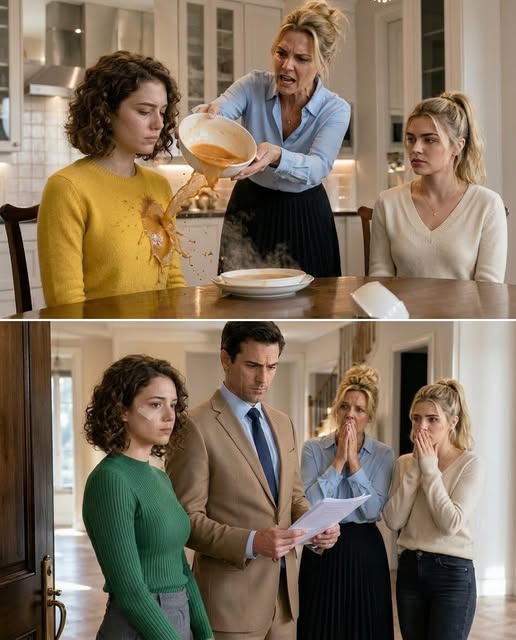
The soup hit me before I even understood my mother had thrown it.
One second I was standing in the middle of her kitchen, trying to keep my voice level while my stepsister held my purse like a trophy. The next, heat splashed across my cheek, my collarbone, and the front of my cream blouse. The ceramic bowl struck the floor and shattered near my shoes, sending broth and broken pieces skidding across the tile.
For a moment, no one moved.
Steam rose between us in thin white ribbons.
My mother stood at the far side of the kitchen island, one hand still lifted from the throw, her face flushed with anger but not regret. Marissa sat at the breakfast table in a silk robe she had never bought for herself, clutching my designer bag against her chest like a child hugging a stolen doll. The house around us—the house where I had learned to walk, where my father had taught me to play piano, where my mother had once kissed scraped knees before she became a woman I no longer recognized—seemed to hold its breath.
I pressed a dish towel to my cheek.
The heat stung. Not enough to send me screaming, but enough to make my eyes water. Enough to remind me that the woman who gave birth to me had just decided that burning my skin was an acceptable way to end a conversation.
“You just threw that at me,” I said quietly.
My mother’s expression did not soften.
“Stop exaggerating, Lena. It wasn’t that serious.”
The bowl lay in pieces between us.
The soup still steamed on my blouse.
Marissa tilted her head and gave the little smile that had made men underestimate her and women want to slap her since we were teenagers.
“So?” she said. “Are you leaving, or are you going to apologize?”
Advertisements
My name is Lena Calloway. I was thirty-two years old that afternoon, standing in the kitchen of the white brick colonial in Fairfield County, Connecticut, where my father’s money, taste, and patience had built nearly every beautiful thing my mother and stepsister now believed belonged to them.
The house sat behind black iron gates at the end of a curved driveway lined with old maples. Six bedrooms. Slate roof. Tall windows. A library paneled in walnut. A rose garden my father planned himself because my mother liked roses only if someone else pruned them. To other people, it looked like wealth. To me, it looked like memory. My father sitting at the piano after dinner. My mother laughing before bitterness made her mouth hard. Me at twelve, reading under the staircase during Christmas parties because the adult world felt too loud.
Now, at thirty-two, I stood with soup soaking through my clothes while my mother shouted the sentence she had been building toward for months.
“Give her all your things—or leave!”
She pointed at Marissa.
Her voice shook, but not from remorse. From the fury of a woman who had mistaken tolerance for permanent surrender.
Across the table, Marissa ran one finger over the gold clasp of my bag.
“She doesn’t need any of it,” she said casually. “She’s single, boring, basically invisible. What’s she doing with nice things anyway?”
Invisible.
That was always the word beneath their words, even when they did not say it aloud.
I was the quiet daughter. The practical one. The one who went to work, paid bills, handled paperwork, remembered insurance deadlines, took my mother to appointments, signed birthday cards, sent flowers, and knew which window leaked in the east guest room. Marissa was the exciting one. The pretty one. The one who called chaos “passion” and irresponsibility “living fully.” She arrived in our family when I was fifteen, two years after my father died and my mother married Franklin Sloane, a charming widower with soft hands, bad investments, and a daughter who could cry on command.
Franklin died six years later, leaving behind debt, golf clubs, and Marissa.
My mother kept Marissa.
At first, I tried to understand it. Grief rearranges people. Loneliness makes strange loyalties. My mother had lost my father, then her second husband, and maybe in Marissa she found someone who needed her in a way I had stopped performing. Marissa took. My mother gave. I worked. My mother resented me for not needing rescue. It was a small imbalance at first, then a family system, then a religion.
“Family shares,” my mother would say whenever Marissa wanted something.
Family shares.
My cashmere coat before a ski weekend.
My earrings for a charity luncheon.
My car for a “quick errand” that turned into three days.
My bedroom when Marissa decided the southern light was better for her “healing process.”
My late father’s watch, which disappeared from my dresser and reappeared on Marissa’s wrist in a restaurant selfie with the caption Vintage mood.
When I confronted my mother, she said, “Don’t be petty, Lena. You have so much. She’s had a harder life.”
Marissa had not had a harder life. She had simply refused to live the one she had without taking pieces from mine.
The thefts became larger after my mother learned about the trust.
That is the part she would later deny, though denial was useless by then. My father, Henry Calloway, had been many things. Brilliant. Stubborn. Old-fashioned in some ways, progressive in others. He could be stern, but he was never careless. Before his cancer became too advanced for signatures, he created a trust for me. Not because he did not love my mother. He did. In his way. But he knew her weakness. My mother loved comfort, admiration, and being relieved of responsibility. My father understood that if everything passed directly to her, there would be nothing left by the time I was old enough to ask where it had gone.
So he structured the house, certain investments, and family heirlooms in a trust with my uncle Martin as trustee until my thirty-second birthday. My mother had a right to live in the house as long as she maintained it, paid no taxes because the trust handled those, and did not attempt to sell, encumber, remove, or transfer trust property. At thirty-two, full control would pass to me.
My father told me when I was seventeen.
We sat in the library one month before he died, when the house smelled faintly of antiseptic and winter flowers. He was thin then, his hands too large for his wrists, but his eyes were clear.
“One day,” he said, “people will make you feel guilty for keeping what I protected for you.”
I had cried, because seventeen-year-old girls do not want trusts and warnings. They want fathers who will live long enough to embarrass them at graduations.
He took my hand.
“Listen to me, Lena. Kindness is not the same as surrender. Remember that when I am not here.”
I did not understand then how often I would need that sentence.
For years, I let my mother live as if the house were hers because arguing over technical ownership felt cruel. She had been widowed twice. Marissa was unstable. I was busy building a career as a financial compliance consultant in New York. I kept a small apartment in the city during the week and came back to the house on weekends, then less often as the atmosphere grew colder. My mother hosted luncheons in rooms my father had paid for. Marissa filmed lifestyle videos in my bedroom, calling it “our family estate.” I swallowed the discomfort because fighting seemed uglier than enduring.
Then small things began disappearing.
At first, jewelry.
Then cash from the lockbox in the library.
Then one of my father’s fountain pens.
Then the watch.
Then a painting from the upstairs hall, allegedly moved to storage, though the storage room was empty.
Then my car title folder.
Then a conversation I was not meant to hear.
Two months before my thirty-second birthday, I came home early on a Thursday and stopped outside the library when I heard Marissa’s voice.
“She’s not going to do anything. Lena never does anything.”
My mother answered, lower. “The trust changes soon.”
“So get her to sign something before it does.”
My pulse slowed.
People talk about betrayal like it arrives as a shock. Sometimes it arrives as confirmation.
I took one step back, pulled out my phone, and began recording.
Marissa said, “If she’s so family-oriented, she can put the house in all our names. Or at least transfer the cash accounts. You said Dad would’ve wanted us taken care of.”
My mother snapped, “Henry was not your father.”
A silence followed.
Then Marissa said, colder, “No. But Franklin was your husband, and he left you with nothing. So unless you want to depend on boring little Lena for the rest of your life, maybe stop acting sentimental.”
I left before they found me.
That was the day I stopped hoping my mother was being manipulated.
She was participating.
Quietly, I began preparing.
I called Uncle Martin, who had been waiting years for me to stop pretending. I met with the trust attorney, Eleanor Price, a woman in her late sixties who wore steel-gray suits and had the moral warmth of a courthouse statue until she decided you were worth protecting. She reviewed every document with me. Trust terms. Property schedules. Heirloom inventory. Occupancy rights. Evidence of removal. Procedures for transfer. Notice requirements. Emergency options if assets were at risk.
“Your mother has a residential license,” Eleanor said, tapping the document with one blunt nail. “Not ownership. Not life estate beyond the terms. The trust allowed her to live there under conditions. If she is removing trust property, attempting to coerce transfer, or damaging assets, we act.”
“What about Marissa?”
“She has no legal right to be there unless you grant one.”
I almost laughed.
“She thinks she owns the east wing.”
“Many people think things,” Eleanor said. “Paper decides which thoughts matter.”
I liked her immediately.
For weeks, I documented everything.
Quietly.
Photographs of missing items.
Screenshots of Marissa’s posts wearing my jewelry.
Bank statements.
Texts from my mother demanding I “share responsibly.”
Receipts.
Insurance schedules.
The old inventory my father had made of heirlooms before his death.
I packed my important documents in a suitcase and kept it at my city apartment. I moved certain jewelry into a safe-deposit box. I changed passwords. I reviewed the security system, which was still registered in my name because I had been paying for it since college after my mother forgot twice and let coverage lapse. I added a camera in the front hall under the explanation that package theft had increased.
My mother called it paranoid.
Marissa posed in front of it.
The morning before the soup, the trust transfer was finalized.
At 9:14 a.m., Eleanor called.
“It’s done,” she said. “Title records are updated. Trustee authority has shifted. You are now the controlling beneficiary and legal owner through the trust structure.”
I stood in my office overlooking midtown traffic and felt no triumph. Only heaviness.
The house was mine.
Which meant the final illusion was gone.
I drove out that evening with one suitcase already packed upstairs and the documents in my bag, intending to sit down with my mother and explain what came next. I had even written notes because some naive part of me still believed that if I presented the truth calmly enough, she might choose dignity over war.
Instead, I walked into the kitchen and found Marissa holding my handbag, my mother standing beside the stove, and a pile of my belongings on the table like items at an estate sale.
My silk scarf.
My pearl earrings.
A small framed photograph of my father and me.
My bag.
My father’s watch.
I said, “Put those down.”
Marissa smiled.
My mother said, “We need to talk about fairness.”
The conversation lasted eleven minutes before the soup flew.
Now I stood with a towel pressed to my cheek while my mother folded her arms as if I had inconvenienced her by being burnable.
“Stop standing there like a victim,” she said. “You have always been dramatic in that quiet way of yours.”
“Quiet drama,” Marissa said. “That’s her specialty.”
I looked at them both.
Something in me did not break exactly. It cleared.
All those months of preparation. All those years of swallowing. All those careful documents and photographs and recordings. I had thought I was preparing in case they crossed a line.
I realized, standing in that kitchen, that the line had been behind us for years.
I lowered the towel.
My mother’s eyes flicked to my reddened cheek, then away. Seeing it made denial harder, and denial was her preferred room.
“My suitcase is upstairs,” I said.
Marissa laughed. “Finally.”
My mother lifted her chin. “Good. Take what you can carry. The rest stays until you learn how to behave like family.”
I almost smiled.
“Family,” I said.
“Yes,” she snapped. “Family. That means you don’t hoard things while your sister goes without.”
“She is not my sister.”
Marissa’s eyes hardened.
My mother slapped the counter. “Do not say that.”
“She is your stepdaughter. She is not my father’s child. She is not a beneficiary. She is not an owner. And she is not entitled to my property.”
My mother’s face went very still.
For a second, I saw the knowledge there.
She knew.
Not all the details, perhaps. Not the timing. But she knew enough to fear my calm.
“Go upstairs,” she said. “Get out before I say something I regret.”
“You already did.”
I walked out of the kitchen.
Behind me, Marissa called, “She’s always so quiet.”
Yes.
Quiet enough to keep records.
Quiet enough to listen outside library doors.
Quiet enough to save every document.
Quiet enough to know the truth when the loudest people in the room assumed silence meant surrender.
Upstairs, my old bedroom had already been invaded.
Marissa’s perfume hung in the air. The bedspread was wrinkled. A half-empty glass of white wine sat on my nightstand, leaving a ring on the wood. My closet door stood open. Several of my dresses were missing. The photograph of my father that usually sat on my dresser had been turned face down.
I stood there for one second and let the pain pass through me.
Then I moved.
I changed out of the soup-stained blouse and photographed the redness on my cheek and neck. I took pictures of the room. The wineglass. The drawers left open. The missing spaces in the closet. The overturned photograph. Then I took my suitcase from beneath the bed where I had packed it that morning because some part of me had known.
Inside were clothes, my documents, my laptop, medication, jewelry that remained, and the original letter my father had written to me when the trust was created.
I did not cry.
Not because I was strong in some glamorous way. Because clarity does not always leave room for tears at first.
I carried the suitcase downstairs.
My mother stood in the foyer with Marissa beside her, both wearing identical expressions of satisfaction.
“Finally making the right choice?” my mother asked.
I looked at her once.
“No,” I said calmly. “For the first time, I’m making the legal one.”
My mother blinked.
Marissa rolled her eyes. “Oh my God. She’s going to threaten us with paperwork.”
I opened the front door.
“Not threaten.”
Outside, late autumn air cooled my cheek. The sky had gone pewter over the maples. I pulled my suitcase down the front steps, every wheel bump sounding final against the stone.
Behind me, Marissa called, “Don’t come crawling back!”
I did not turn around.
At the end of the driveway, I placed my suitcase in the trunk, sat behind the wheel, and touched my cheek.
Then I called Eleanor.
“It’s time,” I said.
Her voice was calm. “Then we move forward tonight.”
The first thing Eleanor told me to do was go to a clinic.
“Before you go to a hotel. Before you answer them. Before anything else,” she said. “Medical documentation. Now.”
So I went.
The urgent care doctor was younger than me and looked horrified when I explained that my mother had thrown hot soup at me. She treated the superficial burn, noted the redness, took photographs with my consent, and asked whether I felt safe returning home.
“No,” I said.
That one word felt strange.
Not because it was untrue.
Because I had spent years translating unsafe into manageable.
While I sat in the clinic parking lot afterward, my phone lit up.
My mother: You made your choice. Don’t embarrass us.
That was all.
Not Are you hurt?
Not I lost control.
Not I’m sorry.
Don’t embarrass us.
Marissa posted twenty minutes later.
A photo of herself lying on my bed, wearing my pearl earrings, my father’s watch visible on her wrist, my handbag positioned beside her like a magazine prop.
Caption: Some people lose. Others upgrade.
Messages began almost immediately.
Lena, what’s going on?
Is that your room?
Is Marissa staying there now?
Are you okay?
I sent the screenshot to Eleanor.
She replied: Excellent evidence. Do not engage.
By the next morning, my mother and Marissa had changed the locks.
I knew because the security system sent me an alert: unauthorized door hardware tamper at 8:03 a.m. Then another alert from the side entrance. Then a third from the service door.
At 8:21, my mother texted: We changed the locks for safety. Do not come here without calling.
My house.
My system.
My locks.
I forwarded it to Eleanor.
She called within five minutes.
“They changed locks on trust property after notice of transfer?”
“Yes.”
“And you have the alert records?”
“Yes.”
“Good.”
Her pleasure was frightening.
At noon, Eleanor called again.
“Are you sure you want to proceed fully?” she asked.
I was sitting in my hotel room near the window, looking at my reflection in the dark television screen. My cheek was less red now, but the faint mark remained. I looked tired. Calm. Certain.
“What does fully mean?” I asked, though I knew.
“Emergency motion for access and preservation of trust property. Notice to vacate for unauthorized occupants. Civil standby for retrieval of your personal property and trust assets at risk. Police report for assault and theft. Demand letter for return of items documented in Marissa’s posts. Notice to the insurer regarding potential conversion of scheduled property. We also send warning regarding attempted interference with trust transfer.”
I looked at the screenshot of Marissa wearing my father’s watch.
“Yes,” I said. “Fully.”
That evening, they held a celebration.
I know because Marissa livestreamed it.
Some people incriminate themselves by accident. Marissa did it in good lighting.
She stood in my kitchen with a glass of champagne, panning her phone across relatives gathered around the island. Aunt Pauline, who had always preferred proximity to money over loyalty to truth. Cousin Brett, who had once asked to borrow five thousand dollars and called me cold when I offered to connect him with a debt counselor instead. Two of Marissa’s friends, both holding wine and laughing too loudly. My mother near the stove, wearing pearls and a smile sharp enough to cut bone.
“She thought she was better than us,” Marissa told the camera. “Now she has nothing.”
My mother lifted her glass.
“A selfish daughter ends up alone.”
I watched from my hotel room, the glow of the livestream reflecting in the window over my face.
For one terrible moment, pain rose so sharply I nearly closed the app.
Then Marissa turned toward the breakfast table.
“Now we just need to handle a few property papers,” she said, picking up a folder I recognized from my mother’s desk.
My mother’s head snapped toward her.
“Not on camera,” she hissed.
Too late.
Eleanor captured everything.
So did I.
An hour later, Eleanor sent a message: Emergency order signed. Civil standby confirmed for 7:15. Stay available.
People imagine legal power as dramatic. A judge slamming a gavel. Police bursting through doors. Villains shouting. In reality, legal power often arrives as PDFs, timestamps, quiet phone calls, and professionals who understand that emotion is loud but procedure moves furniture.
At 7:15 p.m., two moving trucks arrived at the house with a court order, a civil standby officer, Eleanor’s associate, a professional inventory team, and the access code I had not changed because the system belonged to me. My mother and Marissa were not home; the livestream showed them at a restaurant with relatives, still celebrating my supposed exile.
The movers did not empty the house recklessly.
That would have been satisfying.
It would also have been stupid.
They removed what was legally mine or trust property at risk: my bedroom furniture, personal clothing, jewelry boxes, documents, my father’s watch after Eleanor’s associate located it on Marissa’s vanity where she had apparently removed it before dinner, scheduled art, family silver, certain antiques listed in the trust inventory, and my father’s piano from the library.
The piano was the only item that made me cry.
Not in the moment. I was not there. But later, when the inventory company sent a photograph of it being professionally wrapped, I pressed my fist against my mouth and finally broke.
My father had played that piano every Sunday evening. Badly, if I am honest. Enthusiastically, if I am kind. He loved old standards and Christmas carols and one dramatic section of Rachmaninoff he never mastered but attacked with conviction. When I was little, I sat beside him and pressed the high notes. After his funeral, I played one key and could not touch it again for years.
Marissa had posted a video once pretending to play it while laughing.
The piano left that house before they returned.
Everything removed was photographed, logged, and taken to secure climate-controlled storage under court supervision. What remained belonged to my mother or Marissa, or could not be moved until later proceedings clarified possession.
The house did not become empty.
It became honest.
Without my father’s things, without my furniture, without the art and heirlooms and silent evidence of a man they had been feeding on for years, the rooms revealed what they had actually contributed: cheap throws, scented candles, clothes spilling over chairs, half-finished wine, and entitlement.
At 9:42 p.m., my mother and Marissa returned.
I know the time because the security camera captured them entering through the front door using the temporary access code provided for their remaining belongings, unaware that the officer and Eleanor’s associate still waited in the entry hall.
Marissa’s voice came first.
“What the hell?”
Then my mother’s heels clicked rapidly across the floor.
Room to room.
Living room.
Dining room.
Library.
Her voice changed when she reached the library.
“Where is the piano?”
Then they saw him.
Eleanor’s associate, David Kim, stood in the entryway in a navy suit with a folder in one hand. He was young, composed, and had the particular calm of a lawyer who knows the answer to every question before it is asked.
“Mrs. Calloway,” he said, “I represent Lena.”
My mother’s face drained of color.
“This is my house.”
“No,” David said. “It was your late husband’s trust property. As of yesterday, control transferred to Lena Calloway as the designated beneficiary.”
Marissa barked a laugh. “That’s not possible.”
David opened the folder.
“You were notified this morning through counsel. You changed the locks afterward, which has been documented. You also removed or retained property listed in the trust inventory and attempted to discuss property paperwork on a public livestream.”
Marissa’s mouth opened, then closed.
My mother gripped the banister.
“You had no right to come in here.”
“The court granted emergency access for preservation and retrieval of trust and personal property at risk of conversion,” David said. “An officer was present. An inventory was completed. Your personal items were not removed.”
“This is a family matter,” my mother said.
I stepped inside then.
I had been waiting on the porch, partly because Eleanor advised it, partly because I wanted the legal facts delivered before my mother could make the scene about my tone. I wore black slacks, a wool coat, and a small bandage near my cheek. My suitcase was no longer in my hand. For the first time in years, I entered that house with nothing to carry.
My mother looked at me.
“Lena.”
Her voice broke on my name in a way that might have moved me once.
Not now.
“You told me to leave,” I said. “So I did.”
Marissa stepped forward. “You can’t do this.”
“I already have.”
Two officers stood near the entrance behind me. Not there to perform revenge. There to keep a volatile situation from becoming another assault. One of them had taken my report that afternoon. He looked at my bandage, then at the woman who had caused it, and said nothing. Sometimes silence from the right witness is more powerful than speech.
My mother began to cry.
“She is my daughter,” she said to the room, to the officer, to David, to anyone willing to restore the old order. “This is a family matter.”
I met her eyes.
“No,” I said. “This is about actions and consequences.”
Marissa pointed at me.
“You were nothing without this house.”
The sentence echoed strangely through the stripped entry hall.
I looked around at the walls, the staircase, the chandelier my mother had chosen with my father’s money, the floor where I had once sat in pajamas waiting for him to finish phone calls so we could play cards. For years, I had believed the house held power. The name. The inheritance. The proof that I belonged somewhere before my mother and Marissa began treating me like an inconvenience inside my own history.
But standing there, with my father’s things safe and their lies documented, I understood.
The house had never been the power.
My silence had been.
“That’s where you’re wrong,” I said. “The house was never the power. My silence was.”
Marissa’s face twisted. “You think you’re so smart.”
“No,” I said. “I think I was quiet long enough.”
My mother took one step toward me. The officer shifted slightly.
She stopped.
“Please,” she whispered. “Don’t do this.”
For the first time, I heard fear in her voice. Not fear for me. Not fear over what she had done. Fear of losing comfort. Fear of losing the story where she was a wronged mother and I was a selfish daughter. Fear of learning that the law did not care how convincingly she could cry.
I thought of the soup.
The watch.
The livestream.
The years of Family shares.
I thought of my father sitting in the library, telling me kindness was not surrender.
“You already did,” I said softly.
The formal process took longer than that night.
It always does.
My mother and Marissa were not dragged to jail in pearls while relatives applauded. Real consequences do not always have good lighting. They were served with notices. My mother’s license to occupy was terminated for breach of trust conditions, damage, conversion, and hostile conduct. Marissa was treated as an unauthorized occupant and later required to leave after a court hearing where she tried to explain that “emotional investment” in a room should count as a legal interest.
It did not.
The assault report moved slowly because family violence in wealthy homes is often softened by everyone around it. But the clinic record, photographs, broken bowl, and my statement mattered. My mother agreed to a civil protective order and a settlement that included no contact for a fixed period, reimbursement for damaged items, and cooperation in inventory recovery. Marissa, who had posted half the evidence herself, was ordered to return jewelry, clothing, and personal effects. The watch came back first. The pearls came later. Some things never returned. That hurt less than I expected.
Objects are not memory.
They are containers.
Once emptied by betrayal, some containers can be released.
The relatives scattered in predictable directions.
Aunt Pauline called to say she had not known the full story.
I said, “You laughed in the livestream.”
She said, “That was taken out of context.”
I said, “So were you.”
Cousin Brett sent a long message about family unity and how my father would have wanted peace. I responded with one photograph: Marissa wearing my father’s watch under the caption Some people lose. Others upgrade.
He did not reply.
Marissa tried to reinvent herself online as a victim of “inheritance abuse,” a phrase she appeared to have made up after a bottle of wine and a search engine. For a few days, people commented with hearts. Then someone shared the clip of my mother saying, Not on camera. Then another person posted a screenshot of Marissa on my bed. Then Patricia Wells, my father’s former assistant, commented publicly: Henry Calloway created that trust because he knew exactly who would try this.
That ended the sympathy campaign.
My mother wrote once.
Not an apology.
A letter.
There is a difference.
Lena,
You have always been difficult to reach emotionally. I know you believe you were wronged, and perhaps emotions ran high on all sides. I should not have thrown the bowl, but you must understand the pain of being made to feel like a guest in the home where I lived for decades. Marissa has her flaws, but she needed compassion. Your father would have wanted you to be generous.
Mother
I read it twice.
Then I placed it in a folder labeled Not Enough.
Eleanor saw the label during a meeting and smiled for the first time since I had known her.
Months later, when the house was finally clear and quiet, I returned alone.
Winter had arrived. The maples along the driveway were bare, their branches black against a pale sky. The house looked beautiful from the outside. It always had. That was part of its danger. Beautiful houses convince people that whatever happens inside them must be civilized.
I walked room by room.
The kitchen first.
The tile had been cleaned. No trace of soup. No broken bowl. Nothing to prove a mother had chosen violence over accountability except the fading mark on my skin and the documents in Eleanor’s files.
The library.
Empty space where the piano had stood. Dust outlines on shelves where books had been removed. Afternoon light cutting across the floor. I stood in the doorway and remembered my father’s hands on the keys, his voice calling me Lenabug until I was old enough to pretend I hated it.
The rose garden.
Overgrown now. My mother had enjoyed roses in vases, not in soil. I found the old pruning shears in the potting shed, rusted but still usable. For half an hour, I cut back dead canes until my hands ached. It was the first time I had worked on the garden myself since childhood.
I thought I would feel triumphant owning the house.
I did not.
I felt grief.
Grief for the father who had protected me with paper because he knew love alone would not be enough. Grief for the mother who had chosen Marissa’s hunger over her own daughter’s dignity. Grief for the younger version of myself who kept trying to earn kindness from people who benefited more from her silence.
I sat on the back steps until the cold came through my coat.
Then I called a realtor.
“I want to sell it,” I said.
She sounded surprised. “Are you sure?”
I looked at the rose garden, the windows, the rooms full of ghosts.
“Yes.”
Selling the house shocked people more than taking legal action did.
They understood fighting over property. They did not understand choosing peace over the symbol of victory. But I had learned something my mother and Marissa never did: ownership is not the same as freedom if the thing you own keeps you tied to the people who harmed you.
I kept the piano.
I kept my father’s watch.
I kept the framed photograph.
I kept the letter he wrote me about kindness and surrender.
The rest could become someone else’s beginning.
The house sold in spring to a family with three children, two dogs, and the kind of cheerful chaos my mother would have found vulgar. At the final walkthrough, the youngest child ran through the empty living room making airplane sounds while his mother apologized. I told her not to. The house needed noise that did not come from cruelty.
After closing, I moved to a smaller place by the water in Madison, Connecticut.
A cottage, though my realtor insisted on calling it a coastal bungalow because cottages apparently do not justify the price. It had weathered gray shingles, a blue front door, two bedrooms, and windows that looked toward the Sound. No gates. No ballroom-sized dining room. No library paneled in walnut. No staircase designed for dramatic entrances.
It was quiet.
That was what I wanted.
I placed my father’s piano in the front room, though it barely fit. The movers complained. I bribed them with coffee and unreasonable tips. On the first evening, after they left, I sat at the bench and pressed one key.
The note rang through the little house.
Clear.
Lonely.
Alive.
I began taking lessons again at thirty-three, which is a humbling age to be told by a twenty-six-year-old instructor that your left hand has commitment issues. I loved every minute. Sometimes I played badly with the windows open and let the neighbors suffer through progress. Sometimes I imagined my father laughing.
The mark on my cheek faded.
Not completely. In certain light, especially after heat or cold, a faint shadow remained. I used to cover it with makeup. Then one morning, while getting ready for work, I touched it and realized I no longer saw humiliation.
I saw a timestamp.
The exact moment the old life ended.
Not because my mother threw the soup.
Because I stopped trying to convince myself it was not that serious.
I learned to live differently after that.
No more automatic yes.
No more family requests that sounded like invoices.
No more lending sentimental objects to people who treated sentiment as weakness.
No more translating cruelty into stress.
No more protecting people from consequences they had worked so hard to earn.
My mother tried to contact me once after the sale closed.
The message was short.
You sold your father’s house. I hope you’re satisfied.
I looked at it while sitting on my porch, coffee in hand, gulls crying over the water.
Then I typed back one sentence.
I kept what mattered.
I blocked her afterward.
Marissa sent nothing directly, but I heard things. She moved into an apartment she could not afford, then out of it. She tried to sell a bracelet that Eleanor had already flagged as stolen, which caused another legal letter. She posted vague quotes about betrayal and “blood not meaning loyalty,” which was funny in a bitter way because we had never shared blood and she had never shown loyalty. Eventually she disappeared from my online world because I stopped looking.
That is another kind of freedom people underestimate.
Not knowing.
Not checking.
Not refreshing someone else’s downfall to see whether justice has finished cooking.
Justice, I discovered, is not always a meal you need to watch.
A year after the soup, I hosted dinner in my cottage.
Not a grand event. No relatives circling money. No performance of family unity. Just Uncle Martin, Eleanor, Patricia Wells, my friend June from work, and my neighbor Mrs. Alvarez, who had adopted me within three weeks of my arrival and decided I needed better soup recipes, an irony I appreciated privately.
I made pasta.
I burned the garlic bread.
Eleanor brought wine. Uncle Martin brought old photographs of my father from college. Patricia brought a small box of items she had saved from his office before my mother cleared it years ago: a letter opener, two cufflinks, and a note in my father’s handwriting that said, Remind Lena she is braver than she feels.
I had to leave the room for a minute after that.
When I returned, no one commented on my eyes.
Good people know when silence is kindness.
After dinner, Uncle Martin stood near the piano and touched the polished wood.
“Henry would like this place,” he said.
“You think so?”
“He liked anywhere you could think clearly.”
I looked around at my small house. The blue door. The imperfect walls. The table crowded with dishes people actually helped carry. The piano slightly too large for the room. The water beyond the dark windows.
For the first time, I believed him.
Sometimes stories like mine get told as revenge.
I understand why. There is satisfaction in the image of my mother and Marissa returning to rooms stripped of stolen comfort. There is satisfaction in legal letters landing where insults used to stand. There is satisfaction in watching people who called you invisible discover you were the only one keeping records.
But revenge is too small a word for what happened.
Revenge would have kept me tied to them.
What I wanted was release.
I wanted my father’s watch off Marissa’s wrist.
I wanted my mother’s hands away from my future.
I wanted the law to say what my family refused to: that taking is not sharing, that cruelty is not honesty, that motherhood is not ownership, and that silence does not mean consent.
I wanted to wake in a house where nothing had to be guarded from people who claimed love as their excuse.
Now, some mornings, I sit on the porch wrapped in a sweater, coffee warming my hands, and watch light spread over the water. I think about my father. I think about the girl I was, hiding under the staircase with a book while adults performed happiness in rooms built by his labor. I think about my mother too, less often than before, and not with the sharp pain I expected to carry forever. More like touching an old bruise and discovering it no longer hurts as much as you remember.
I think about the bowl.
The soup.
The steam.
Marissa’s smile.
My mother’s voice saying, Give her all your things—or leave.
In the end, I did exactly what she ordered.
I left.
But I did not give Marissa all my things.
I gave them back to myself.
THE END