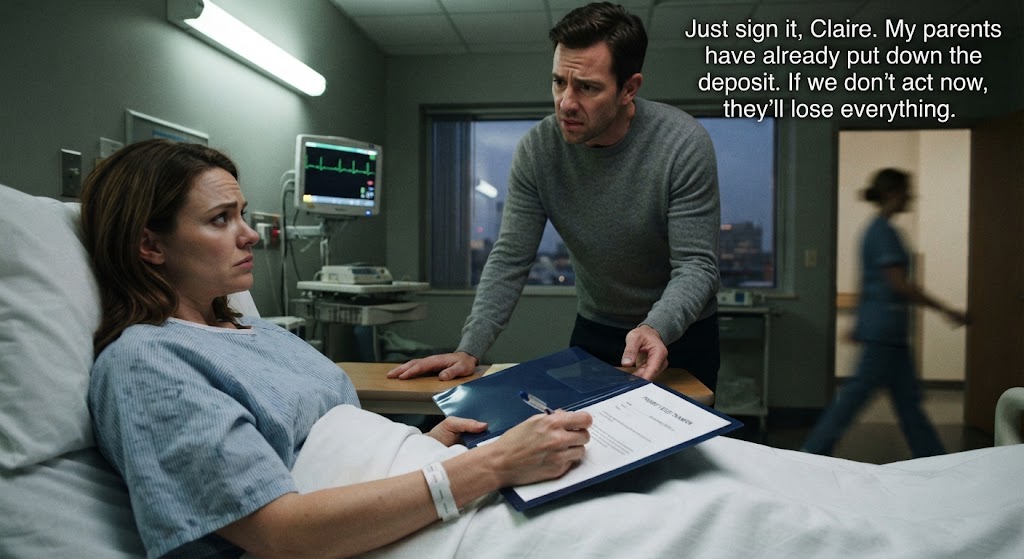
I stared at the folder on my hospital bed.
Scott stood beside me as if he were asking me to sign a routine insurance form.
“Just sign it, Claire,” he repeated. “My parents have already put down the deposit. If we don’t act now, they’ll lose everything.”
I slowly closed the folder.
“You want me to borrow $90,000 against our home so your parents can buy a house they cannot afford?”
“They’ll pay us back.”
“With what?”
Scott looked away.
I already knew the answer.
Nothing.
For three years, I had been paying his parents $1,500 every month. I had lent Megan $27,000. And now Scott wanted to put our home at risk.
While I was lying in the hospital fighting pneumonia.
“I’m not signing this.”
His face changed.
“You’re making a huge mistake.”
“No. I made the mistake three years ago when I confused helping your family with being responsible for them.”
He grabbed the folder.
“You’re going to destroy my family.”
I looked directly at him.
“Scott, your family was never my responsibility.”
He stormed out.
For the first time since we married, I didn’t chase after him.
That evening, Julia, my attorney, called.
“Did your husband bring you documents?”
“Yes.”
“Did you sign anything?”
“No.”
There was a pause.
“Good. Do not sign anything he brings you. And Claire, I found something else in the financial records you sent me.”
My stomach tightened.
“What?”
“There’s a second transfer.”
“From where?”
“Your joint account. $18,500. Six months ago.”
I opened my banking app.
Julia continued.
“It went to an account belonging to Megan.”
I felt the room become strangely quiet.
“I never approved that.”
“Your husband did.”
I immediately called Scott.
He answered on the fourth ring.
“Claire, I’m busy.”
“Why did you send Megan $18,500?”
Silence.
Then he sighed.
“She needed it.”
“For what?”
“She had business expenses.”
“She already owes me $27,000.”
“I was going to tell you.”
“When?”
“When things settled down.”
I laughed softly.
Not because anything was funny.
Because suddenly everything made sense.
The monthly $1,500.
The missing emergency savings.
The $18,500.
The house deposit.
And the folder.
Scott wasn’t asking me to help his family.
He was trying to make me financially responsible for them.
“Scott,” I said quietly, “I want you to leave our house.”
“What?”
“You heard me.”
“You’re in the hospital.”
“And you’re not my husband anymore.”
He became furious.
“You can’t make that decision while you’re sick!”
“I just did.”
Then I hung up.
The next morning, I was finally discharged.
Rachel picked me up and drove me home.
But when I opened the front door, I noticed something immediately.
Half of the closet was empty.
Scott had already taken his clothes.
On the kitchen table sat another envelope.
My name was written across it.
Inside was a single page.
I hope you understand what you’re doing to this family.
Underneath it was a message from Patricia:
If you leave Scott, you will regret it. We know things about you too.
I stared at the words.
Then I called Julia.
She arrived less than an hour later.
And when she read the message, her expression changed.
“Claire,” she said, “I think we need to find out exactly what they mean.”
That night, we opened every financial file we had.
And at 1:13 a.m., Julia found something that made both of us stop breathing.
Scott had opened a credit application.
In my name.
Without my permission.
The requested amount?
$120,000.
And the collateral listed was our house.
I looked at Julia.
“What do we do now?”
She closed the laptop.
“Now we stop protecting him.”
And that was the moment I realized my marriage wasn’t ending because I stopped sending money.
It was ending because I finally discovered what my husband had been willing to do to keep that money flowing.
The next morning, Julia helped me freeze my personal credit and separate my finances from Scott’s.
Then she told me something I never expected.
“Claire, there’s another problem.”
I looked up.
“What?”
“Your husband didn’t just apply for the $120,000 loan.”
She slid a document across the table.
“He submitted financial information claiming you agreed to use the house as collateral.”
My hands went cold.
“But I never signed anything.”
“I know.”
“So how did he submit it?”
Julia pointed to the signature page.
“It appears someone copied your signature from an older document.”
I stared at the page.
It looked like mine.
But it wasn’t.
For three years, I had trusted Scott completely.
And while I was trusting him, he had apparently been building a financial trap around me.
Then Julia discovered the final piece.
The $18,500 sent to Megan wasn’t for her salon.
It had been transferred into a private investment account.
An account Scott and Megan had opened together.
I couldn’t believe it.
I called Megan.
She answered immediately.
“Claire?”
“Why did Scott send you $18,500?”
Silence.
“Megan?”
Finally she whispered, “He said you’d understand.”
“No. I don’t.”
“He said you were going to help us.”
“I was never asked.”
“He told me the money was part of your savings.”
My heart sank.
“So you knew it wasn’t yours?”
She started crying.
“I didn’t know what to do.”
“You could have returned it.”
“I spent some of it.”
“On what?”
She refused to answer.
I ended the call.
Then I called Scott.
He arrived at the house that afternoon.
For once, he didn’t look angry.
He looked frightened.
“Claire, please listen.”
I placed the documents on the table.
“You forged my signature.”
“I didn’t forge anything.”
“You submitted a loan application claiming I agreed to it.”
“I was trying to protect our family.”
“No. You were protecting your parents.”
He sat down.
“I thought you’d eventually understand.”
“Understand what?”
“That family comes first.”
I looked at him for a long moment.
“You’re right.”
His expression softened.
“Finally.”
I shook my head.
“Family does come first. And that’s why I’m choosing myself.”
He went silent.
I handed him the divorce papers Julia had prepared.
Scott stared at them.
“You’re serious?”
“I’ve never been more serious about anything.”
He started crying.
He told me he loved me.
He promised to change.
He said his parents had pressured him.
He blamed Megan.
He blamed the circumstances.
But he never blamed himself.
That was when I knew my decision was right.
Two months later, the court finalized our divorce.
The house remained mine because I had purchased it before our marriage and could document the majority of the payments.
The fraudulent loan application was withdrawn after the lender investigated the documents.
Megan eventually agreed to a repayment plan for the $27,000 she owed me.
Frank and Patricia lost the house they had tried to purchase because they couldn’t afford the remaining down payment.
And Scott?
He moved into a small apartment and finally had to support himself.
Six months later, I received one final message from Patricia.
You destroyed our family.
I stared at it for several seconds.
Then I deleted it.
Because the truth was much simpler.
I hadn’t destroyed their family.
I had only stopped financing it.
For three years, they had mistaken my kindness for weakness.
They thought my money would never stop.
They thought my marriage would keep me silent.
They thought I would sign anything if they called it “family.”
They were wrong.
The hospital taught me something I should have learned years earlier:
When you’re lying in a hospital bed wondering whether you’ll recover, you suddenly realize how little the opinions of people who never showed up for you actually matter.
I survived the illness.
I survived the betrayal.
And most importantly, I survived the marriage I had spent years trying to save.
Sometimes losing someone isn’t the tragedy.
Sometimes the tragedy is spending your life refusing to let them go.
And sometimes the strongest thing you can say is simply:
“No more.”