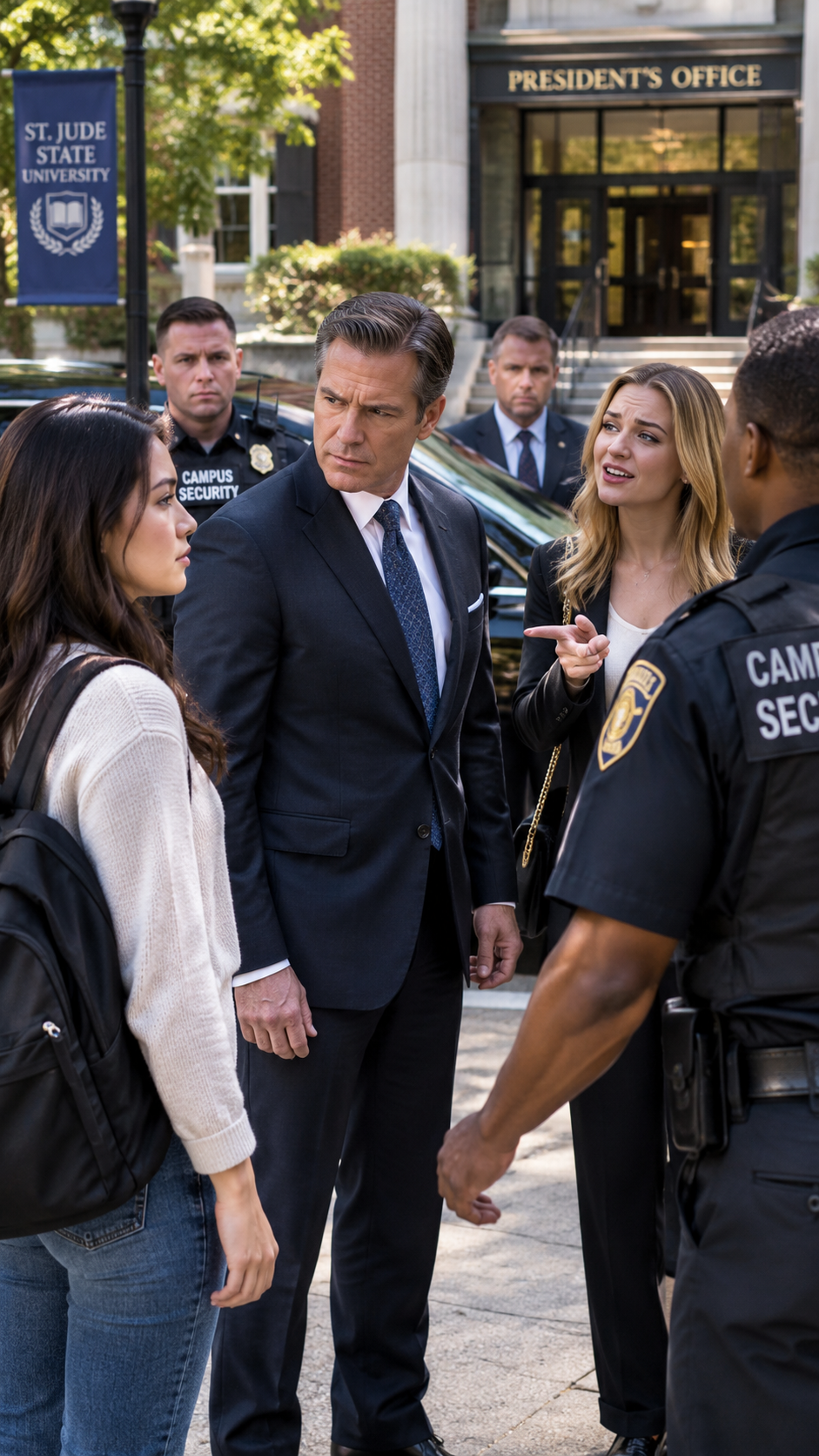
PART 3 — The Files That Could Destroy an Empire
The moment I held the black USB drive in my hand, Gregory Mercer stopped looking like a powerful university administrator and started looking like a man who had just seen his carefully constructed world begin to collapse.
“Please,” he repeated, lowering his voice. “That belongs to me.”
I looked at the label.
PROJECT MERIDIAN — CONFIDENTIAL.
“Then you should have kept it in your briefcase.”
His jaw tightened.
“Dr. Hart, I don’t know what you think you’re doing, but this is highly sensitive university property.”
“Interesting,” I replied. “Because you just told me five minutes ago that I was a trespasser who had no business on university property.”
The surrounding students had grown quiet.
Some were still recording.
Others were whispering into their phones, apparently sending messages to friends who had missed the confrontation.
Alyssa stood beside her uncle, her face flushed with embarrassment.
“Uncle Gregory, why is she holding your drive?”
“I don’t know,” he snapped.
I raised an eyebrow.
“You dropped it.”
He turned toward me.
“Give it back.”
“No.”
The answer came so calmly that he seemed momentarily confused.
Then his expression hardened.
“You are not authorized to access that material.”
“Neither are you authorized to destroy private property or order security to remove the university president without verifying her identity.”
Dean Helen Whitmore stepped between us.
“Enough. The Board is waiting.”
Gregory looked at her sharply.
“Dean, this is an operational matter.”
“No,” Helen replied. “It has become a governance matter.”
That sentence made several staff members exchange nervous glances.
Gregory had spent years cultivating an atmosphere in which people obeyed before asking questions.
But Helen Whitmore had been at St. Jude State University for twenty-six years.
She had survived four presidents, three major funding crises, and a faculty strike that had nearly divided the institution.
She was not easily intimidated.
I handed the USB drive to Eleanor Grant, chairwoman of the Board of Regents.
“Please place this in a secure evidence envelope.”
Eleanor took it without hesitation.
“Mr. Mercer, did you bring this drive to campus?”
Gregory hesitated.
“Yes.”
“Why?”
“It contains routine project documents.”
“Then you should have no objection to having them reviewed.”
He opened his mouth.
Nothing came out.
Alyssa looked from one adult to another.
“Why is everyone acting like my uncle did something wrong?”
I turned toward her.
“Because your uncle is being asked a question.”
“And he doesn’t have to answer you!”
“Actually,” Eleanor said, “he does.”
Alyssa’s face changed.
Eleanor was not merely another administrator.
She was the chairwoman of the body that had appointed me.
And, more importantly, she had the authority to demand answers from every senior executive at St. Jude State University.
“Mr. Mercer,” Eleanor continued, “you will attend the meeting immediately.”
Gregory glanced at the security chief.
“Douglas, I expect you to secure the drive.”
Douglas nodded.
“Of course.”
I looked at him.
“Secure it according to the university’s evidence-preservation policy.”
He froze.
Then he straightened.
“Yes, President Hart.”
The title traveled through the crowd like a spark.
President Hart.
President Hart.
Students began repeating it under their breath.
Alyssa heard them.
Her face twisted.
“You’re all acting ridiculous. She is barely older than me!”
I stopped walking.
“Age is not a qualification for authority, Alyssa.”
She laughed bitterly.
“Then what is?”
“Competence. Integrity. Accountability.”
I paused.
“And the ability to recognize that a person’s value is not determined by the price of her clothing.”
The words landed harder than I intended.
Alyssa looked away.
Gregory gestured impatiently toward the building.
“Let’s get this over with.”
We entered the President’s Office through the main doors.
The lobby was decorated with photographs of every previous university president.
Most were elderly men in dark suits.
A few were women with silver hair and decades of academic experience.
My photograph had not yet been installed.
That was deliberate.
I had requested that my portrait not be displayed until I had completed my first year.
I wanted students to remember the work, not the face.
But now, as I walked through the lobby, I could feel everyone watching me.
A receptionist rose from her chair.
“President Hart?”
“Yes.”
She smiled nervously.
“Welcome to St. Jude State University.”
“Thank you.”
Gregory walked past her without acknowledging the greeting.
He was already reaching for his phone.
I noticed.
“Mr. Mercer.”
He stopped.
“Please leave your phone with your personal assistant during the meeting.”
He stared at me.
“Why?”
“Because the Board is reviewing confidential material.”
“I have a right to communicate with my staff.”
“So do I.”
Eleanor held out her hand.
“Gregory.”
His nostrils flared.
Then, reluctantly, he handed his phone to the assistant accompanying him.
I did the same with my damaged phone.
The glass was cracked, but the device still functioned.
My secretary, Nora Bennett, had already sent a message to my backup number.
I am in the President’s Office. The Board has been informed. Please proceed with the scheduled meeting.
I had no idea whether she had witnessed the courtyard confrontation.
But Nora had worked with me for four years.
She understood that when I said I wanted to observe the university without a security detail, I did not mean I wanted to be unprotected.
I meant I wanted to see how the institution behaved when it thought no one important was watching.
And what I had seen was worse than I expected.
The Board conference room was on the third floor.
It overlooked the central courtyard, where dozens of students still gathered around the fountain.
As I entered, I saw the university’s senior leadership already seated around the long table.
Provost Samuel Reed.
Chief Financial Officer Margaret Lawson.
General Counsel Daniel Brooks.
Dean Helen Whitmore.
Three faculty representatives.
Two student representatives.
And several members of the Board of Regents.
The atmosphere was tense.
Nobody knew exactly what had happened outside.
But everyone had heard enough to understand that the morning had gone badly.
Eleanor took her seat at the head of the table.
“Let us begin.”
Gregory sat opposite me.
Alyssa was not supposed to be in the meeting.
She stood near the doorway anyway.
“Miss Mercer,” Eleanor said, “this is a closed administrative session.”
“But I’m involved!”
“You may wait outside.”
Alyssa looked at Gregory.
He gave her a small nod.
She left, but not before glaring at me.
The doors closed.
Eleanor folded her hands.
“Dr. Hart, before we discuss the materials delivered to the Board last night, I want you to explain what occurred this morning.”
I did.
I described Alyssa’s demand, the damaged phone, the false accusation, and Douglas Miller’s refusal to review the security footage.
I did not exaggerate.
I did not insult anyone.
I simply stated the facts.
When I finished, General Counsel Daniel Brooks asked:
“Do you have evidence of the damage?”
“Yes. The phone is in the evidence bag.”
“And witnesses?”
“Several dozen students. The security cameras should also provide a record.”
Daniel nodded.
“Mr. Miller?”
Douglas sat near the end of the table.
His shoulders were rigid.
“I acknowledge that I did not review the footage before directing the president to the security office.”
“Why not?” Daniel asked.
Douglas glanced at Gregory.
That glance told me more than his answer could have.
“I believed Miss Mercer’s account.”
“Why?”
“She is a student.”
“That does not answer the question.”
Douglas looked down.
Gregory suddenly leaned forward.
“This is absurd. We are holding a formal meeting over a misunderstanding involving a student and a damaged phone.”
I turned toward him.
“Then why are you concerned about the USB drive?”
His face tightened.
“I am not concerned.”
“Good.”
I looked at Eleanor.
“Then perhaps we should review it.”
The general counsel opened a secure laptop.
“I have already contacted our information security officer. The drive will be examined on an isolated system.”
Gregory pushed his chair back.
“That is unnecessary.”
Daniel looked at him.
“Mr. Mercer, the drive was found on university property. It is labeled confidential. It was in your possession. The Board has a responsibility to determine whether it contains material relevant to the institution.”
“I am the vice president of operations.”
“And that is precisely why the Board must examine the matter.”
Gregory looked around the room.
For the first time, he seemed to realize that the usual methods were not working.
He could not dismiss Eleanor.
He could not intimidate Daniel.
He could not order Helen to leave.
And he could not pretend that I was a stranger.
The security officer arrived ten minutes later.
He connected the drive to an isolated computer.
The first folder was labeled:
MERIDIAN — CONTRACTUAL DOCUMENTATION.
The second:
MERIDIAN — APPROVALS.
The third:
MERIDIAN — PRIVATE COMMUNICATIONS.
The room became silent.
The officer opened the first folder.
Inside were spreadsheets, invoices, construction proposals, and payment schedules.
Margaret Lawson leaned forward.
“Those numbers are wrong.”
Gregory turned toward her.
“What?”
Margaret pointed at the screen.
“These are not the figures submitted to finance.”
The officer opened another file.
A spreadsheet showed a proposed construction project valued at $18.4 million.
A second document listed the same project at $27.9 million.
A third showed a payment schedule with several companies that had no apparent connection to the university’s approved vendor list.
Daniel adjusted his glasses.
“Who authorized these changes?”
Gregory shook his head.
“I have no idea. Anyone could have put those files on the drive.”
Eleanor looked at him.
“Was the drive in your briefcase?”
“Yes.”
“Did anyone else have access to your briefcase?”
Gregory paused.
“I don’t know.”
I said nothing.
The officer opened the folder marked PRIVATE COMMUNICATIONS.
There were dozens of messages.
Some appeared to be ordinary project correspondence.
Others were more troubling.
One message, dated seven months earlier, read:
The board will never approve the revised amount if they see the original vendor comparison. Keep the first version out of the packet.
Another said:
The family arrangement remains unchanged. The transfer will be completed after the second payment clears.
A third contained only a bank account number and the phrase:
Use the consulting entity.
Daniel’s expression hardened.
“Who sent these?”
The officer displayed the sender information.
The sender was listed as an address belonging to Gregory Mercer’s administrative office.
Gregory rose from his chair.
“This is a setup.”
Eleanor did not raise her voice.
“Sit down.”
He remained standing.
“You cannot accuse me based on files that could have been fabricated.”
“We have not accused you,” Daniel said. “We are examining evidence.”
“Evidence?” Gregory shouted. “This is a political attack!”
I looked at him.
“By whom?”
He turned toward me.
“You arrived today with an agenda.”
“That is correct.”
The room fell silent.
I continued.
“I arrived today because I was appointed to lead this institution. And because I received confidential documentation indicating that university funds may have been misused.”
Gregory stared at me.
“Who gave you those documents?”
“I am not going to identify the source until the Board’s counsel determines the appropriate protections.”
He laughed.
“Convenient.”
“Necessary.”
Eleanor nodded.
“Continue.”
The security officer opened a file containing a diagram of the Meridian project’s financial structure.
Several companies appeared in a chain of ownership.
One company was registered in Texas.
Another in Delaware.
A third had an address that led to a small office suite shared by multiple businesses.
Margaret Lawson leaned closer.
“These entities were not disclosed in the procurement process.”
Daniel looked at Gregory.
“Were they involved in the Meridian project?”
Gregory shook his head.
“I don’t know.”
Margaret looked at him.
“You signed the authorization memo.”
He turned sharply.
“That memo was prepared by my staff.”
“And you approved it.”
“I signed hundreds of documents.”
“Then you should have no trouble explaining this one.”
Gregory said nothing.
The officer opened another document.
It was a scanned contract.
At the bottom was a signature.
Gregory Mercer.
Beside it was a handwritten note:
Approved — proceed according to revised terms.
Daniel zoomed in.
The revised terms included an additional $9.5 million in construction costs.
The room was silent.
Then Eleanor asked:
“Where did the additional money go?”
Nobody answered.
The officer opened the next file.
It contained a list of payments.
The recipient names were different from the approved vendors.
But several amounts matched the invoices.
Margaret Lawson began taking notes.
Daniel asked the security officer to make a secure copy of every file.
Gregory sat back down.
His face had become strangely calm.
Too calm.
I recognized the expression.
It was the look of someone who had stopped trying to defend the facts and started planning how to control the people examining them.
He turned toward me.
“Dr. Hart, you should understand that this university has a complicated history. There are always irregularities in large projects.”
“An irregularity is a mistake,” I replied. “A concealed payment structure is something else.”
He leaned forward.
“You are new here. You do not understand the relationships involved.”
“Then explain them.”
He said nothing.
Eleanor asked Daniel to summarize the legal implications.
Daniel spoke carefully.
“At this stage, we have documents suggesting possible procurement violations, undisclosed financial relationships, and potential misuse of university funds. We need an independent forensic audit. We also need to preserve all relevant records immediately.”
Gregory shook his head.
“You cannot suspend operations based on speculation.”
“We are not suspending operations,” Eleanor said. “We are suspending your access to the records related to this project pending review.”
Gregory stared at her.
“You cannot do that.”
“I can.”
“You need a vote.”
Eleanor looked at the other Regents.
“Then we will vote.”
The motion passed unanimously.
Gregory was removed from oversight of Project Meridian pending investigation.
His administrative access was temporarily restricted.
The Board also voted to preserve the university’s procurement records, email archives, payment systems, and security footage.
Then Eleanor turned toward me.
“President Hart, is there anything else you believe the Board should know?”
I hesitated.
There was one more document.
One that I had not yet mentioned.
The report I received the night before contained a reference to a payment made to a consulting company called Hartwell Advisory.
The name had been familiar.
Not because of me.
Because Hartwell Advisory was a company I had encountered years earlier during a university financial review.
It had been dissolved after a dispute over tax filings.
But the report suggested that the company had been revived under a new registration.
I had not yet determined who controlled it.
I looked at Gregory.
“Not yet.”
His eyes narrowed.
“Not yet?”
“I want to verify the information before I present it.”
Eleanor nodded.
“That is reasonable.”
The meeting continued for another hour.
By the time we finished, the university’s legal counsel had begun contacting external auditors.
The security department had preserved the courtyard footage.
And Gregory Mercer had been instructed to surrender his university access credentials.
He stood at the door, visibly furious.
“This is not over,” he said.
I looked at him.
“No. It isn’t.”
He turned toward the hallway.
Then stopped.
“President Hart?”
“Yes?”
“You should be careful about the people advising you.”
I smiled faintly.
“I am.”
He left.
I remained in the conference room with Eleanor.
She looked exhausted.
“Amelia, you understand that this will become public.”
“I expected that.”
“The students will be watching. The faculty will be watching. The press will be watching.”
“Then we should give them something worth watching.”
Eleanor studied me.
“You are thirty-two years old. You have just walked into an institution with a budget larger than some small cities. You have inherited a leadership team that may be divided. And one of your senior executives may be involved in serious misconduct.”
“I know.”
“Are you frightened?”
I looked through the window toward the courtyard.
Students were still gathered around the fountain.
Some were laughing.
Some were arguing.
Some were showing one another the videos from that morning.
“No,” I said. “But I am disappointed.”
“Why?”
“Because I wanted to spend my first day listening to students talk about their hopes for this university.”
I paused.
“Instead, I spent it learning how quickly power can turn ordinary people into accomplices.”
Eleanor stood.
“Then tomorrow, you should begin listening.”
I nodded.
As she left, my secretary Nora entered the room.
She carried a sealed envelope.
“President Hart, this was delivered to your office.”
I took it.
There was no return address.
Inside was a single sheet of paper.
You are looking in the wrong direction.
Below that, someone had written:
Project Meridian is only the beginning. Ask who paid for your appointment.
I read the sentence twice.
Then I looked toward the window.
Across the courtyard, Gregory Mercer stood beside his car.
He was speaking to someone.
A man in a gray suit.
The man glanced up at the President’s Office.
And when he saw me watching, he smiled.
Then he walked away.
I turned back to Nora.
“Please arrange a private meeting with the university’s former chief financial officer.”
“Of course.”
“And Nora?”
“Yes?”
“Find out who registered Hartwell Advisory.”
She nodded.
I folded the note and placed it inside my desk.
Then I looked at the clock.
It was 11:47 in the morning.
My first day as president was barely three hours old.
And I had already discovered that the university’s biggest problem might not be the man who had tried to remove me from campus.
It might be the people who had helped him get there.