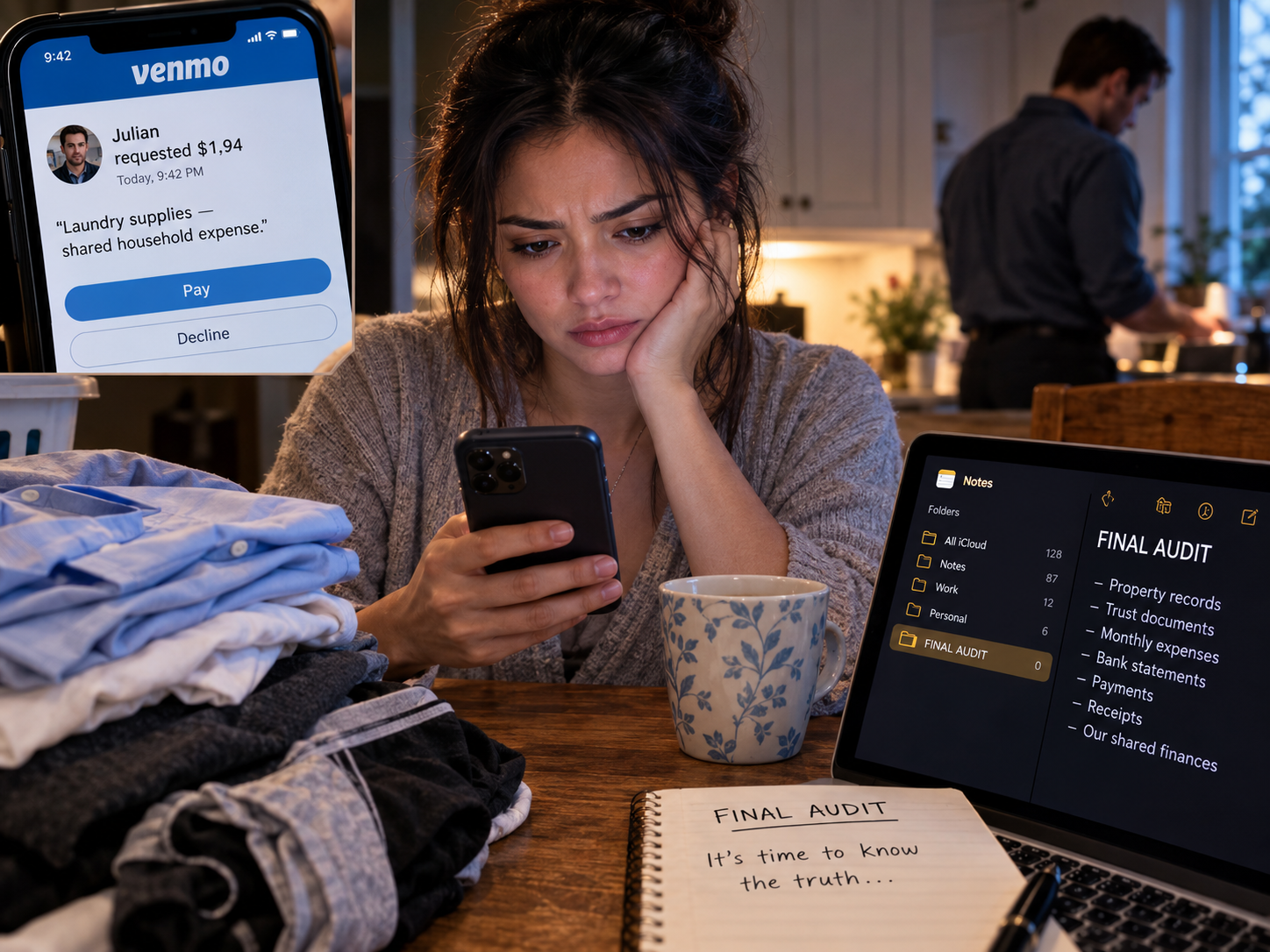
I sat at the kitchen table staring at the wall.
Six months.
For half a year, Julian had known that the commercial building my father left me was gone.
And during those six months, he had looked me in the eyes every morning.
He had kissed me goodbye before work.
He had complained about grocery prices.
He had reminded me to send my half of the electric bill.
He had asked me for $1.94 for laundry detergent.
All while $742,000 had disappeared from an asset connected to my father’s trust.
I looked at the laptop on the counter.
Julian’s laptop.
For a moment, I wanted to open it.
But the attorney’s warning came back to me.
Don’t confront him yet.
Don’t give him time to move anything.
So I did something I had never done during our marriage.
I became patient.
When Julian came home that evening, he found me cooking dinner.
“How was your day?” he asked.
“Fine.”
He kissed my cheek.
“What are we doing about the washing machine?”
“I called someone.”
“How much?”
“I don’t know yet.”
He frowned.
“We should compare prices.”
I smiled.
“Of course.”
He sat down.
I put his plate in front of him.
Chicken.
Rice.
Vegetables.
The ordinary dinner of an ordinary married couple.
Except nothing was ordinary anymore.
After dinner, Julian opened his banking app.
“You still haven’t transferred your half of the insurance.”
“I’ll do it tomorrow.”
He looked annoyed.
“Why tomorrow?”
“Because I said I’ll do it tomorrow.”
He stared at me.
For years, I would have immediately apologized.
That night, I didn’t.
Something in my silence made him uncomfortable.
He closed his phone.
“You’ve been different lately.”
“I’ve been thinking.”
“About what?”
“Our finances.”
His face barely changed.
But I noticed his hand stop moving.
“What about them?”
“I realized I don’t really understand them.”
He smiled.
“That’s because spreadsheets aren’t your thing.”
There it was.
That familiar little dismissal.
The one he had used for years.
I looked down at my plate.
“Maybe I should learn.”
“You don’t need to.”
“Why?”
“Because I’ve always handled it.”
I nodded.
“Right.”
He relaxed.
He thought the conversation was over.
It wasn’t.
The next morning, I met the attorney.
Her office was small and quiet.
She spread copies of the trust documents across the table.
“The commercial property was originally transferred into the trust,” she explained.
I nodded.
“And your father named you as the primary beneficiary.”
“So Julian couldn’t sell it?”
“Not without authority.”
“Did he have authority?”
“That’s what we’re investigating.”
She slid a document toward me.
“This is the sale record.”
I looked at the signature.
My name appeared at the bottom.
I froze.
“That isn’t my signature.”
“I know.”
“Then someone forged it.”
“We don’t know that yet.”
I looked at her.
“What else could it be?”
“An authorized representative may have signed under a power of attorney.”
I remembered the stack of papers Julian had given me after Dad died.
The sticky notes.
The places where he told me to sign.
The documents I barely understood.
My stomach tightened.
“Could Julian have had power of attorney?”
The attorney looked directly at me.
“Yes.”
I closed my eyes.
“Can you find out?”
“Yes.”
She paused.
“But I need you to tell me something.”
“What?”
“Did you ever give your husband permission to manage your father’s estate?”
I swallowed.
“I told him he could help me.”
“That’s different.”
“I know that now.”
She pushed another document across the table.
“This is the most important thing.”
I read it.
It was an authorization.
My name was on it.
But the date was wrong.
It had been signed three months after my father’s funeral.
I remembered that day.
I had been at work.
I had never signed it.
The attorney watched my face.
“You didn’t sign this?”
“No.”
She nodded.
“Then we’re going to have a very different conversation with your husband.”
I stared at the document.
“How much money was in the trust?”
She pulled up a statement.
I expected a small number.
Instead, I saw:
$318,442.17
I stared.
“That was the cash balance?”
“At one point, yes.”
“And Julian told me there was almost nothing.”
The attorney didn’t answer.
She didn’t have to.
I felt something inside me collapse.
Not because of the money.
Because of the years.
Five years of believing I was financially irresponsible.
Five years of being told I didn’t understand money.
Five years of splitting every bill down the middle while he controlled assets I didn’t even know existed.
I asked the attorney one final question.
“Where did the $742,000 go?”
She pointed to several transactions.
“We’ve traced approximately $510,000 so far.”
“To where?”
She hesitated.
“Several business accounts.”
“Whose?”
“That’s where it gets complicated.”
She turned the page.
One company belonged to Julian.
Another belonged to a business associate.
And the third was connected to a woman named Rebecca Sloan.
I recognized the name.
“Who is Rebecca?”
The attorney looked at me.
“She appears to have been involved in several of Julian’s property deals.”
I stared at the name.
Something about it bothered me.
“Was she just a business partner?”
“We’re still investigating.”
I nodded.
Then I remembered something.
Julian had once told me Rebecca was an accountant.
Nothing more.
I left the attorney’s office with a folder under my arm.
On the drive home, I made a decision.
I wasn’t going to confront Julian yet.
I wanted the whole picture.
Because I had finally learned something my husband never expected me to learn.
Being quiet wasn’t the same as being powerless.
That night, Julian sent me another Venmo request.
$38.50.
Dinner groceries.
I paid it.
Then I added another line to my spreadsheet.
Evidence.
And underneath it:
Julian thinks every dollar must be accounted for.
I smiled faintly.
“So do I.”
PART 4 — THE WOMAN IN THE RECORDS
For the next two weeks, I lived two lives.
In the first, I was Julian’s wife.
I went to work.
I made dinner.
I paid bills.
I asked whether he wanted coffee.
I listened when he complained about clients.
I laughed at the right moments.
In the second life, I was building a case.
Every morning before work, I checked the bank records.
Every afternoon, I emailed the attorney.
Every evening, I entered information into my spreadsheet.
And slowly, a pattern emerged.
Julian hadn’t simply taken money from the trust.
He had built a network around it.
Money moved from the trust into one company.
Then into another.
Then into an investment account.
Some of it eventually returned.
Some didn’t.
The attorney called these transactions “layered transfers.”
I called them something simpler.
A maze.
One afternoon, she sent me a message.
We found Rebecca Sloan.
I stared at the screen.
Then came another message.
She agreed to meet.
We met at a coffee shop on a rainy Thursday.
Rebecca arrived ten minutes late.
She was in her early forties, professionally dressed, with a leather folder under her arm.
She looked nervous.
“Are you Claire?”
“Yes.”
She sat down.
“I almost didn’t come.”
“Why did you?”
She looked at the folder.
“Because I think you deserve to know what happened.”
My heart began beating faster.
“What happened?”
Rebecca opened the folder.
“I worked with Julian for three years.”
“On property deals?”
“Yes.”
“Did you know about my father’s building?”
“Yes.”
I stared at her.
“How much did you know?”
“Not everything.”
“But something.”
She nodded.
“Julian told me it was part of an investment restructuring.”
I felt my hands tighten around my coffee.
“Did he tell you it belonged to me?”
Rebecca looked away.
“Not initially.”
“When did you find out?”
“After the sale.”
“Then why didn’t you tell me?”
She took a long breath.
“Because by then, I was already scared.”
“Of Julian?”
“Yes.”
She opened the folder.
Inside were emails.
Messages between her and Julian.
I read them slowly.
One message from Julian said:
Claire doesn’t understand the trust documents. Keep everything under the management company.
Another said:
She’ll sign whatever I put in front of her if I explain it as administrative paperwork.
My eyes blurred.
I put the paper down.
“He said that?”
Rebecca nodded.
“He also said you were too emotional to manage financial decisions.”
I laughed once.
It was a horrible sound.
“Of course he did.”
Rebecca looked ashamed.
“I should have warned you.”
“Yes.”
“I know.”
She slid another document toward me.
“This is the part you don’t know.”
It was a draft purchase agreement.
The commercial property had been sold for $742,000.
But the buyer had originally agreed to pay $910,000.
I stared at the number.
“Why was the sale price lowered?”
Rebecca looked at me.
“Because Julian had already received another payment.”
My stomach turned.
“From whom?”
“The buyer.”
“Personally?”
She nodded.
“Approximately $168,000.”
I couldn’t speak.
The $742,000 sale price wasn’t the whole story.
Julian had apparently received additional money outside the transaction.
Rebecca continued.
“There was something else.”
“What?”
“The buyer wasn’t random.”
She pointed to the company name.
I recognized it.
It was one of Julian’s development partners.
“So he sold my property to his own business network?”
“That’s what the records suggest.”
I stared out the window.
Rain streaked the glass.
For years, Julian had told me he was building our future.
Apparently, he had been building his future.
Using my father’s property.
Using my money.
Using my trust.
I asked Rebecca one question.
“Why are you telling me now?”
She looked at me for several seconds.
“Because Julian did something to me too.”
“What?”
“He told me my partnership interest was worthless.”
She laughed bitterly.
“He moved the profits into another company and told me there was nothing I could do.”
I looked at her.
“So he does this to everyone.”
Rebecca shook her head.
“No.”
She closed the folder.
“He does it to people who trust him.”
That sentence stayed with me.
When I got home, Julian was already there.
He was sitting on the couch watching television.
“You’re late.”
“I stopped for coffee.”
He looked at me.
“With who?”
I smiled.
“A friend.”
His eyes narrowed.
“Which friend?”
I took off my coat.
“Does it matter?”
“Yes.”
I looked at him.
For the first time, I saw fear behind his irritation.
Not much.
Just a flicker.
But it was there.
And I knew something.
He suspected I was getting close.
That night, while he slept, I opened the drawer where we kept our old documents.
At the bottom was a small black folder.
I had never seen it before.
Inside were copies of documents from my father’s estate.
And one page had handwritten notes.
Julian’s handwriting.
One sentence was underlined twice:
Claire must never know about the second account.
I stared at those words until dawn.
The next morning, I called the attorney.
“I found something.”
“What?”
“A second account.”
There was silence.
Then she said:
“Don’t touch it.”
“Why?”
“Because if it still exists, we may finally be able to see where the missing money went.”
I looked toward the bedroom.
Julian was still asleep.
I whispered:
“Then let’s find it.”