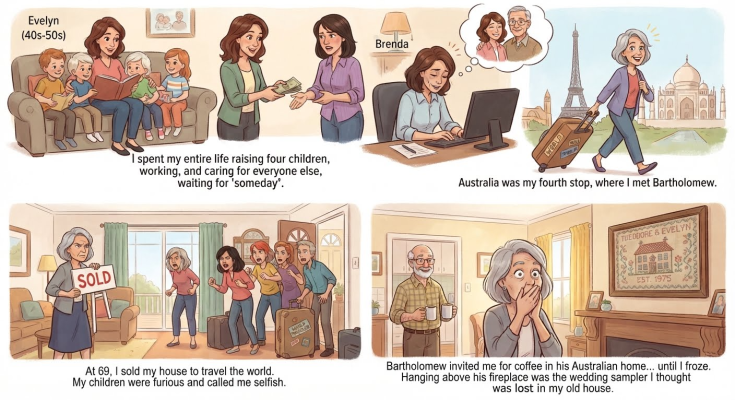
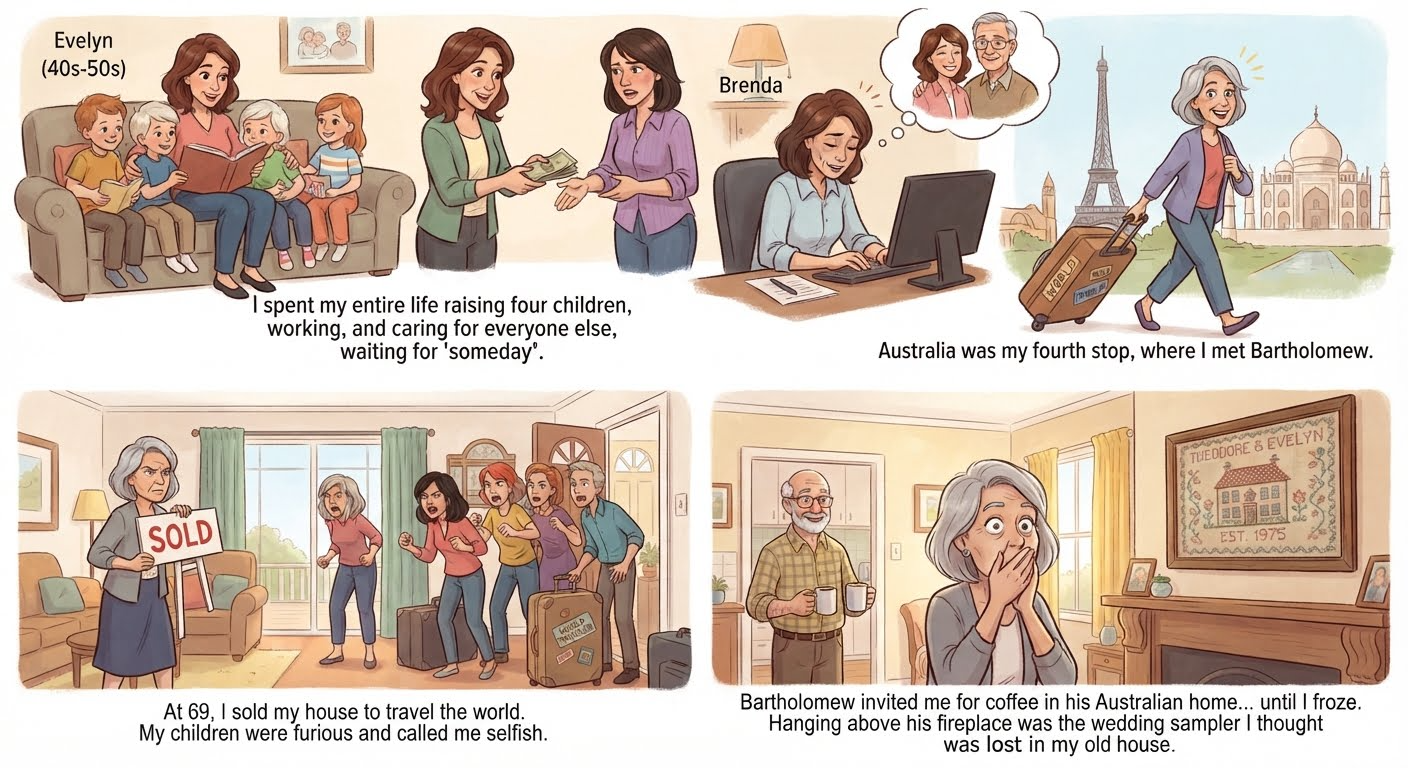
Because I knew that house.
I knew that garden.
I knew the crooked wooden fence on the left side.
I knew the apple tree that leaned toward the kitchen window.
I knew the woman standing in the middle of the photograph.
I had seen that photograph hundreds of times.
It had belonged to my husband, Theodore.
It had been in our house for more than forty years.
Or at least, I thought it had.
My knees suddenly felt weak.
I reached for the back of a chair.
Bartholomew returned carrying two cups of coffee.
He stopped when he saw my face.
“Are you all right?”
I couldn’t answer.
Instead, I pointed toward the fireplace.
“Where did you get that?”
He followed my gaze.
His expression changed.
Not dramatically.
Just enough.
Enough for me to know that whatever I had discovered, he already knew it was important.
“The photograph?”
“Yes.”
He put the cups down slowly.
“Why?”
“Because that’s my house.”
He stared at me.
Then he looked back at the photograph.
“No,” he whispered.
“Yes.”
I walked closer.
My hands were trembling so badly that I had to clasp them together.
“That was my home in Ohio.”
Bartholomew’s face had gone pale.
“How do you know this?”
“Because I lived there for thirty-eight years.”
He didn’t speak.
I pointed at the woman.
“That is my sister, Margaret.”
Then I pointed at the little boy standing beside her.
“That is Theodore.”
Bartholomew took one slow step backward.
“Theodore?”
“My husband.”
The room seemed to become smaller.
I could hear the ticking of a clock somewhere behind me.
Bartholomew rubbed both hands over his face.
Then he sat down.
“Please,” he said quietly. “Sit.”
“I don’t want to sit.”
“I think you should.”
There was something in his voice.
Something that frightened me.
I remained standing.
“Where did you get that photograph?”
He looked at the floor.
“From my father.”
“Your father?”
He nodded.
“My father died eighteen years ago.”
I stared at him.
“And what did your father have to do with my husband?”
Bartholomew didn’t answer immediately.
Instead, he got up and walked toward an old cabinet in the corner.
He opened the bottom drawer.
From inside, he removed a small metal box.
He brought it to the table.
Then he looked at me.
“Before I show you what’s inside, I need you to promise me something.”
“What?”
“That you won’t leave until you’ve heard the entire story.”
My heart began pounding.
“I don’t understand.”
“I know.”
He opened the box.
Inside were letters.
Dozens of them.
Old envelopes.
Some yellowed with age.
Some tied together with faded blue ribbon.
And on the top envelope was a name.
Theodore.
My husband’s name.
I reached for it.
Bartholomew caught my wrist.
“Wait.”
I looked at him.
“Why?”
“Because once you read these, you won’t be able to go back to the life you thought you knew.”
I slowly pulled my hand away.
For twelve years, I had believed I knew my husband.
Theodore had been the quiet center of my life.
He wasn’t perfect.
He could be stubborn.
He could be distant.
But I had loved him.
Even after he died.
Especially after he died.
There were nights when I still turned toward his side of the bed before remembering it was empty.
There were mornings when I reached for my coffee mug and thought I heard him moving around downstairs.
And now this stranger was telling me there was something about Theodore I had never known.
“What are those letters?”
Bartholomew looked directly into my eyes.
“They were written to my father.”
“By whom?”
He swallowed.
“Your husband.”
The room spun.
I grabbed the chair again.
“No.”
“I know this is difficult.”
“No.”
“I didn’t know who you were when I met you.”
“Then how did you know about Theodore?”
“I didn’t.”
“Then why did you invite me here?”
“I invited you because I liked you.”
I looked at him suspiciously.
“And the photograph?”
“I’ve had it since I was a child.”
“Why?”
“My father told me never to throw it away.”
“Why?”
Bartholomew looked at the photograph again.
“Because he said one day, someone might come looking for it.”
I felt a chill move through me.
“Someone like me?”
He nodded.
I stared at the photograph.
The woman beside Theodore was my sister Margaret.
But Margaret had died when she was twenty-six.
And the photograph had been taken in front of my childhood home.
A photograph I remembered disappearing decades ago.
I looked at Bartholomew.
“What did my husband write to your father?”
He opened the first envelope.
Inside was a letter.
The paper was brittle.
The handwriting was unmistakable.
I knew those letters.
I had seen Theodore write grocery lists, birthday cards, notes on the refrigerator.
It was his handwriting.
I took the letter.
My hands shook as I unfolded it.
The first line read:
Dear Arthur,
I stopped.
Arthur.
Bartholomew’s father.
I kept reading.
The letter was dated forty-seven years earlier.
And the final sentence made my blood run cold.
If she ever finds out what happened that night, I hope she can forgive me.
I looked up.
“What’s that supposed to mean?”
Bartholomew didn’t answer.
I read the letter again.
Then again.
There was a date.
A date I remembered.
The night Margaret disappeared.
My sister had supposedly run away from home.
That was what our family had always been told.
She had left without saying goodbye.
She had taken a small suitcase.
She had never returned.
My mother blamed herself.
My father refused to discuss it.
And Theodore…
Theodore had always told me Margaret simply wanted a different life.
But according to this letter, Theodore knew more.
Much more.
I looked at Bartholomew.
“What happened to my sister?”
His eyes filled with sadness.
“I think that’s what you’ve been searching for your entire life.”
“I wasn’t searching for anything.”
“Yes, you were.”
He looked toward the photograph.
“You just didn’t know it.”
Then he handed me another envelope.
“This one explains why your husband kept the secret.”
I hesitated.
Then I opened it.
And as I read, the life I thought I understood began falling apart.
Not because Theodore had betrayed me.
But because he had spent forty-seven years protecting someone.
Someone who was still alive.
Someone whose name I knew.
Someone I had spoken to only weeks before leaving America.
Someone who had called me selfish for selling my house.
My eldest daughter, Brenda.
I dropped the letter.
“That’s impossible.”
Bartholomew looked at me.
“What is?”
I whispered the words.
“My daughter knew.”
He didn’t respond.
“Brenda knew about Margaret.”
“How?”
“I don’t know.”
I picked up the letter again.
There was another page.
At the bottom was a name.
Not Theodore’s.
Not Arthur’s.
Margaret’s.
And beneath it were six words that made my entire body go cold.
I never left willingly, Evelyn.
My name.
My sister had written my name.
And suddenly, I understood why Theodore had never wanted me to ask questions.
Because the truth wasn’t buried in the past.
It had been following my family all along.
I didn’t sleep that night.
Bartholomew let me stay in the spare bedroom.
He didn’t pressure me to talk.
He didn’t ask questions.
He simply left a glass of water beside the bed and said, “Whatever you decide, you don’t have to face it alone.”
I lay awake until sunrise.
Every memory of my life had become suspicious.
Every conversation.
Every photograph.
Every silence.
Most of all, every silence.
I thought about Theodore.
I remembered the night Margaret disappeared.
I had been twenty-two.
Margaret was twenty-six.
She had argued with our father after dinner.
I remembered hearing shouting.
I remembered Margaret crying.
I remembered Theodore arriving later that evening.
At the time, I had assumed he came to calm everyone down.
The next morning, Margaret was gone.
And somehow, over the years, the story became simple.
She had left.
She wanted freedom.
She didn’t want to be found.
We accepted it because accepting it was easier than asking questions.
But now I knew that wasn’t the truth.
At seven in the morning, Bartholomew knocked gently on the door.
“Coffee?”
I sat up.
“Yes.”
When I entered the kitchen, he had already prepared breakfast.
Two plates.
Two cups.
He looked at me carefully.
“You don’t have to read anything else today.”
“Yes, I do.”
“You’ve barely slept.”
“I’ve waited forty-seven years.”
He lowered his eyes.
I sat across from him.
“Tell me about your father.”
Bartholomew sighed.
“My father was a complicated man.”
“Was he friends with Theodore?”
“Yes.”
“How did they meet?”
“Through work.”
“What kind of work?”
Bartholomew hesitated.
“Your husband worked with my father for several years.”
My heart sank.
“Theodore never mentioned him.”
“He probably didn’t want you to know.”
“Why?”
“Because my father was involved in something illegal.”
I stared at him.
“What?”
“Financial fraud.”
I felt strangely calm.
Perhaps after everything else, there was no room left for shock.
“Was Theodore involved?”
“No.”
Bartholomew leaned forward.
“But he found out.”
“And Margaret?”
“My father believed Margaret knew too much.”
The room became silent.
“What did he do to her?”
Bartholomew shook his head.
“My father never told me everything.”
“Then what do you know?”
“I know Margaret didn’t run away.”
My eyes filled with tears.
“I knew it.”
“I know.”
“I always knew.”
Bartholomew reached across the table but didn’t touch me.
“There was a place,” he continued. “A farmhouse outside the city. My father used it to hide documents.”
I stared at him.
“Was Margaret there?”
“For a while.”
“Is she alive?”
He looked away.
“I don’t know.”
That answer hurt more than a simple no.
I closed my eyes.
For forty-seven years, I had imagined my sister walking somewhere under another name.
I had imagined her growing old.
I had imagined finding her.
And now I was terrified that my imagination had been kinder than reality.
Bartholomew went upstairs.
When he returned, he was holding another box.
“This belonged to my father.”
He placed it on the table.
Inside was a small cassette tape.
An old photograph.
And a handwritten address.
I stared at the address.
I knew it.
My hands went numb.
It was the address of the farmhouse.
The same farmhouse Theodore had once told me belonged to a friend.
I looked at Bartholomew.
“My husband knew.”
“Yes.”
“Why didn’t he tell me?”
“Because he was afraid.”
“Of my father?”
“No.”
“Then who?”
Bartholomew’s voice became very quiet.
“Your family.”
I couldn’t understand.
“My family?”
“Your father had threatened him.”
“With what?”
“Your father knew Theodore loved you.”
I stopped breathing.
“He told Theodore that if he ever told you what happened to Margaret, he would destroy your life.”
“But Theodore could have told me after my father died.”
“Yes.”
“Why didn’t he?”
Bartholomew looked at the floor.
“Because by then, he believed Margaret was dead.”
The tears came before I could stop them.
For the first time in twelve years, I cried for Theodore.
Not because he had kept a secret.
But because I finally understood the weight of it.
He had carried it alone.
And perhaps he had believed that protecting me meant allowing me to hate him for his silence.
Then I noticed something.
The photograph.
I picked it up.
On the back was a date.
And beneath it, a sentence.
She is safe.
My heart stopped.
“Bartholomew.”
He looked at me.
“This photograph was taken after Margaret disappeared.”
He nodded.
“Yes.”
“Then who took it?”
“My father.”
“Where?”
He didn’t answer.
I turned the photograph over again.
There was another line I hadn’t noticed.
An address.
I read it.
It wasn’t the farmhouse.
It was a small coastal town several hours away.
My hands began shaking.
“She’s alive.”
Bartholomew stared at me.
“We don’t know that.”
“I do.”
“How?”
“Because Theodore knew.”
I remembered something from the letter.
A sentence I had almost ignored.
I promised her I would never reveal where she was unless Evelyn was finally free.
Finally free.
I suddenly understood.
Selling my house.
Leaving my children.
Traveling.
For the first time in my life, I had stopped living according to everyone else’s expectations.
I had finally become free.
And perhaps that was why the truth had found me.
That afternoon, Bartholomew drove me to the coastal town.
We stopped outside a small blue house.
I couldn’t move.
“What if she’s not there?”
“What if she is?”
I looked at the front door.
Then I knocked.
Once.
Twice.
Nothing.
I knocked again.
Footsteps.
Slow footsteps.
The door opened.
An elderly woman stood there.
Her hair was white.
Her shoulders were slightly bent.
But her eyes…
I knew those eyes.
My entire body went weak.
The woman stared at me.
For a moment, neither of us spoke.
Then she whispered my name.
“Evelyn?”
I covered my mouth.
“Margaret?”
She began crying.
So did I.
We didn’t hug immediately.
We simply stood there, staring at one another, as though we were both afraid that moving would make the other disappear.
Then Margaret opened her arms.
I stepped forward.
And after forty-seven years, I held my sister again.
That night, she told me everything.
She had never run away.
She had been forced to disappear because she had discovered what our father was doing.
Theodore had helped her escape.
He had arranged for her to leave the state.
He had visited her twice.
Then once.
Then never again.
Because our father had found out.
Margaret had spent decades living quietly under another name.
She had married.
She had lost her husband.
She had built a life.
But she had never forgotten me.
“Why didn’t you come back?” I asked.
She took my hand.
“Because Theodore told me you would be safer if you believed I was gone.”
I cried.
“He protected me all those years.”
“Yes.”
“Why didn’t he tell me before he died?”
Margaret looked down.
“Because he was afraid you’d blame yourself.”
I couldn’t speak.
Then she gave me something.
A letter.
The last letter Theodore had ever written to her.
I opened it.
There were only a few paragraphs.
He wrote that he was sick.
He wrote that he didn’t have much time.
And he wrote that someday, if I ever stopped living for everyone else, Margaret should find me.
The final line broke my heart.
Evelyn deserves the truth only when she is strong enough to choose her own life.
I folded the letter against my chest.
For years, I had thought Theodore’s greatest gift to me was our marriage.
I had been wrong.
His greatest gift was the freedom he had quietly protected for me.
When I returned home weeks later, I didn’t call my children immediately.
For the first time in my life, I didn’t feel obligated to explain myself.
Eventually, I called Brenda.
She answered.
“Mom?”
Her voice sounded cautious.
“I found Margaret.”
There was silence.
Then Brenda whispered, “What?”
“I found my sister.”
She began crying.
And then she said something I never expected.
“Grandma used to talk about her.”
I froze.
“What did you say?”
“Grandma told me about Aunt Margaret.”
“Brenda, how much did you know?”
“I didn’t know where she was. I swear.”
I believed her.
But I also understood something else.
My family had spent generations protecting secrets because they believed secrets were another form of love.
They weren’t.
Love should not require you to disappear.
Love should not require you to sacrifice your entire life.
And love should never mean that one person gives everything while everyone else simply takes.
I still traveled.
I still carried my own suitcase.
I still stayed in small hotels and drank coffee with strangers and watched sunsets in places I had never imagined seeing.
But I also began visiting Margaret.
We had forty-seven years to make up for.
Sometimes we talked for hours.
Sometimes we sat quietly.
Sometimes we laughed about childhood memories.
Sometimes we cried.
And occasionally, when I looked at the photograph above Bartholomew’s fireplace, I remembered the woman I had been before that day.
A woman who believed her purpose was to take care of everyone else.
A woman who thought saying no was selfish.
A woman who believed her children were entitled to every sacrifice she had left to give.
I don’t think she was foolish.
I think she was simply tired.
And perhaps that’s why, at sixty-nine, I finally gave myself permission to become someone new.
I had spent my entire life waiting for someday.
Someday to travel.
Someday to rest.
Someday to be happy.
Someday to live for myself.
But someday had never been a date on the calendar.
It had always been a choice.
And when I finally chose myself, I didn’t lose my family.
I discovered which parts of my family were worth keeping.
The strange thing is, I had left America believing I was running away from my past.
I wasn’t.
I was finally traveling far enough to find the truth.
And, in the end, the greatest mystery wasn’t why my sister had disappeared.
It was why I had spent so many years disappearing from my own life.
I never made that mistake again.
PART 3 CONTINUED — THE LETTER THEODORE NEVER SENT
I never made that mistake again.
That was what I told myself.
It sounded firm.
It sounded like the sort of sentence a woman could build the rest of her life around.
But making one brave decision did not erase sixty-nine years of habits.
I still reached for my phone when I thought one of my children might need something.
I still felt a little guilty ordering a good meal when there was no one across the table to enjoy it with me.
And some mornings, even after finding Margaret, I woke with a terrible urge to go backward.
Back to the house.
Back to the routines.
Back to a life whose disappointments I understood.
The truth had given me my sister.
It had also taken away the comfort of believing I knew every person I had loved.
Three weeks after I returned from Australia, I rented a furnished apartment near the lake.
Six months.
That was all I committed to.
The woman showing it to me kept mentioning how convenient it would be for visiting grandchildren.
I let her finish.
Then I asked whether the bedroom window caught the morning light.
She looked surprised.
“Yes,” she said.
“It does.”
I took it.
On my first morning there, sunlight crossed the floor in a pale rectangle.
I made coffee.
I sat in the chair beside the window.
Nobody had left laundry for me.
Nobody needed a ride.
Nobody had borrowed money without saying when they would return it.
The silence should have felt like peace.
Instead, it made me cry.
Then my phone rang.
Margaret.
“Have you eaten?” she asked.
I laughed through the tears.
“You sound like our mother.”
“Oh, don’t say that.”
Her answer came so quickly that we both went quiet.
There were still names we could not use casually.
Still memories with sharp edges.
After a moment, Margaret said, “Have you eaten, though?”
“Toast.”
“That doesn’t count as a meal.”
“It counts as breakfast.”
“Only if there’s something on it.”
“There’s butter.”
“Fine.”
I could hear the kettle in her kitchen.
For forty-seven years, I had imagined finding my sister in some grand, overwhelming moment.
I had never imagined arguing with her about toast.
That was the part I wanted now.
Not another revelation.
An ordinary morning.
A woman on the other side of the world who remembered who I had been before I became everyone else’s mother.
Then Margaret said, “I found something.”
My hand tightened around the mug.
“What?”
“A letter.”
“From Theodore?”
“Yes.”
I looked toward the suitcase still standing near my bedroom door.
“There were so many.”
“This one was never posted.”
“Then how do you have it?”
“He left it with me.”
“When?”
“The last time he came.”
I did not speak.
Margaret’s voice grew careful.
“It’s addressed to you.”
THE PART I HAD CALLED PROTECTION
She sent me photographs of the letter that afternoon.
Theodore’s handwriting filled four pages.
I opened the first image.
Then I closed it.
For twelve years, I had lived with the permanent fact that my husband would never say another new thing to me.
Now his voice kept arriving from drawers and envelopes.
Every new sentence changed the meaning of an old memory.
I made tea.
I moved to the table.
Then I opened the image again.
Evelyn,
I have started this letter so many times that the first paragraph no longer feels honest.
So I am going to begin with what happened.
I read slowly.
Theodore described the night Margaret disappeared.
The argument.
My father’s anger.
Arthur arriving after dark.
The farmhouse.
The first time Theodore understood that Margaret had not been free to leave.
There were things Margaret had already told me.
There were things she had not.
He wrote about helping her get away.
He wrote about money.
He wrote about arranging transport through someone Arthur knew, then worrying for years that trusting that person had been another mistake.
But it was the third page that made me put down the phone.
Your father frightened me.
That is true.
But it is not the whole truth.
After he died, there were chances to tell you.
There were birthdays.
Quiet evenings.
Long drives when you asked whether I ever thought about Margaret.
I said I did.
I let you believe we were remembering the same loss.
By then, I was not only protecting her location.
I was protecting myself from the moment you would look at me and understand how long I had kept something from you.
I stared at the words.
For weeks, I had held the story of Theodore’s sacrifice against my heart.
It had made the pain easier to carry.
He had protected me.
He had protected Margaret.
He had suffered quietly.
All of that might be true.
But here was another truth, written by the man himself.
He had also been afraid of my anger.
I opened the final page.
If I give you this letter, I will have to accept whatever you decide.
If I do not, I will leave you with a version of our marriage that cannot answer your questions.
I know which choice is right.
I wish knowing made it easier.
The letter ended there.
No promise.
No instruction about waiting until I was strong enough.
No comforting conclusion.
I called Margaret.
She answered on the third ring.
“Did you read it?”
“Yes.”
For a while, I could not say anything else.
Then I asked, “Why didn’t he give it to me?”
“He said he would.”
“When?”
“Before he went home.”
“But he didn’t.”
“No.”
I looked at the sunlight moving across my rented floor.
“I’ve been telling myself he had no choice.”
Margaret was quiet.
Then she said, “I did that too.”
“About Theodore?”
“About everyone.”
Her voice softened.
“It helped me get through some years.”
I leaned back in the chair.
“I can love him and be angry.”
“Yes.”
“I don’t know how to do both.”
“You don’t have to do it neatly.”
I began crying.
Not the sharp crying of the day I found her.
Something slower.
A grief with a new shape.
The man I had loved had done brave things.
He had done frightened things.
He had given me a good life in many ways.
He had also decided which truths I could bear.
I could not ask him why.
I could not make him stay in a room while I told him what that had cost.
Margaret waited on the telephone.
Then she said, “Evelyn?”
“Yes?”
“You were strong enough before you sold the house.”
I closed my eyes.
“You were strong enough when you were twenty-two.”
BRENDA AT THE DOOR
Brenda came to my apartment on a Saturday.
She called first.
That small courtesy mattered more than she knew.
“I’d like to see you,” she said.
“What about?”
“You.”
I let the silence stretch.
Then she added, “And some things I should have said sooner.”
“All right.”
She arrived carrying flowers.
I put them in water because flowers did not deserve to become part of an argument.
Brenda sat on the sofa with her handbag on her knees.
She looked around.
“It’s smaller than your house.”
“Yes.”
“Do you like it?”
“I do.”
She nodded.
Then she began crying.
I had expected anger.
Perhaps excuses.
I was less prepared for tears.
For years, Brenda’s tears had sent me immediately into motion.
A bill paid.
A child collected.
A weekend rearranged.
This time, I stayed in my chair.
“I’m sorry I blocked you,” she said.
I looked at her.
“Why did you?”
“I was angry.”
“About what?”
“The house.”
“The money?”
She flinched.
“That too.”
I waited.
Brenda lowered her eyes.
“I had plans.”
“With my money?”
She wiped her face.
“Yes.”
The answer hurt.
It was also the first honest one she had given me.
“I didn’t think of it that way.”
“How did you think of it?”
“As family money.”
“It was my home.”
“I know.”
“And selling it did not make the money belong to everyone.”
“I know that now.”
I looked at the flowers on the counter.
“Do you?”
She nodded.
Then she said, “I was scared.”
“Of what?”
“That there wouldn’t be enough later.”
“Enough for whom?”
She did not answer immediately.
At last, she whispered, “For me.”
There it was.
Not a monstrous confession.
An ordinary selfish thought she had allowed to become a right.
I sat with it.
Then I asked about Margaret.
“What did Grandma tell you?”
Brenda folded a tissue into a small square.
“Not much at first.”
“How old were you?”
“Sixteen.”
I remembered that year.
My mother had been ill.
Brenda spent several afternoons with her after school.
I had thought it was kind.
It had been kind.
It had also given my mother a new audience.
“She said you had a sister who caused trouble,” Brenda told me.
I felt my jaw tighten.
“What kind of trouble?”
“She said Margaret accused people.”
“She said she nearly destroyed the family.”
“She said sometimes a person had to leave because staying would make everyone miserable.”
I looked toward the window.
The language had changed.
The story had not.
“Did she say Margaret was alive?”
“Once.”
Brenda’s voice trembled.
“She said, ‘People can be alive and still be gone from a family.’”
I remembered my mother saying something similar after an argument with a cousin.
At the time, it had sounded like bitterness.
Now I heard its purpose.
“What did you do?” I asked.
“Nothing.”
“Did you ask your father?”
“Yes.”
My chest tightened.
“What did he say?”
“He told me your aunt’s life was private.”
“He said bringing it up would hurt you.”
Brenda began crying harder.
“He made me promise not to repeat Grandma’s stories.”
I stood and fetched a box of tissues.
Then I sat again.
“So you knew there was something I didn’t know.”
“Yes.”
“But you didn’t know where Margaret was.”
“No.”
“I didn’t know she was in Australia.”
“I didn’t even know whether Grandma had told me the truth.”
I looked at my daughter.
For years, I had thought secrecy belonged to older people.
My father.
My mother.
Theodore.
Now I saw how easily it moved.
A whisper.
An instruction.
A child praised for being mature enough to keep quiet.
Brenda had carried it into adulthood.
Then she had stood in my kitchen and called me selfish because I would not preserve the life she expected.
“I wish you’d asked me,” I said.
“I was afraid.”
“Of me?”
She nodded.
That answer hurt differently.
“Why?”
“Because whenever Dad’s name came up after he died, you looked like you couldn’t survive hearing anything bad about him.”
I wanted to deny it.
Then I remembered defending his habits.
His absences.
His silences.
The way I had made grief into a room nobody else could enter without being careful.
“I might have been angry,” I said.
“I know.”
“But that still should have been my conversation to have.”
Brenda nodded.
“I’m sorry.”
I looked at her for a long time.
Then I said, “An apology doesn’t give us the years back.”
“I know.”
“What it can do is change what happens next.”
She put the tissue down.
“What do you want me to do?”
“Call me sometimes when you don’t need anything.”
Her face crumpled.
“And don’t punish me for having a life.”
THE DINNER MY CHILDREN DID NOT EXPECT
Two weeks later, I invited all four children to dinner.
Not at my apartment.
A quiet restaurant.
Everyone would pay for their own meal.
I wrote that clearly in the message.
Douglas responded with a laughing face.
I did not answer it.
Mitchell asked whether there was a special occasion.
“Yes,” I wrote.
“We need to talk.”
Jocelyn called.
“Is something wrong?”
“There are things I want to say.”
“About Australia?”
“About all of us.”
They came.
For a moment, seeing them around one table moved me so deeply that I nearly abandoned everything I had planned.
Brenda’s hair fell across her cheek the way it had when she was little.
Mitchell kept adjusting the cuff of his shirt.
Douglas looked tired.
Jocelyn reached for my hand before sitting down.
These were my children.
I remembered fevers.
School plays.
Nightmares.
The first time each of them said my name.
I loved them.
That was precisely why I had to stop pretending love could survive any arrangement without changing.
We ordered.
The waiter left.
Then Douglas said, “So, what’s the big announcement?”
I placed my napkin in my lap.
“I’m going back to Australia.”
Mitchell sighed.
“For how long?”
“Several months.”
Jocelyn looked surprised.
“Several?”
“Yes.”
“What about Christmas?”
“We’ll make plans.”
Douglas leaned back.
“Mom, haven’t you traveled enough?”
I looked at him.
“No.”
Brenda watched her brothers.
Mitchell put down his water glass.
“Do you know what all this is costing?”
“Yes.”
“Have you thought about the future?”
“Every day.”
“What happens when you need help?”
“I’m making arrangements.”
“Arrangements with whom?”
I held his gaze.
“That’s a reasonable question if you’re asking because you want to help me plan.”
He went quiet.
“If you’re asking because you want me frightened enough to stop living, it’s a different conversation.”
Jocelyn squeezed my hand.
“Mom, we’re worried.”
“I believe that.”
“And we miss you.”
I looked at her.
“Then say that.”
She swallowed.
“We miss you.”
“That I can hear.”
For a moment, the table softened.
Then Douglas said, “The house still should have stayed in the family.”
I looked at him.
“What did that mean to you?”
He frowned.
“What?”
“Did it mean you would maintain it?”
“Pay the taxes?”
“Come when the plumbing failed?”
“Stay with me when I was lonely?”
He shifted in his chair.
“It was our childhood home.”
“It was my everyday home.”
Nobody spoke.
“You got to remember it,” I said.
“I had to live in it.”
Brenda looked down.
Mitchell stared at the table.
I continued.
“I am not telling you this because I don’t love you.”
“I’m telling you because I spent years saying yes and quietly resenting the people I was saying yes to.”
Jocelyn’s eyes filled.
“I didn’t know.”
“Sometimes I didn’t let you know.”
I took a breath.
“I said I was fine when I wasn’t.”
“I offered help before you asked.”
“I made being needed feel safer than being alone.”
I looked at each of them.
“That part belongs to me.”
“Treating my time and money as something you could count on without asking belongs to you.”
The waiter returned with our meals.
For a few minutes, practical things interrupted us.
Plates.
Cutlery.
Someone asking for extra dressing.
I was grateful.
Families cannot change without occasionally needing to pass the salt.
When the waiter left, Mitchell spoke.
“I was angry you didn’t discuss the sale with us.”
“I told you before I sold.”
“You didn’t let us decide.”
“No.”
He stared at me.
Then, slowly, he nodded.
Brenda said, “I owe you an apology.”
Douglas looked at her.
“You already gave one.”
“I owe her one here.”
She turned toward me.
“I blocked your number because I wanted you to feel the loss until you changed your mind.”
Jocelyn covered her mouth.
Brenda’s eyes filled.
“That was cruel.”
I held her gaze.
“Yes.”
“I’m sorry.”
“Thank you.”
Douglas pushed food around his plate.
He did not apologize that evening.
I did not force him.
At the end of dinner, we paid separately.
Jocelyn hugged me.
Mitchell asked whether I would send him my itinerary.
“Of course.”
Brenda asked whether she could visit before I left.
“Yes.”
Douglas stood beside his car with his hands in his pockets.
“I still think this is a mistake.”
I nodded.
“You’re allowed to think that.”
Then I went home.
For once, disagreement did not require me to surrender the decision.
THE MAN WHO HAD OPENED THE DOOR
Bartholomew called every Sunday.
Sometimes we talked for an hour.
Sometimes ten minutes.
He told me about the garden.
A leaking tap.
A neighbor’s dog who stole gardening gloves and hid them behind a shed.
I told him about my apartment.
The lake.
My children.
The dinner.
He listened.
Then one afternoon, I asked him something I had been afraid to ask since Australia.
“Why did your father keep the letters?”
Bartholomew grew quiet.
“I don’t know all his reasons.”
“What do you think?”
“He wanted proof that he hadn’t been the worst man in the story.”
I looked at the wall.
Arthur had been involved in what happened to Margaret.
Later, he had helped preserve records.
He had kept a photograph.
He had allowed evidence of his own life to survive.
None of that made the earlier things disappear.
“Did he ever apologize to her?” I asked.
“Yes.”
“Did she forgive him?”
“I don’t know.”
“Did you ask?”
“No.”
A pause.
“I used to think I had the right to an answer.”
“And now?”
“Now I think that was between them.”
I let that settle.
Then I asked, “When you handed me the letters, how much did you know?”
He drew a breath.
“Enough to know your family was connected.”
“Not enough to understand every page.”
“And you didn’t know who I was when we met?”
“No.”
I remembered his hand catching my wrist.
His warning that nothing would be the same.
“Then why did you sound so certain about my life?”
His answer came slowly.
“Because I was frightened too.”
I waited.
“I had imagined someone arriving for those letters for years.”
“Then you were standing in my living room.”
“And instead of letting you decide what you needed, I tried to direct the moment.”
He paused.
“I shouldn’t have touched your wrist.”
I looked down at my hand.
“No.”
“I’m sorry.”
“Thank you.”
For a while, neither of us spoke.
Then Bartholomew said, “Would you still like to come for coffee when you’re here?”
I smiled.
“Yes.”
“No promises required?”
“No promises.”
He laughed softly.
“Good.”
I did not know whether what was growing between us was friendship or something more.
For the first time in my life, I did not feel obliged to give it a name before enjoying it.
MARGARET’S OWN LIFE
When I returned to Australia, Margaret insisted I stay nearby rather than in her house.
“Not because I don’t want you,” she said.
“I know.”
“Because I’ve lived alone a long time.”
“So have I.”
“And I sometimes need an entire afternoon without speaking.”
“I understand.”
She looked relieved.
I rented a small apartment within walking distance.
On the first evening, we ate at her kitchen table.
She served soup and bread.
A photograph of her late husband stood on the sideboard.
I had looked at it before.
I had not asked much.
Too much of our first reunion had been devoted to the family we shared.
Now I pointed toward it.
“Tell me about him.”
Margaret looked over her shoulder.
“Samuel.”
“I know his name.”
“I mean him.”
Her expression softened.
“He hated pears.”
I laughed.
“That’s where you’re starting?”
“It was a serious opinion.”
She set down her spoon.
“He could repair a clock.”
“He couldn’t make rice.”
“He cried at films and blamed his allergies.”
I smiled.
“What did he know about us?”
“Most of it.”
“Did he want you to come home?”
“He wanted me to choose.”
She looked at the photograph again.
“He said home shouldn’t be somewhere you had to earn the right to return.”
I felt my throat tighten.
“Did he make you happy?”
“Yes.”
Then she added, “We argued.”
“Of course.”
“Sometimes I was unfair.”
“Sometimes he was.”
“He left cupboard doors open.”
“I thought that was a personal attack.”
I laughed.
Margaret laughed too.
For a while, we were simply two women discussing husbands.
Then she grew quiet.
“I need to tell you something.”
“All right.”
“Finding you is wonderful.”
I waited.
“But the years before you found me weren’t all empty.”
I looked at her.
“I know.”
“I don’t think you always do.”
The words stung.
She reached across the table.
“I had friends.”
“I had work.”
“I had Samuel.”
“I grew flowers.”
“I had terrible haircuts.”
She smiled sadly.
“I missed you.”
“But I also lived.”
I looked toward Samuel’s photograph.
I had been calling those decades lost.
To me, they were.
To Margaret, they contained an entire marriage.
An ordinary life.
A version of herself I had not known.
“I’m sorry,” I said.
“I don’t want to turn your life into a waiting room.”
Her eyes filled.
“That’s what I was trying to say.”
I took her hand.
“Then tell me about the terrible haircuts.”
She laughed.
“Oh, Evelyn.”
“There were photographs.”
THE JOURNEY SHE HAD NOT TAKEN
By the end of the month, Margaret and I had developed routines.
Tuesday lunches.
Thursday walks.
Sunday mornings with old photographs.
Sometimes Bartholomew joined us.
Sometimes Ruth.
Sometimes Margaret said she was tired, and I went home without asking whether she was really all right.
One afternoon, I found a travel brochure beneath a gardening magazine.
Tasmania.
“You’ve been?” I asked.
“No.”
“Would you like to?”
Margaret looked at the brochure.
“Samuel and I talked about it.”
“What happened?”
“Work.”
“Then his health.”
“Then mine.”
She smiled faintly.
“The usual things.”
I knew them.
The respectable reasons a dream could be postponed until nobody remembered calling it a dream.
“We could go,” I said.
She shook her head.
“I don’t know.”
“We don’t have to.”
“I’ve never traveled with anyone except Samuel.”
“All right.”
“I’d be slow.”
“So would I.”
“I’d need to rest.”
“Excellent.”
“I’m serious.”
“So am I.”
She looked at me.
I let the idea sit.
For three days, she said nothing about it.
On the fourth, she called.
“I want a room with my own bathroom.”
I smiled.
“Of course.”
“And no itinerary where we have to be somewhere before breakfast.”
“Agreed.”
“And if I want to spend a day doing nothing—”
“Then we do nothing.”
She was quiet.
Then she said, “I think I’d like to go.”
We booked four nights.
Not around the world.
Not an expedition.
A small trip.
On the morning we left, Margaret stood outside her blue house with a suitcase beside her feet.
Her hand shook while she locked the door.
I waited.
When she turned toward me, her eyes were wet.
“What is it?”
She looked at the suitcase.
“The last time I left a house with a bag, I wasn’t doing it because I wanted to.”
I moved closer.
“Would you like to stay?”
She shook her head.
“No.”
She took the handle.
“I want to know what this feels like.”
TWO SISTERS BESIDE THE WATER
We were not elegant travelers.
I forgot where I put the tickets.
Margaret packed enough cardigans for a small orchestra.
We disagreed about whether we needed a map.
Then we discovered neither of us understood the map.
At the hotel, Margaret opened every cupboard.
“Checking for criminals?” I asked.
“Checking for spare blankets.”
“A sensible priority.”
Our first evening, we sat beside a window overlooking the water.
Margaret held a cup of tea in both hands.
Outside, the sky changed slowly.
No one needed us home.
No one was waiting for dinner.
No one had left a message saying we were selfish.
After a long while, Margaret said, “Do you remember the night we slept in the garden?”
I smiled.
“We weren’t supposed to.”
“You said the apple tree would protect us.”
“I was nine.”
“You were very persuasive.”
We remembered a blanket.
A jar with holes in the lid.
Our mother calling from the kitchen.
The way the night grew colder than we expected.
Then Margaret said, “I used to remember us as children because it hurt less than imagining you grown.”
I looked at her.
“Why?”
“Children don’t choose to stop calling.”
I felt tears rise.
“I would have come.”
“I know.”
“If I’d known, I would have come.”
She turned toward me.
“I know that now.”
The water outside moved in dark bands beneath the fading light.
I took her hand.
For years, I had wanted an explanation large enough to make everything bearable.
There wasn’t one.
There was no sentence that returned the missing birthdays.
No apology that restored our mother while leaving her choices behind.
No letter that gave Theodore another chance to tell me.
There was this.
My sister’s hand.
A hotel room.
Tomorrow morning.
We stayed by the window until neither of us could see the water clearly.
Then Margaret said, “I’m hungry.”
I laughed through my tears.
“So am I.”
We went downstairs for dinner.
THE GRANDDAUGHTER WHO ASKED A DIFFERENT QUESTION
While I was away with Margaret, my granddaughter Lucy called.
Brenda’s daughter.
Twenty-three.
Fresh out of college.
She appeared on the screen wearing a sweatshirt with paint on one sleeve.
“Grandma?”
“Hello, sweetheart.”
“Mom said you’re traveling again.”
“I am.”
“Is Aunt Margaret there?”
Margaret leaned into the picture.
Lucy smiled.
“Hi.”
Margaret waved.
Then Lucy looked back at me.
“Can I ask something?”
“Yes.”
“Were you scared when you left?”
I thought about the sold house.
The airport.
The first hotel room.
The way I had cried while pretending to look for something in my suitcase.
“Yes.”
“But you went anyway.”
“Yes.”
Lucy nodded.
Then she lowered her eyes.
“I have a job offer.”
“That’s wonderful.”
“It’s far away.”
“How far?”
She told me.
Not another continent.
Still far enough to change the way her family used her time.
“Your mother knows?”
“Yes.”
“What does she think?”
Lucy hesitated.
“She says she’ll miss me.”
I waited.
“She also says I should go.”
Something inside me loosened.
“Does she mean it?”
“I think so.”
“She cried.”
“People can mean it and cry.”
Lucy smiled faintly.
“I was worried you’d say I should stay close.”
I looked at Margaret beside me.
“No.”
“Not because of me.”
Lucy took a breath.
“What if I hate it?”
“Then you’ll learn something.”
“What if I come home?”
“Then you come home.”
She stared at me.
“That’s it?”
“That’s it.”
After we ended the call, Margaret leaned back.
“Brenda told her to go?”
“Yes.”
We sat quietly.
Then Margaret said, “Something changed.”
I looked at the darkened phone.
“Yes.”
Something had.
Not all of it.
Enough to begin….To be continue