Part 2
Marcus’s camera hit the auditorium floor with a sharp crack that echoed louder than the applause had.
No one bent to pick it up.
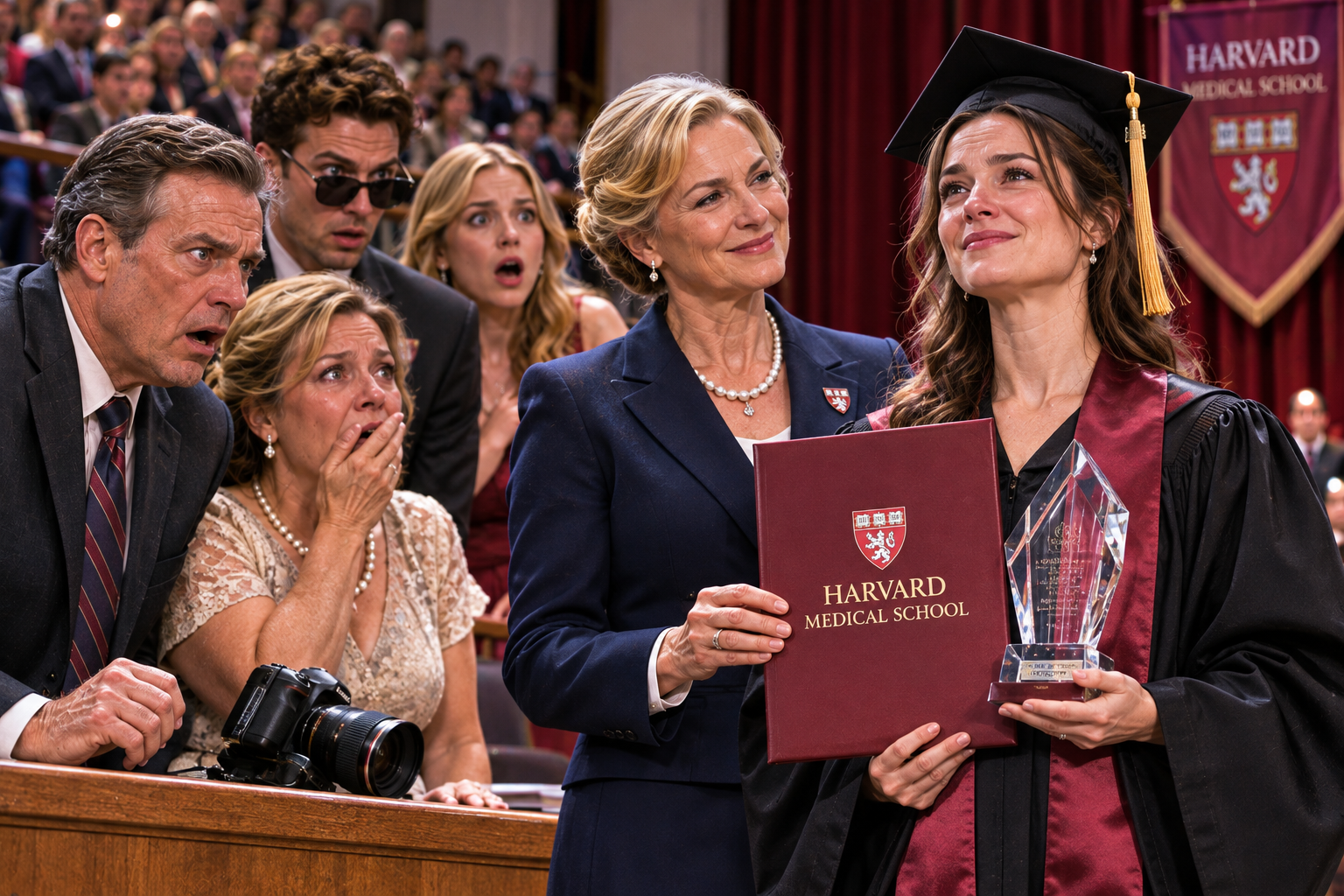
Even Marcus just stared at the crimson folder in Dr. Porter’s hands as though it had appeared from another world.
Dr. Porter smiled—not the kind of smile people use to entertain a crowd, but the calm smile of someone announcing something that had already been earned.
“Six months ago,” she began, “Sarah Thompson was accepted into Harvard Medical School.”
The words floated through the auditorium before they landed.
Then the room erupted.
Applause rolled across the seats again, louder this time. Students turned to find me. Professors stood. Somewhere behind me someone whistled.
I couldn’t hear any of it clearly.
I was watching my parents.
My mother’s lips parted, but nothing came out.
My father blinked several times as if he had misheard.
Marcus looked from me to Dr. Porter and back again, waiting for someone to laugh and admit it was a mistake.
No one did.
Dr. Porter continued.
“Along with her admission, Sarah has been awarded one of our most competitive full scholarships, recognizing both academic excellence and exceptional research potential.”
Another wave of applause.
Professor Liang was clapping with tears in his eyes.
He had known before anyone else.
He was also the only person who had ever looked at my grades before asking whether I had eaten dinner.
The dean handed me my diploma.
It felt almost weightless compared to everything else I was carrying.
Dr. Porter leaned toward the microphone again.
“Many students impress us with intelligence,” she said. “Very few impress us with resilience.”
She looked directly at me.
“When Sarah interviewed in Boston, she apologized because she was worried the coffee stains on her sleeve hadn’t washed out after finishing an overnight shift before catching her flight.”
Soft laughter drifted through the audience.
“I remember telling her the stains didn’t matter.”
She paused.
“What mattered was that every answer she gave came from someone who had already learned how to survive disappointment without allowing it to define her.”
I lowered my eyes.
I had forgotten I told her that.
Actually…
No.
I hadn’t forgotten.
I had tried to.
Because remembering that interview also meant remembering how terrified I had been.
After it ended, I had walked three miles through Boston because I couldn’t afford another taxi.
I had sat on a bench overlooking the Charles River, convincing myself Harvard would never choose someone who counted every dollar before buying lunch.
Apparently…
I had been wrong.
The ceremony finished a few minutes later, but everything had changed.
Students rushed toward friends.
Parents hugged their children.
Cameras flashed in every direction.
Mine didn’t.
Marcus’s expensive camera still lay broken beneath his chair.
For once, no one cared enough to pick up the pieces.
My mother reached me first.
“Oh, sweetheart…” she whispered, grabbing both my hands.
She hadn’t called me sweetheart in years.
“I’m so proud of you.”
The sentence sounded unfamiliar coming from her.
Like she was reading someone else’s script.
I smiled politely.
“Thank you.”
Nothing more.
She searched my face, waiting for warmth.
When it didn’t come, her smile faltered.
My father stepped closer.
“You never told us.”
His voice carried more confusion than anger.
“I tried,” I answered quietly.
He frowned.
“When?”
I looked at him.
“The science fair in ninth grade.”
His eyebrows pulled together.
“The scholarship letter in high school.”
Silence.
“The internship I got sophomore year.”
His expression shifted.
“I left every acceptance letter on the kitchen counter.”
Neither of them spoke.
“You walked past every single one.”
My father opened his mouth.
Closed it.
Opened it again.
“I… don’t remember that.”
“I know.”
Three words.
No accusation.
No raised voice.
Just truth.
Sometimes truth hurts more because it doesn’t need to shout.
Marcus finally joined us.
His face had lost all of its confidence.
“Harvard Medical?” he asked.
I nodded.
He laughed once.
A short, hollow sound.
“I thought… I mean…”
“You thought I worked at the coffee shop because I wasn’t smart enough for anything else.”
He looked away.
“I never said that.”
“You didn’t have to.”
Another silence settled over us.
This one heavier.
Emma finally looked up from her phone.
“Wait…”
She blinked.
“So you’re going to be a doctor?”
“If everything goes well.”
Her eyes widened.
“I told Jessica my sister just worked in a café.”
I almost laughed.
Not because it was funny.
Because it explained everything.
The café had been easier for them to remember than the laboratory.
Professor Liang walked over carrying a small envelope.
“I think this belongs to you.”
I recognized the handwriting immediately.
Mine.
Confused, I opened it.
Inside was a folded piece of paper I had given him during my first semester.
I stared at it.
“I forgot this existed.”
“I didn’t,” he said gently.
“Read it.”
The paper was worn along its folds.
Across the top I had written a date from four years earlier.
Below it, in shaky handwriting, were words I barely recognized as my own.
If I ever become the person I want to be…
I hope she remembers this version of herself.
The girl who cried in the lab bathroom because she failed an exam.
The girl who thought working two jobs meant she wasn’t good enough.
The girl who kept showing up anyway.
Please don’t forget her.
I couldn’t breathe for a second.
Professor Liang smiled.
“I kept it because I suspected one day you’d need proof of where you started.”
A tear slipped down my cheek.
Not because of Harvard.
Not because of the award.
Because someone had believed I would become the person who eventually read that letter.
No one in my family spoke.
They had never known those nights existed.
The panic attacks.
The empty refrigerator.
The mornings I chose bus fare over breakfast.
To them, success had appeared all at once, wrapped in a crimson folder.
They hadn’t seen the years hidden underneath.
Dr. Porter checked her watch.
“Our flight leaves in three hours.”
I nodded.
“I’ve already packed.”
My father looked surprised.
“Today?”
“Yes.”
“So… you’re leaving now?”
“I always was.”
He stared at me.
“When were you planning to tell us?”
I looked around the crowded auditorium one last time.
“I just did.”
No one answered.
Outside, the spring sun poured across the campus lawns.
Families laughed together while graduates tossed caps into the air.
Professor Liang helped carry one of my boxes to the curb.
Dr. Porter loaded the rest into a waiting university car.
Boston suddenly felt much closer than it had that morning.
As I reached for the passenger door, I heard footsteps behind me.
“Sarah.”
It was my father.
His voice sounded smaller than I had ever heard it.
I turned.
He held something in his hand.
Something old.
Something faded.
Something I recognized instantly.
It was a crumpled blue ribbon from my eighth-grade science fair—the first prize I had ever won.
The ribbon I had searched for after it mysteriously disappeared from my bedroom.
“I found this last night,” he said quietly.
“I was cleaning out the attic.”
He looked at the ribbon for a long moment.
Then back at me.
“I need to tell you something.”
The expression on his face wasn’t pride.
It wasn’t regret alone, either.
It was fear.
The kind of fear people carry when they realize a secret they’ve buried for years is finally about to be uncovered.
And before I could answer, he whispered the words that made my heart stop.
“I know who threw your science project away.”
My father’s voice barely carried above the laughter echoing across the campus.
“I know who threw your science project away.”
Everything around me seemed to slow.
The graduates.
The families.
Even the breeze that lifted the corners of the crimson folder in my hands.
For years I had wondered.
In eighth grade, I had spent six months building a neuroscience model from scrap electronics, cardboard, and borrowed library books. It was the first project I had ever loved more than the grade attached to it.
The night before the regional competition, it disappeared.
Everyone told me I must have misplaced it.
My mother sighed dramatically and said, “Maybe if your room wasn’t such a mess.”
Marcus shrugged.
“It probably wasn’t that good anyway.”
I believed them.
At thirteen, children usually believe their parents before they believe themselves.
Now my father looked as though carrying those words had aged him.
“It wasn’t an accident,” he said.
“I know.”
He swallowed.
“It was Marcus.”
Silence.
Not because I was shocked.
Because somewhere deep inside me…
I had always known.
Marcus’s face lost every trace of color.
“Dad…”
“No.”
My father’s voice cracked.
“No more lies.”
Marcus stared at the ground.
“I was seventeen.”
“I know.”
“I didn’t think…”
“I know.”
“I was jealous.”
The confession hung in the air.
“You won everything that year.”
His voice trembled.
“The teachers kept talking about you.”
“The principal called home.”
“They said you might earn scholarships.”
He laughed bitterly.
“For the first time… they weren’t talking about me.”
I closed my eyes.
He continued.
“So I threw it in the dumpster behind the school.”
My mother gasped.
“You told us someone stole it,” she whispered.
Marcus nodded.
“I lied.”
She stepped backward as though she no longer recognized her own son.
My father covered his face with one hand.
“I found out the next day.”
I looked at him.
“You knew?”
He nodded without lifting his head.
“I knew.”
The words hurt far more than Marcus’s confession.
“You knew…”
“And I told your mother we shouldn’t say anything.”
“Why?”
His eyes filled with tears.
“Because Marcus had already gotten into trouble so many times.”
“We thought exposing him would ruin his future.”
I let that sentence settle between us.
“So you sacrificed mine.”
He couldn’t answer.
Because there wasn’t an answer.
Only truth.
After a long silence, my mother whispered, “We failed you.”
For the first time in my life…
I believed she meant it.
Not because she wanted forgiveness.
Because she had finally stopped protecting herself from the truth.
Marcus stepped toward me.
“I’m sorry.”
His voice shook.
“I’ve been sorry for years.”
I looked at him.
“I know.”
He blinked.
“You… know?”
“People who aren’t sorry don’t avoid looking at someone for fifteen years.”
His shoulders dropped.
“I wanted to tell you a hundred times.”
“But you didn’t.”
“No.”
We stood there, surrounded by families taking graduation photos, while our own family finally spoke honestly for the first time.
No one could change what had happened.
No apology could return the years.
No confession could give thirteen-year-old Sarah back the confidence she lost that morning she searched every room of the house for a project that would never be found.
Some things stay broken.
But broken things can stop controlling your future.
I reached into my graduation gown pocket.
There was a folded envelope.
I handed it to my father.
“What is this?”
“Open it.”
Inside was a photograph.
Not of Harvard.
Not of my award.
It was an old picture Professor Liang had secretly scanned from the school’s archives.
Thirteen-year-old me.
Standing beside the science project the day before it disappeared.
Smiling so widely that my eyes were nearly closed.
On the back, I had written one sentence.
“She deserved better.”
My father’s hands trembled.
“So did you,” he whispered.
“Yes.”
No anger.
No triumph.
Just agreement.
Dr. Porter checked the time.
“We really have to leave.”
I nodded.
Before getting into the car, I turned one last time.
My mother asked quietly, “Will you come home for Christmas?”
I thought carefully before answering.
“Maybe.”
It wasn’t punishment.
It wasn’t revenge.
It was honesty.
Trust isn’t rebuilt by holidays.
It’s rebuilt by choices.
One choice at a time.
Marcus wiped his eyes.
“I don’t expect you to forgive me.”
“I know.”
“I just hope… someday…”
I smiled gently.
“Forgiveness isn’t the same as pretending nothing happened.”
He nodded.
“I understand.”
“I hope you do.”
I got into the car.
As we pulled away, I watched them grow smaller in the side mirror.
For years I had imagined this moment.
I thought leaving would feel like winning.
It didn’t.
It felt like breathing.
Boston welcomed me with unfamiliar streets, impossible expectations, and more work than I could imagine.
Medical school was harder than anything I had survived before.
There were nights I questioned myself.
Exams I barely passed.
Patients whose stories stayed with me long after the hospital lights dimmed.
Whenever I felt like giving up, I unfolded the old photograph of the girl beside her science project.
I remembered that she kept dreaming even after someone threw her work away.
Years later, on the day I received my white coat as a physician, Professor Liang sat in the front row.
Dr. Porter stood beside him.
After the ceremony, a little girl approached me, clutching a homemade model of the human brain.
“I heard your speech,” she said shyly.
“Do you think someone like me could become a doctor?”
I smiled.
I saw thirteen-year-old Sarah standing in front of me.
“I don’t think it.”
“I know it.”
She beamed.
As she walked away, her father carefully picked up her model so it wouldn’t fall.
He carried it like it was the most valuable thing in the world.
For a moment, I couldn’t look away.
Then I realized something.
My story had never been about proving my family wrong.
It was about refusing to let someone else’s opinion become the author of my future.
Success did not erase the pain.
Love did not magically repair every wound.
My family and I slowly rebuilt a relationship over the years. Some conversations were awkward. Some holidays were quiet. Marcus apologized more than once, not because he thought repetition would erase the past, but because he understood that trust returns slowly.
My parents changed too—not all at once, but enough that I could see they were trying. They listened more. Compared less. Celebrated without conditions.
It wasn’t a perfect ending.
It was a real one.
And sometimes, real endings are the strongest kind.
Because the greatest victory wasn’t the crystal award.
It wasn’t Harvard.
It wasn’t becoming Dr. Sarah Thompson.
The greatest victory was this:
A little girl once believed she wasn’t enough because the people she loved couldn’t see her worth.
A woman grew up and discovered that worth had been there all along.
No one—not even family—had the power to take it away.
PART 3 — THE SECOND ENVELOPE
Three months after I arrived in Boston, my father mailed me a package with no return address.
I knew it was from him before I opened it.
The handwriting on the label was stiff and uneven, the way his writing always looked when he was trying too hard to appear calm.
For two days, the package sat unopened on the narrow desk beside my bed.
I told myself I was too busy.
That wasn’t true.
I was afraid.
Harvard had already taught me that exhaustion could become a lifestyle.
My days began before sunrise and ended long after the city lights reflected across the Charles River.
There were lectures, laboratory rotations, endless reading, and moments when everyone around me seemed smarter, faster, and more certain than I was.
But even on my hardest days, I felt free.
No one here introduced me as Marcus’s little sister.
No one laughed when I spoke about research.
No one treated my ambition like an inconvenience.
For the first time, I was simply Sarah.
That was why the package frightened me.
It carried the possibility that my old life had found a way to reach into my new one.
On the third night, I finally opened it.
Inside was the blue science-fair ribbon my father had shown me at graduation.
Underneath it was a small brass key.
And beneath the key was a note.
Sarah,
I told you Marcus destroyed your project.
That was true.
But it wasn’t the whole truth.
There are things in the attic that your mother doesn’t know I kept.
The key opens the gray metal box behind the cedar cabinet.
I should have shown you years ago.
I was a coward.
I am sorry.
Dad
I read the note twice.
Then a third time.
My first instinct was to throw everything away.
The second was to call him and demand answers.
Instead, I placed the key on the desk and stared at it until dawn.
At 6:14 the next morning, my phone rang.
It was Marcus.
I almost ignored it.
Then I remembered the package.
I answered.
“What did Dad send you?” he asked without saying hello.
His voice was too fast.
Too tense.
“A key.”
Silence.
Not confusion.
Recognition.
“What does it open?” I asked.
“I don’t know.”
He answered too quickly.
I leaned back in my chair.
“Marcus.”
“I said I don’t know.”
“You called me before seven in the morning because you don’t know?”
He exhaled sharply.
“Sarah, listen to me. Whatever Dad sent, don’t come home for it.”
My hand tightened around the phone.
“Why?”
“Because none of it matters anymore.”
“That isn’t your decision.”
“I’m trying to protect you.”
I almost laughed.
The sentence sounded obscene coming from him.
“Protect me from what?”
He lowered his voice.
“From learning that the science project wasn’t the only thing that disappeared.”
The room became very still.
Outside my window, a garbage truck groaned along the street.
Somewhere down the hall, a door slammed.
But inside me, everything went silent.
“What else?” I asked.
Marcus didn’t answer.
“Marcus, what else did you destroy?”
“I didn’t destroy all of it.”
All of it.
The words lodged beneath my ribs.
“How much was there?”
“I don’t know.”
“You’re lying.”
“I was a kid.”
“You were seventeen.”
“I was scared.”
“Of me?”
His voice cracked.
“Of what happened whenever they noticed you.”
I stood slowly.
“What does that mean?”
“You don’t understand what it was like.”
“No, Marcus. I understand exactly what it was like.”
He said nothing.
I continued.
“When they noticed you, they celebrated.”
“When they noticed me, something disappeared.”
A long pause followed.
Then he whispered, “Mom made comparisons.”
My throat tightened.
“What comparisons?”
“She said you were becoming difficult.”
“Because I won a science fair?”
“No.”
“Then why?”
“Because teachers started telling Dad you might be gifted.”
I closed my eyes.
The word gifted should not have sounded like an accusation.
But in my family, anything that threatened Marcus had become one.
“She said you were too young to understand attention,” he continued.
“She said praise would make you arrogant.”
“And you believed her?”
“I wanted to.”
That answer hurt because it was honest.
“What is in the metal box?”
“I don’t know everything.”
“You know enough to be afraid.”
He breathed into the phone for several seconds.
Then he said, “There are letters.”
“What kind of letters?”
“School letters.”
My knees weakened.
I sat on the edge of the bed.
“What school letters?”
“Scholarships.”
The word barely reached me.
“And recommendations.”
My pulse began pounding.
“And one invitation.”
“Invitation to what?”
He didn’t answer.
“Marcus.”
“A summer science program.”
I gripped the blanket beside me.
“Where?”
“Boston.”
The room tilted.
I had applied to a summer science academy in Boston when I was sixteen.
Only twelve students were selected nationwide.
I had checked the mailbox every afternoon for six weeks.
When nothing came, my mother sat beside me at the kitchen table and said rejection was part of growing up.
She told me perhaps science wasn’t really my path.
I believed her.
I remembered crying in the bathroom so no one would hear.
I remembered throwing away every brochure.
I remembered taking extra shifts at the grocery store that summer because I thought I had failed.
“Did I get in?” I asked.
Marcus started crying.
It was quiet at first.
Then I heard him struggling to breathe.
“Did I get in?”
“Yes.”
The answer shattered something I thought had already healed.
I pressed one hand against my mouth.
For years, I had carried that rejection like proof.
Proof that maybe my family had been right.
Proof that I was trying to enter rooms where I didn’t belong.
But there had been no rejection.
There had been a letter.
A place.
An opportunity.
Someone had simply taken it before I could see it.
“Who hid it?” I asked.
Marcus didn’t speak.
“Did you?”
“No.”
“Dad?”
“No.”
My heart began beating harder.
“Mom?”
Silence.
That silence was enough.
I stood so quickly the key slid from the desk and struck the floor.
“Why?”
“She said the program was too expensive.”
“It was fully funded.”
“I know that now.”
“She knew then.”
“I don’t know.”
“You just said there were letters.”
“There were.”
“Where?”
“In the box.”
“Why did Dad keep them?”
“I don’t know.”
“Why didn’t he give them to me?”
“I don’t know.”
“Stop saying you don’t know!”
My voice cracked so loudly that someone in the hallway stopped walking.
Marcus went silent.
I lowered my voice.
“You knew I spent years believing I wasn’t accepted.”
“Yes.”
“You watched me blame myself.”
“Yes.”
“You heard Mom tell me I wasn’t ready.”
“Yes.”
“And you said nothing.”
“I was afraid.”
“Of losing your place.”
He didn’t deny it.
That was the worst part.
I ended the call.
My hands were shaking so badly I nearly dropped the phone.
Ten minutes later, I called Professor Liang.
He answered on the second ring.
“Sarah?”
“I need to go home.”
He didn’t ask why immediately.
Instead, he listened while I told him about the key, the metal box, and the letters.
When I finished, he was silent for several seconds.
Then he said, “Do not go alone.”
“I’m not afraid of them.”
“I know.”
His voice softened.
“But strength does not mean walking into every painful room without support.”
I stared at the crimson folder resting on my shelf.
“What should I do?”
“Document everything.”
The scientist in him had taken control.
“Take photographs before moving anything. Record dates. Preserve envelopes. Do not allow anyone to destroy or remove documents.”
I swallowed.
“You think they might?”
“I think people who have protected secrets for years sometimes panic when those secrets are uncovered.”
That afternoon, Dr. Porter helped arrange a weekend flight.
Professor Liang offered to come with me, but I refused.
Not because I didn’t want him there.
Because there was one person who needed to stand beside me more.
I called Emma.
She answered from a noisy restaurant.
“Sarah?”
“I need your help.”
The background noise faded as she moved somewhere quieter.
“What happened?”
“Dad sent me a key.”
She didn’t understand at first.
Then I explained.
Unlike Marcus, Emma didn’t cry.
She became angry.
Real anger.
The kind I had rarely heard from her.
“I’ll pick you up at the airport,” she said.
“Don’t tell Mom.”
“I won’t.”
“And don’t tell Marcus.”
“I won’t.”
My flight landed Friday night.
Emma was waiting outside the terminal in our mother’s old sedan.
She looked different.
Not physically.
But the careless expression she had worn through most of my graduation was gone.
She hugged me before I could speak.
“I’m sorry,” she whispered.
“For what?”
“For not seeing any of it.”
I stepped back.
“You were younger.”
“I was old enough to notice.”
There was nothing useful to say to that.
So I got into the car.
We drove home in silence.
My parents’ house looked exactly the same.
The porch light flickered.
The curtains were drawn.
Marcus’s car was parked beside the pool house.
Emma killed the engine.
“They think I’m staying with Jessica tonight.”
“Good.”
We entered through the side door with the spare key Emma still carried.
The kitchen smelled like lemon cleaner and coffee.
Family photographs covered the refrigerator.
Marcus at his law-school orientation.
Marcus holding a trophy.
Marcus beside his first car.
Emma at prom.
My graduation photograph had been added recently.
It sat in the center.
I stood onstage holding the crystal award and the crimson folder.
My mother had written beneath it:
Our brilliant daughter, future doctor.
I stared at those words for a long moment.
Then I turned away.
The attic stairs groaned beneath our feet.
Dust floated through the beam of Emma’s flashlight.
Behind the cedar cabinet, exactly where Dad said it would be, sat a gray metal box.
It was smaller than I imagined.
Small enough to hold under one arm.
Small enough to hide fifteen years of someone’s life.
I inserted the brass key.
The lock clicked.
Emma lifted her phone and began recording.
I opened the lid.
Inside were dozens of envelopes tied together with faded white string.
My name was written across every one.
Sarah Elizabeth Thompson.
Some were unopened.
Others had been carefully sliced along the edge.
At the top was the Boston summer program letter.
Congratulations.
The word appeared in bold across the first page.
I couldn’t read beyond it.
My eyes blurred.
Emma touched my shoulder.
“There’s more.”
Under the acceptance letter was a scholarship notice from the state science foundation.
A recommendation from my eighth-grade teacher.
A letter from a private academy offering financial assistance.
A handwritten note from the regional science-fair judge asking my parents to contact him about mentorship opportunities.
All of them had been hidden.
All of them had been kept.
I reached the bottom of the box.
There was one final envelope.
Unlike the others, it didn’t carry my name.
It was addressed to my father.
The return address belonged to a genetic-testing laboratory.
Emma frowned.
“What does that have to do with your school letters?”
I didn’t answer.
The envelope had already been opened.
Inside was a report dated six months before my eighth-grade science fair.
At the top were my father’s name and mine.
Below them was a line of clinical language I didn’t understand at first because my mind refused to accept the meaning.
Probability of biological relationship: 0.00%.
Emma read it over my shoulder.
Her breath caught.
The attic door slammed shut behind us.
We spun around.
My mother stood at the top of the stairs.
She wasn’t looking at the scholarship letters.
She wasn’t looking at the science-fair ribbon.
She was staring at the laboratory report in my hand.
Her face had gone completely white.
“Put that back,” she whispered.
I held the paper tighter.
“Who is my father?”
She took one step toward me.
“Sarah, you don’t understand.”
“Then explain it.”
Footsteps thundered below us.
Marcus appeared behind her.
Then Dad.
No one spoke.
I looked from the report to the man who had raised me.
He looked devastated.
Not surprised.
That told me everything.
“You knew,” I whispered.
Dad closed his eyes.
My mother began crying.
Emma stared at both of them.
Marcus moved toward the metal box.
I stepped between him and the letters.
“Don’t touch anything.”
“Sarah,” he said, “this isn’t what you think.”
I looked directly at him.
“Then tell me what it is.”
He opened his mouth.
But it was my father who answered.
His voice sounded empty.
“Your mother didn’t hide those opportunities because she thought you would fail.”
He looked at the genetic report in my hand.
“She hid them because she was terrified that if you succeeded, the man who is actually your father would find you.”
PART 4 — THE MAN FROM BOSTON
No one moved.
The attic seemed to shrink around us.
Dust hung motionless in the beam of Emma’s phone while my father’s words settled into the silence.
“She hid them because she was terrified that if you succeeded, the man who is actually your father would find you.”
My mother made a sound that was almost a sob.
Marcus looked away.
Emma stopped recording for one second, then quickly started again.
I stared at the man I had called Dad for twenty-two years.
“Who is he?”
My father lowered his eyes.
My mother answered first.
“No one who deserves to know you.”
“That wasn’t my question.”
“Sarah—”
“Who is my father?”
Her face tightened.
It was the same expression she used whenever she wanted a conversation to end.
The expression that had worked when I was twelve.
Sixteen.
Nineteen.
It didn’t work anymore.
I held up the genetic report.
“You tested us.”
My father nodded slowly.
“When?”
“Fifteen years ago.”
“Why?”
He glanced toward my mother.
“She told me.”
My mother wiped her face.
“I didn’t have a choice.”
“You always had a choice.”
“You don’t understand what happened.”
“Then explain it.”
She looked toward the stairs as if considering escape.
Emma stepped between her and the attic door.
“Not this time,” she said.
My mother stared at her.
“Move.”
“No.”
I had never heard Emma speak to her that way.
Neither had anyone else.
My father sat heavily on an old wooden trunk.
His shoulders folded inward.
“His name is Dr. Jonathan Hale,” he said.
My heartbeat changed.
The name felt familiar.
Not personally.
Academically.
I had seen it in journal articles.
Research papers.
Conference announcements.
Jonathan Hale was a neurologist.
A famous one.
He had spent decades studying inherited neurodegenerative disorders.
His name appeared in some of the first serious articles I had read when I entered Professor Liang’s laboratory.
I laughed once.
A quiet, disbelieving sound.
“You’re saying Dr. Jonathan Hale is my biological father?”
My mother shook her head violently.
“No.”
Dad looked at her.
“Stop.”
She turned on him.
“You promised me.”
“I promised to protect a child.”
“You promised never to tell her.”
“She isn’t a child anymore.”
My mother’s eyes flashed.
“She is still my daughter.”
I looked at the envelopes spread across the metal box.
“Was I your daughter when you hid all of this?”
Her anger disappeared.
For a second, only fear remained.
“I was trying to keep you safe.”
“From a summer science program?”
“From Boston.”
The word came out too quickly.
I looked down at the acceptance letter.
The program had been hosted by a medical institute in Boston.
A program connected to several university hospitals.
Including the hospital where Jonathan Hale worked at the time.
“You thought he would see my name.”
My mother said nothing.
“You thought someone would notice me.”
Silence.
“You thought he would realize who I was.”
Her hands began trembling.
“I couldn’t risk it.”
“So you made sure I failed.”
“No.”
“You hid my scholarships.”
“To keep you close.”
“You destroyed my opportunities.”
“To protect our family.”
“You let me believe I wasn’t good enough.”
“I was afraid!”
Her shout filled the attic.
Everyone went still.
My mother pressed both hands over her mouth.
Then the truth began spilling out.
“I met Jonathan during my first year working at St. Catherine’s Hospital,” she said.
Her voice cracked.
“He was already respected. Brilliant. Ambitious. Everyone listened when he entered a room.”
My father stared at the floor.
“I was young,” she continued. “I thought he loved me.”
“Were you married to Dad?”
“No.”
My father answered for her.
“We met later.”
That should have made the truth simpler.
It didn’t.
“What happened?” I asked.
My mother sat on the floor beside the metal box, suddenly looking much older.
“When I told Jonathan I was pregnant, he didn’t believe me.”
“Did you show him proof?”
“Yes.”
“And?”
“He told me a child would destroy everything.”
The words struck harder than I expected.
“He was applying for a major research appointment. He said there could be no scandal.”
“So he left.”
“He offered money.”
I looked at her.
“How much?”
She closed her eyes.
“Fifty thousand dollars.”
Emma inhaled sharply.
Fifteen years ago, fifty thousand dollars had been more than my parents earned in a year.
“Did you take it?”
“No.”
My mother answered immediately.
Then Dad looked at her.
That one glance was enough.
I turned back to her.
“Did you take it?”
Her shoulders dropped.
“Yes.”
The answer felt like cold water.
“What did you do with it?”
“Your medical bills.”
Dad stood.
“That is not true.”
My mother looked at him sharply.
“Don’t.”
He stepped closer.
“You told me it was savings from your parents.”
“I used some for Sarah.”
“Some.”
My mother looked away.
Dad’s voice grew heavier.
“You used most of it to pay Marcus’s private-school tuition.”
Marcus’s head snapped up.
“What?”
No one answered him.
He stepped forward.
“You said Grandpa paid for that.”
My mother began crying again.
“He needed structure.”
I almost couldn’t process the cruelty of it.
The man who had abandoned me paid for Marcus’s education.
The son my mother protected.
The son whose future always came first.
Marcus looked sick.
“You used Sarah’s money on me?”
“It wasn’t Sarah’s money.”
The words left my mother before she could stop them.
The attic became silent again.
I stared at her.
“What did you just say?”
She pressed her lips together.
I stepped closer.
“What did you mean?”
“It was money Jonathan gave me.”
“Because of me.”
“No.”
“Yes.”
“It was payment for silence.”
“About me.”
She stood too quickly.
“I was the one who suffered.”
The sentence hit something raw inside me.
“You suffered?”
My voice was calm.
That frightened her more than shouting would have.
“You took money from the man who abandoned me.”
“You used it to build Marcus’s future.”
“You hid every opportunity that might have helped me escape.”
“And now you’re standing here telling me you were the victim.”
Her face crumpled.
“I was.”
Dad looked at her as if he had never truly seen her before.
“Maybe you were once,” he said quietly.
“But then you made Sarah pay for it.”
My mother turned toward him.
“You helped.”
“I know.”
He did not defend himself.
He did not hide.
“I helped because I believed keeping Jonathan away was protecting her.”
He looked at the letters.
“But this wasn’t protection.”
His eyes filled.
“This was punishment.”
My mother slapped him.
The sound cracked through the attic.
Emma gasped.
Marcus stepped between them.
“Stop.”
My mother stared at her hand.
Then at Dad’s face.
For one second, I thought she might apologize.
Instead, she looked at me.
“You have no idea what Jonathan Hale is capable of.”
“Then tell me.”
“He didn’t just offer money.”
“What else did he do?”
She hesitated.
My father looked confused.
“What are you talking about?”
My mother backed toward the wall.
“There were letters.”
“What letters?” I asked.
She shook her head.
“I burned them.”
Dad stood straighter.
“You told me he never contacted you again.”
“He didn’t contact me.”
“What does that mean?”
“He contacted my father.”
Grandpa.
My mother’s father had died when I was nine.
I remembered him as quiet and strict.
He never hugged easily.
But he always brought me science magazines from the library.
“What did Jonathan say to Grandpa?”
My mother’s breathing became uneven.
“He said if I ever told you who he was, he would prove I was unstable.”
Dad stared at her.
“He said he would take Sarah?”
She nodded.
“He had money. Lawyers. Hospital connections.”
Her voice shrank.
“He said no judge would leave a child with a woman who had accepted fifty thousand dollars to disappear.”
I looked down at the report.
“Is that why you had the DNA test?”
My father answered.
“Yes.”
“We needed proof in case he came back.”
“Then why keep it hidden?”
“Because the test could also help him.”
“How?”
My mother whispered, “Because once you became old enough, he could use it to contact you.”
“That makes no sense.”
“It did to me.”
“No.”
I shook my head.
“It gave you an excuse.”
She stared at me.
“You didn’t hide me because Jonathan was dangerous.”
“You hid me because you were terrified I might choose him.”
Her face changed.
There it was.
Not fear of losing my safety.
Fear of losing control.
“I raised you,” she whispered.
“You ignored me.”
“I fed you.”
“I fed myself.”
“I gave you a home.”
“You made sure I never felt welcome in it.”
Her eyes filled again.
“Sarah, please.”
I turned away from her.
Inside the metal box, beneath the genetic report, was another folder.
Dark green.
Thicker than the others.
I lifted it out.
My mother lunged toward me.
“No.”
Emma blocked her.
I opened the folder.
Inside were photocopies of checks.
All issued by the Hale Foundation.
The first was for fifty thousand dollars.
The second came two years later.
Twenty-five thousand.
Then another.
And another.
I counted seven payments.
The most recent had been made eight months ago.
My hands went cold.
“He kept paying you.”
My mother’s face collapsed.
Dad took the folder from me.
His eyes moved down the page.
“Eight months ago?”
He looked at her.
“You told me that money came from the sale of your mother’s jewelry.”
She said nothing.
“How much?” Marcus asked.
Dad added the figures slowly.
“Two hundred and eighty thousand dollars.”
Emma covered her mouth.
I looked at my mother.
“For what?”
She shook her head.
“I don’t know.”
“You cashed the checks.”
“He sent them.”
“And you accepted them.”
“I thought if I refused, he would come looking.”
“That isn’t true.”
“You don’t know him.”
“Neither do you.”
“I knew enough.”
I picked up the most recent check.
On the memo line were four words.
Final payment before contact.
My pulse slammed.
I held the check toward her.
“What does this mean?”
She stared at it.
“I don’t know.”
“You knew this was coming.”
“No.”
“Eight months ago, he told you he was going to contact me.”
“I thought it was a threat.”
“Did you answer him?”
She looked away.
My father’s face hardened.
“What did you do?”
My mother pressed both hands against her temples.
“I wrote to him.”
“What did you say?”
“I told him Sarah wanted nothing to do with him.”
My stomach dropped.
“You spoke for me.”
“I protected you.”
“You lied to him.”
“I told him the truth.”
“You didn’t know the truth.”
“I knew what was best.”
I laughed softly.
The sound made everyone turn toward me.
For twenty-two years, she had decided what I deserved to know.
What opportunities I deserved to receive.
Who I deserved to become.
Now even my biological father had been told I rejected him before I knew his name.
I reached for my phone.
My mother’s expression sharpened.
“What are you doing?”
“Finding him.”
“No.”
“I’m not asking permission.”
She grabbed my wrist.
I pulled free.
“Do not touch me.”
The words were quiet.
She stepped back.
I searched Jonathan Hale’s name.
His hospital profile appeared first.
Then research articles.
Then conference photographs.
He had gray hair now.
A serious face.
And eyes that looked disturbingly familiar.
My eyes.
Below his biography was an announcement dated three weeks earlier.
Dr. Jonathan Hale to deliver keynote lecture at Harvard Medical School.
My breath stopped.
I read the date again.
The lecture was scheduled for Monday.
Three days away.
My mother saw the screen.
Her face went pale.
“No.”
My father looked over my shoulder.
“What is it?”
I turned the phone toward him.
Jonathan Hale was coming to Harvard.
To my campus.
To the building where I studied.
My mother shook her head again and again.
“You can’t meet him.”
I looked at her.
“You don’t get to decide that anymore.”
Marcus moved closer to the metal box.
“There’s something else.”
I turned.
He had lifted the false cardboard lining from the bottom.
Underneath it was a sealed crimson envelope.
My name was written across the front.
Not in my mother’s handwriting.
Not in Dad’s.
The postmark was eight months old.
Boston, Massachusetts.
In the upper-left corner were the initials J.H.
My mother rushed forward.
Marcus held the envelope away from her.
“What is this?”
She began crying.
“I was going to destroy it.”
“But you didn’t,” I said.
“I couldn’t.”
Marcus handed it to me.
The envelope had never been opened.
My fingers shook as I broke the seal.
Inside was a single sheet of heavy paper.
The message was handwritten.
Sarah,
You do not know me, but I have known about you every day of your life.
I have been told repeatedly that you never wanted contact.
I accepted that because I believed respecting your wishes was the least I owed you.
Recently, I learned that you may never have been given the choice.
I will be speaking at Harvard this year.
I have no right to ask anything from you.
But if this letter reaches you, I need you to know one truth before someone hides it again.
I did not leave because I did not want you.
I left because your mother told me you had died.
The letter slipped from my hand.
No one spoke.
I looked slowly toward my mother.
She was backed against the attic wall.
Dad stared at her in horror.
Marcus lowered his eyes.
Emma’s phone continued recording.
My mother’s lips trembled.
“Sarah…”
I picked up the letter.
“You told him I was dead?”
She shook her head.
“It wasn’t that simple.”
“Then make it simple.”
Her voice broke.
“I was afraid he would take you.”
“So you killed me on paper.”
“I was trying to keep you.”
I looked at the hidden scholarships.
The payments.
The genetic report.
The unopened letter.
“You didn’t keep me.”
I folded Jonathan’s letter carefully.
“You kept me trapped.”
Then my phone rang.
The number was unfamiliar.
Boston area code.
Everyone stared at the screen.
I answered.
“Hello?”
A man’s voice came through the speaker.
Calm.
Older.
Shaking beneath the control.
“Is this Sarah Thompson?”
“Yes.”
There was a long silence.
Then he breathed in.
“My name is Jonathan Hale.”
My mother slid down the wall.
Jonathan continued.
“I’m sorry to call without warning.”
His voice cracked.
“But someone from your family contacted my office fifteen minutes ago.”
I looked at Marcus.
He shook his head.
Emma shook hers too.
Dad looked confused.
My mother covered her face.
Jonathan lowered his voice.
“They told me you found the letters.”
My eyes moved to my mother.
She was still holding her phone.
The screen glowed between her fingers.
Jonathan spoke again.
“And they warned me that if I come near you, they will finally release the evidence that destroyed my career twenty-two years ago.”
I tightened my grip on the phone.
“What evidence?”
He went silent.
When he finally answered, his words changed everything.
“The evidence that your mother framed me for a crime I never committed.”
PART 5 — THE FILE THAT NEVER EXISTED
For several seconds, no one in the attic breathed.
Jonathan’s voice remained in my ear.
“The evidence that your mother framed me for a crime I never committed.”
I looked at my mother.
She had stopped crying.
That frightened me more than the tears.
Her face had gone completely still.
The kind of stillness that comes when someone realizes every exit has closed.
“What crime?” I asked.
Jonathan did not answer immediately.
In the background, I heard a door shut.
Then the faint scrape of a chair.
When he spoke again, his voice was lower.
“Before I explain, I need to know whether you are safe.”
I looked around the attic.
At my mother against the wall.
At Marcus holding the false cardboard lining.
At Emma’s phone recording everything.
At the man who had raised me standing beside a box filled with twenty-two years of lies.
“I’m safe.”
“Are you alone?”
“No.”
He exhaled slowly.
“Is your mother there?”
“Yes.”
My mother lifted her head.
“Hang up,” she whispered.
I ignored her.
Jonathan heard.
“Please don’t confront her while I’m on the phone.”
My mother laughed bitterly.
“How noble.”
Dad turned toward her.
“What did you do?”
She stared at Jonathan’s letter in my hand.
Nothing else.
“What crime?” I repeated.
Jonathan’s answer came carefully.
“A patient-data theft.”
The attic went silent again.
I frowned.
“What does that mean?”
“Twenty-two years ago, I was part of a hospital research team studying inherited neurological disorders.”
His voice changed when he spoke about the work.
More precise.
More controlled.
“We were collecting family histories, imaging results, and genetic information. It was early work. The privacy rules were different then, but the data was still protected.”
I looked at my mother.
She had worked at St. Catherine’s during that time.
“What happened?”
“Someone copied confidential patient records and sent them to a private pharmaceutical company.”
Dad’s face tightened.
“For money?”
“That was the accusation.”
Jonathan paused.
“My access credentials appeared on the transfer log.”
“Did you do it?”
“No.”
His answer was immediate.
“I was questioned. Suspended. My research appointment was withdrawn.”
My mother closed her eyes.
He continued.
“There was no criminal charge because the hospital feared public exposure. They handled it internally.”
“But your career wasn’t destroyed,” Emma said.
Jonathan heard her.
“No.”
His voice softened.
“I rebuilt it.”
“How?” I asked.
“Slowly.”
There was no pride in the answer.
Only exhaustion.
“Another hospital eventually hired me after a senior physician challenged the evidence. But the scandal followed me for years.”
I stared at my mother.
“What does this have to do with her?”
Jonathan became silent.
My mother answered for him.
“Nothing.”
Dad turned sharply.
“Then why did you warn him away from Sarah?”
“I told you. He was dangerous.”
“No,” Dad said.
His voice trembled.
“You told me he threatened to take her.”
“He did.”
“Did he?”
Jonathan spoke.
“I asked for a paternity test.”
My father looked at the report in my hand.
“And then?”
“Her mother disappeared.”
My mother stepped forward.
“You were trying to ruin my life.”
“I was trying to find my daughter.”
“You had no right.”
“I had every right to know whether she was alive.”
Her face twisted.
“You had already chosen your career.”
Jonathan’s voice remained calm.
“I was suspended.”
“You blamed me.”
“I asked you whether you knew who had accessed my office.”
My mother went pale.
Dad stared at her.
“What was in his office?”
She said nothing.
Jonathan answered.
“The research terminal.”
I felt the pieces moving toward one another.
Not fitting yet.
But close.
“You worked near his office,” I said.
My mother shook her head.
“I worked in administration.”
“You had access?”
“No.”
Jonathan’s voice came through the phone.
“She had temporary access because she helped schedule patient evaluations.”
My mother snapped.
“That proves nothing.”
“No,” he agreed.
“It doesn’t.”
“Then stop speaking as if it does.”
“I never accused you publicly.”
“You suspected me.”
“Yes.”
The word cut through the attic.
My mother stared at the phone.
Jonathan continued.
“Because three days after the data was stolen, you deposited forty thousand dollars.”
Dad looked at her.
“What?”
My mother’s eyes widened.
“That money came from my father.”
Jonathan’s voice remained steady.
“Your father denied giving it to you.”
“He lied.”
“Why would he?”
“To protect himself.”
“From what?”
She had no answer.
Marcus lowered the cardboard lining.
“Mom.”
She looked at him.
“Was the fifty thousand dollars from Jonathan really the first payment?”
My mother stared at her eldest son.
For the first time, Marcus didn’t look like the protected child.
He looked like a man realizing his entire life might have been built from money no one had explained.
“What are you asking me?”
“The private school.”
His voice shook.
“The tutors.”
“The car.”
“The law-school apartment.”
My father’s expression changed.
He moved toward the box.
“What law-school apartment?”
Marcus turned.
“You paid the deposit.”
Dad shook his head.
“No.”
Marcus went still.
“Mom said you did.”
My mother looked toward the stairs.
Emma blocked the exit again.
“Move.”
“No.”
“Emma.”
“You’re not leaving until Sarah gets answers.”
My mother’s voice hardened.
“I am still your mother.”
“And she is still your daughter.”
That stopped her.
Dad took the folder of Hale Foundation payments and began reading every amount again.
“Two hundred and eighty thousand.”
He looked at Marcus.
“How much did she spend on you?”
Marcus swallowed.
“I don’t know.”
“You must know some of it.”
“She paid my tuition.”
“How much?”
“About thirty thousand a year.”
“For four years?”
Marcus nodded.
Dad sat down.
His face emptied.
“Your college fund came from Sarah’s biological father.”
My mother exploded.
“It came to me!”
Her voice filled the attic.
“He gave it to me!”
Jonathan spoke through the phone.
“I sent money because you said Sarah needed medical care.”
My mother froze.
I tightened my grip on the phone.
“What medical care?”
Jonathan’s voice changed.
“Your mother told me you had a congenital heart condition.”
I stared at her.
“I don’t have a heart condition.”
“I know that now.”
My stomach turned.
“She sent copies of hospital invoices.”
Dad looked confused.
“Sarah was never hospitalized for her heart.”
Jonathan continued.
“The documents carried St. Catherine’s letterhead.”
My mother backed away.
Dad stood slowly.
“You forged medical bills?”
“No.”
His face hardened.
“You told him Sarah was sick.”
“She was fragile.”
“I had asthma,” I said.
My mother looked at me.
“You were always in and out of clinics.”
“For allergies.”
She said nothing.
Jonathan’s breathing was audible through the phone.
“For years, I believed the money was helping you.”
“How many years?”
“Until you were eighteen.”
I looked at the checks.
“But the payments continued after that.”
“Yes.”
“Why?”
“Your mother said college costs were overwhelming.”
I laughed once.
A broken sound.
“She stopped helping with my tuition after my first year.”
Jonathan went quiet.
“What?”
“She told me there was no money.”
My mother rushed toward me.
“Sarah, listen—”
I stepped back.
“No.”
She stopped.
I had never seen her look so desperate.
“Where did the money go?”
“I used it for the family.”
“What family?”
Her face crumpled.
“All of you.”
Dad shook his head.
“No.”
He held up the payment list.
“I paid the mortgage.”
“I paid the utilities.”
“I covered Emma’s school.”
He looked at Marcus.
“And apparently Jonathan paid for Marcus.”
My mother’s mouth opened.
No words came.
Dad’s voice dropped.
“What did you use the rest for?”
She looked away.
That was when I noticed something.
The metal box was deeper than it should have been.
The false lining Marcus had removed was not the only hidden layer.
A narrow metal tab sat beneath the inner wall.
I reached for it.
My mother saw.
Her face changed instantly.
“Don’t.”
I pulled the tab.
A second compartment opened beneath the first.
Inside was a black ledger.
A hospital identification badge.
And a flash drive.
Jonathan’s voice sharpened through the phone.
“What did you find?”
I picked up the badge.
The photograph showed my mother at twenty-four.
Under her name were the words:
Research Records Access.
She stared at it.
Dad looked at her in horror.
“You said you worked in administration.”
“I did.”
“This says research records.”
“It was temporary.”
I lifted the black ledger.
The pages were filled with dates, initials, account numbers, and dollar amounts.
Some entries went back twenty-two years.
Others were recent.
At the top of the first page were two initials.
J.H.
Beside them:
$40,000.
The same amount Jonathan said had appeared in my mother’s account after the data theft.
I turned the page.
There were more names.
Doctors.
Research assistants.
Patients.
Companies.
Payments.
Dozens of them.
Emma leaned closer.
“What is this?”
My mother sank to the floor.
Dad took the ledger.
His eyes moved across the page.
Then stopped.
“This isn’t household money.”
She covered her face.
“This is blackmail.”
Jonathan went silent.
My father flipped through more pages.
Every section contained names beside payments.
Some amounts were small.
Others exceeded one hundred thousand dollars.
At the back was a handwritten list titled:
People Who Cannot Risk Exposure.
Jonathan Hale’s name was first.
My father looked at my mother.
“You didn’t frame him because he abandoned Sarah.”
Her shoulders shook.
“You framed him because he discovered what you were doing.”
She began crying again.
This time, no one moved to comfort her.
Jonathan spoke quietly.
“I never knew for certain.”
I lifted the flash drive.
“What is on this?”
My mother looked up.
“Nothing.”
“Then why hide it?”
“It’s old.”
“That isn’t an answer.”
She pushed herself to her feet.
“Give it to me.”
I stepped away.
Her expression changed.
The fear disappeared.
Something colder replaced it.
“Sarah.”
“No.”
“You have no idea what you are holding.”
“Then tell me.”
“That drive could destroy people.”
“Did it destroy Jonathan?”
She glanced toward the phone.
“That was different.”
“How?”
“He would have exposed everything.”
“So you planted his name on the transfer.”
“I did what I had to do.”
The confession came so plainly that for one moment no one reacted.
Then Dad whispered, “You did it.”
My mother realized what she had said.
She looked at Emma’s phone.
The recording light was still on.
Her face drained of color.
“Turn that off.”
Emma tightened her grip.
“No.”
“Turn it off!”
My mother lunged.
Marcus caught her before she reached Emma.
She fought against him.
“Give me the phone!”
“Stop!”
Marcus’s voice cracked through the attic.
“Stop protecting yourself for once!”
She stared at him.
He released her slowly.
“You used me,” he said.
Her face changed.
“No.”
“You spent her money on me so I would always need you.”
“I gave you everything.”
“You gave me things that belonged to someone else.”
“I was your mother.”
“You made me part of this.”
She slapped him.
Harder than she had slapped Dad.
Marcus stumbled into the cedar cabinet.
A stack of old papers fell from the top.
One envelope slid across the floor and stopped beside my shoe.
It was marked with the crest of a private law firm.
Dad picked it up.
The date was five years earlier.
Marcus’s first year at Harvard Law.
He opened it.
Inside was a confidentiality agreement.
The Hale Foundation agreed to make an annual payment.
In exchange, my mother promised never to disclose certain records connected to Jonathan’s former research team.
Jonathan’s voice became sharp.
“What firm?”
I read the name aloud.
He went silent.
Then he said, “That is not my attorney.”
My mother’s head lifted.
“What?”
“The Hale Foundation never hired that firm.”
I looked at the document again.
The signature at the bottom appeared to be Jonathan’s.
He continued.
“That agreement is fraudulent.”
My father turned toward my mother.
“Did you forge this too?”
She shook her head.
“No.”
“Then who did?”
“I don’t know.”
“You kept it.”
“Because someone sent it to me.”
“Who?”
She looked terrified now.
Not cornered.
Terrified.
“I never met him.”
Jonathan lowered his voice.
“Met whom?”
My mother pressed both hands against her face.
“The man who helped me access the records.”
No one spoke.
She looked at me.
“I was twenty-four.”
“I was scared.”
“I owed money.”
“He said no one would be hurt.”
“Who was he?”
“I didn’t know his real name.”
Dad stepped closer.
“Then what did you call him?”
She hesitated.
“Mr. Gray.”
Jonathan inhaled sharply.
The reaction was unmistakable.
“You know that name,” I said.
He didn’t answer.
“Jonathan.”
“Yes.”
My mother stared at the phone.
Jonathan’s voice sounded different now.
Older.
More frightened.
“Mr. Gray approached three members of our research team.”
“For what?”
“Patient information.”
“Why?”
“We never proved it.”
He paused.
“But we believed someone was searching for families carrying a rare genetic mutation.”
I thought of my research.
Neurodegenerative disease.
Inherited disorders.
“Which mutation?”
Jonathan’s answer made my blood run cold.
“Hale Variant Seven.”
I knew the name.
Every neuroscience student did.
A rare inherited marker associated with early-onset cognitive decline.
It had been discovered by Jonathan’s research group.
I looked at the genetic report again.
“Do I carry it?”
Jonathan said nothing.
My mother began crying harder.
“Do I carry it?”
His voice softened.
“I don’t know.”
“You tested me.”
“The report you found only confirmed paternity.”
“Did you ever test me for the mutation?”
“No.”
My mother whispered, “Yes.”
Every person in the attic turned toward her.
I stared at her.
“When?”
“You were seven.”
My father looked stunned.
“You told me that blood test was for allergies.”
She nodded.
“What was the result?” I asked.
My mother’s lips trembled.
“I never opened it.”
I looked at the metal box.
“There’s no report here.”
She closed her eyes.
“Because I mailed it to Mr. Gray.”
The world seemed to tilt.
Jonathan’s voice rose for the first time.
“You sent him Sarah’s genetic results?”
“He said he would erase the records against me.”
“You gave him a child’s medical information?”
“I was trying to survive!”
“You sold her twice,” Dad whispered.
My mother turned on him.
“You don’t know what fear makes people do.”
“No,” he said.
“But I know what love should have stopped you from doing.”
She collapsed against the wall.
I stared at the flash drive.
The answer might be inside.
So might the identities of patients whose information had been stolen.
So might proof that someone had been tracking me since childhood.
I ended the call with Jonathan only after agreeing to meet him Monday at Harvard.
Then I placed the flash drive in my pocket.
My mother watched every movement.
“You can’t take that.”
“I am taking everything with my name on it.”
“It doesn’t belong to you.”
“My childhood didn’t belong to you either, but you controlled that.”
I gathered the letters, the genetic report, and Jonathan’s note.
Emma photographed every page.
Dad carried the ledger.
Marcus stood near the stairs, looking like he had aged ten years in one hour.
As we prepared to leave, my mother spoke.
“You think Jonathan is innocent because he sounds kind on the phone.”
I stopped.
“I think you lied.”
“That doesn’t make him good.”
“No.”
I turned toward her.
“But it means I will decide for myself.”
Her eyes moved to the flash drive.
“Sarah, Mr. Gray is not a story from the past.”
Something in her voice made me pause.
“What does that mean?”
She looked at my graduation photograph visible through the attic hatch below.
Then back at me.
“The final payment arrived eight months ago because he found you.”
My grip tightened around the stair rail.
“Who found me?”
“Mr. Gray.”
The attic became silent.
She continued.
“He sent me a photograph.”
“What photograph?”
“You leaving Professor Liang’s laboratory.”
My pulse stopped.
“How long has he been watching me?”
“I don’t know.”
“You said he found me.”
“He contacted me after your research paper was accepted.”
I thought of the announcement.
My name.
My university.
My research focus.
All public.
“What did he want?”
My mother looked at the flash drive in my pocket.
“The original patient list.”
“Why would he think you still had it?”
“Because I lied to him.”
“About what?”
She swallowed.
“I told him Jonathan kept the only copy.”
Jonathan had been blamed.
Suspended.
Watched for twenty-two years.
Because my mother had redirected Mr. Gray toward him.
“And now?” I asked.
“Now he knows Jonathan doesn’t have it.”
I felt cold from the inside out.
“What does he think?”
Her gaze dropped to my pocket.
“He thinks you do.”
At that exact moment, the lights in the house went out.
Emma’s phone flashlight became the only light in the attic.
From downstairs came the sound of glass breaking.
Then the side door opened.
Slow footsteps moved through the kitchen.
No one in the attic spoke.
My mother whispered one sentence.
“He came sooner than I thought.”
PART 6 — SOMEONE WAS INSIDE THE HOUSE
No one moved.
The attic was swallowed by darkness except for the white beam from Emma’s phone.
Another sound echoed from downstairs.
Not loud.
Deliberate.
A drawer opening.
Then closing.
Dad instinctively stepped in front of us.
“Stay here.”
“No,” I said.
“If someone is downstairs, we call the police.”
Marcus already had his phone in his hand.
“I’m calling.”
Before he could dial, another voice drifted upward.
Calm.
Male.
Older.
“I’m not here to hurt anyone.”
Every muscle in my body tightened.
The voice continued.
“I only want the flash drive.”
Emma whispered, “He knows.”
My mother closed her eyes.
“I told you.”
Dad shouted toward the staircase.
“Who are you?”
No answer.
Instead…
One slow footstep.
Then another.
Whoever had entered the house wasn’t rushing.
He was climbing the stairs.
Marcus whispered, “Police are on their way.”
The dispatcher answered almost immediately.
He quietly gave the address before muting the phone.
The footsteps stopped halfway up the staircase.
The man spoke again.
“I know Sarah is here.”
None of us answered.
“I’ve been looking for her for a long time.”
Dad grabbed an old wooden chair and wedged it beneath the attic door.
“We’re not opening this.”
The stranger laughed softly.
“You won’t need to.”
Then everything became silent.
Ten seconds.
Twenty.
Thirty.
Nothing.
Emma frowned.
“Did he leave?”
Nobody knew.
Marcus carefully lowered himself onto one knee and listened through the floorboards.
“I can’t hear him.”
Dad looked toward me.
“Give me the flash drive.”
“No.”
“If he wants it, we need to keep it away from you.”
“I’ll keep it.”
“You don’t know what’s on it.”
“Neither do you.”
Professor Liang’s words suddenly echoed inside my head.
Document everything.
Protect the evidence.
Trust no one.
I slipped the flash drive into the hidden pocket sewn inside my graduation backpack.
Only then did I realize something.
The stranger had asked for only one thing.
Not the letters.
Not the genetic report.
Not the money.
Only the flash drive.
Whatever was inside it mattered more than everything else.
Five minutes later, red and blue lights flashed through the attic window.
Police.
Marcus exhaled.
“They’re here.”
Heavy footsteps entered the house.
Several officers announced themselves.
After checking every room, one of them climbed into the attic.
“The house is clear.”
Dad frowned.
“But someone was inside.”
The officer nodded.
“We found the kitchen window forced open.”
“So he escaped?”
“We believe so.”
Another officer approached carrying a small evidence bag.
“This was left on the dining room table.”
He handed it to me.
Inside was a folded white card.
No fingerprints.
No writing on the outside.
I opened it carefully.
One sentence had been typed across the center.
THE DRIVE BELONGS TO THE FOUNDATION.
Nothing else.
No signature.
No logo.
No explanation.
The officer looked at me.
“Do you know what this means?”
Before I could answer, Jonathan called again.
I stepped away from everyone before answering.
“Sarah.”
His voice sounded urgent.
“I just received a call from an old colleague.”
“What happened?”
“He saw your research paper.”
“So?”
“He recognized your last name.”
I frowned.
“He remembered something from twenty-two years ago.”
“What?”
Jonathan hesitated.
“When the patient files disappeared…”
“Yes?”
“…one file was never listed among the stolen records.”
My heart started pounding.
“Which file?”
There was a long pause.
Then Jonathan answered.
“Yours.”
I looked down at the flash drive hidden inside my backpack.
Jonathan continued quietly.
“Sarah…”
“I don’t think Mr. Gray has been searching for you.”
The silence felt endless.
“I think he’s been searching for whatever was hidden inside your medical file.”
At that exact moment, one of the officers walked into the attic carrying another evidence bag.
“Miss Thompson?”
“Yes?”
“We found this in the backyard.”
Inside the bag was a recent photograph.
It wasn’t taken years ago.
It wasn’t taken months ago.
It had been taken yesterday.
The picture showed me walking across Harvard Medical School’s campus.
I wasn’t alone.
Standing beside me was Professor Liang.
A red circle had been drawn around him.
Across the bottom of the photograph, someone had written five words in black ink.
HE HAS IT. NOT YOU.
PART 7 — PROFESSOR LIANG’S SECRET
I stared at the photograph until the officer asked whether I needed to sit down.
Professor Liang stood beside me outside the Harvard research building, one hand raised as he explained something, his expression patient and focused.
The photograph had been taken from across the street.
Close enough to recognize us.
Far enough that neither of us had noticed.
A red circle surrounded Professor Liang.
Beneath it, five words had been written in black ink.
HE HAS IT. NOT YOU.
My first thought was that the message was wrong.
My second was that it wasn’t.
Professor Liang had saved my letter for four years.
He had found the old photograph of my science project.
He had known how to preserve evidence before I told him what was inside the attic.
And when I said my father had sent a key, he had not sounded surprised.
He had sounded prepared.
The officer watched my face carefully.
“Do you know the man in the picture?”
“Yes.”
“Who is he?”
“My research mentor.”
“Could he have something connected to the flash drive?”
“I don’t know.”
That answer felt dishonest.
Not because I knew the truth.
Because, for the first time, I realized how many questions I had never asked.
Dad stepped closer.
“What does Liang have?”
I folded the photograph and handed it back to the officer.
“I need to call him.”
My mother’s voice came from behind us.
“He won’t answer.”
I turned.
She sat on the old trunk with a blanket around her shoulders. One of the officers had given it to her after she started shaking.
“How would you know?”
Her eyes dropped to the floor.
“Because if Mr. Gray found him, Liang already knows he’s being watched.”
Emma stared at her.
“You know Professor Liang?”
My mother didn’t answer.
My stomach tightened.
“Do you know him?”
She slowly lifted her face.
“I met him once.”
Dad looked stunned.
“When?”
“Years ago.”
“How many years?”
She swallowed.
“Before Sarah started college.”
The attic seemed to tilt again.
“You met my professor before I did?”
“I didn’t know he would become your professor.”
“Where did you meet him?”
“At St. Catherine’s.”
Jonathan’s hospital.
Jonathan’s research team.
The stolen files.
Every answer opened another door.
“What was he doing there?”
“He was a graduate assistant.”
I almost laughed.
Professor Liang had never mentioned St. Catherine’s.
Not once.
“He worked with Jonathan?”
“For one year.”
Jonathan was still on the phone, listening through the speaker.
His voice changed.
“Liang Chen?”
My mother looked at the phone.
“Yes.”
Jonathan went silent.
“You remember him,” I said.
“Of course I remember him.”
“Why didn’t you recognize his name when I told you about my mentor?”
“You called him Professor Liang. I didn’t connect it.”
“What happened?”
Jonathan breathed slowly.
“Liang was the youngest person on our research team. Brilliant. Quiet. He noticed patterns everyone else missed.”
My mother interrupted.
“He also stole things.”
Jonathan’s voice hardened.
“No.”
“He took copies.”
“To preserve them.”
“To protect himself.”
“To protect the patients.”
She shook her head.
“You always believed him.”
“Because he was the only one who tried to stop the data transfer.”
That silenced her.
I looked at my mother.
“You told me Professor Liang had the only copy.”
She didn’t respond.
“Of what?”
Her lips trembled.
“The original patient list.”
Dad stepped toward her.
“You said the flash drive contained it.”
“I said Mr. Gray believed that.”
“Where is the real list?”
She looked at me.
“With Liang.”
My heartbeat slowed.
Not from calm.
From the body’s strange way of preparing for something terrible.
“What else does he have?”
My mother closed her eyes.
“Your file.”
Jonathan spoke immediately.
“That’s impossible.”
“No,” she whispered.
“He took it before I could send everything.”
My hand tightened around the phone.
“You told me you mailed my genetic result to Mr. Gray.”
“I mailed a copy.”
“Where is the original?”
She looked toward the photograph.
“With Professor Liang.”
I called him.
The phone rang six times.
No answer.
I called again.
Voicemail.
A third time.
Nothing.
One of the officers stepped closer.
“Do you have his address?”
“No.”
“But the university does,” Emma said.
The officer nodded.
“We’ll contact campus security.”
Jonathan’s voice became urgent.
“Sarah, listen carefully. Do not go to him alone.”
“I’m not waiting.”
“You don’t know what Liang has been hiding.”
“He protected my file.”
“Maybe.”
I froze.
“What does that mean?”
Jonathan paused.
“I trusted him once.”
“Then what changed?”
“The night the records were stolen, Liang disappeared.”
My mother looked up sharply.
Jonathan continued.
“He never returned to the hospital.”
“That doesn’t mean he was guilty.”
“No.”
“But he took something with him.”
“The patient list?”
“We believed so.”
I stared at the photograph again.
Professor Liang had never seemed like a man hiding from anyone.
He was steady.
Gentle.
Careful.
But perhaps careful was exactly what hiding looked like after twenty-two years.
Campus security called back within minutes.
Professor Liang’s office was locked.
His phone was found on his desk.
His apartment was empty.
There were no signs of forced entry.
No packed luggage.
No note.
No indication of where he had gone.
Only one unusual detail.
His office computer had been wiped thirty-seven minutes earlier.
Emma looked at me.
“That happened after you called him.”
The officer asked, “Did he know you were coming home?”
“Yes.”
“Did he know about the flash drive?”
“Yes.”
“Did he know about the metal box?”
“Yes.”
Dad’s expression hardened.
“You told him everything.”
“I trusted him.”
My mother laughed weakly.
“So did Jonathan.”
I turned on her.
“Don’t.”
She stopped.
I called Dr. Porter next.
She answered immediately.
“Sarah, where are you?”
“At my parents’ house.”
“Are you safe?”
“For now.”
She exhaled.
“Professor Liang missed a meeting this morning.”
“He’s gone.”
Silence.
Then she said, “I was afraid of that.”
My pulse jumped.
“You knew something was wrong?”
“He came to my office yesterday.”
“What did he say?”
“He asked me to protect your place in the program if he disappeared.”
The attic went silent.
“What exactly did he say?”
Dr. Porter hesitated.
“He said, ‘Sarah must not lose another future because adults were afraid to tell the truth.’”
My throat tightened.
“Did he leave anything?”
“Yes.”
“What?”
“A sealed envelope.”
“For me?”
“No.”
“Then who?”
Dr. Porter’s voice lowered.
“For Jonathan Hale.”
Jonathan heard.
“Where is it?”
“In my office safe.”
“I’m coming to Boston,” Jonathan said.
“No,” I replied.
“I’m already scheduled to speak Monday.”
“Then come sooner.”
Dad looked at me.
“So are we.”
I shook my head.
“This isn’t your decision.”
“You’re not facing this alone.”
I almost reminded him that I had faced everything alone until now.
But his expression stopped me.
He wasn’t asking to control me.
He was asking for the chance to stand beside me.
That was different.
Not forgiveness.
Not trust.
But different.
The police collected the flash drive, ledger, forged agreement, and photographs as evidence.
I insisted on receiving a written inventory for every item.
Professor Liang had taught me that too.
Before leaving the attic, I checked the metal box one final time.
The compartments were empty.
At least they appeared empty.
Then Emma noticed a thin line along the lid.
She ran her finger beneath it and pulled free a strip of tape.
A folded piece of tracing paper had been hidden inside.
On it was a hand-drawn map of Harvard Medical School.
One building had been circled.
The old anatomy wing.
Below the map, Professor Liang had written a date.
Monday.
The same date as Jonathan’s lecture.
And a time.
5:30 a.m.
Beneath it were three words.
Bring your father.
I looked at Jonathan’s name on my phone screen.
Then at Dad.
Which father?
The man who raised me?
Or the man whose blood I carried?
On the back of the map was another message.
Sarah,
If you are reading this, the box has been opened and your mother has finally been forced to admit part of the truth.
Only part.
Do not trust the genetic report.
It was altered.
My fingers went numb.
I turned the paper over again, hoping I had misread it.
I hadn’t.
Jonathan’s voice came through the phone.
“What does it say?”
I read the sentence aloud.
He went silent.
Dad stared at me.
My mother covered her face.
Emma whispered, “Altered how?”
No one answered.
Then Marcus, who had been standing near the attic stairs, spoke for the first time in several minutes.
“I know.”
We all turned toward him.
His face was pale.
His eyes were fixed on the report in my hand.
“I saw Mom change it.”
My mother stood.
“Marcus.”
He stepped away from her.
“I was twelve.”
“You don’t remember correctly.”
“I remember the number.”
My heart pounded.
“What number?”
He looked at me.
“The probability wasn’t zero.”
My father stopped breathing.
Jonathan’s voice disappeared into silence.
Marcus continued.
“It said 99.98%.”
No one moved.
I looked at the man who had raised me.
Then at the phone carrying Jonathan’s voice.
The report had not proved that Dad wasn’t my biological father.
It had proved the opposite.
My mother had changed it.
Which meant Jonathan Hale might not be my father at all.
And the entire story she had told us had been built around a lie inside another lie.
Dad took the report from my hand.
His eyes moved over the altered line.
“Why?” he whispered.
My mother backed toward the attic wall.
“Because I needed him to believe Sarah wasn’t his.”
Dad looked up.
“Jonathan?”
She shook her head.
“No.”
Her eyes moved toward the dark staircase.
“I needed Mr. Gray to believe it.”
The attic fell silent.
I asked the only question that mattered.
“Why would Mr. Gray care who my father was?”
My mother looked at me with an expression I had never seen before.
Not guilt.
Not fear.
Grief.
“Because Jonathan Hale wasn’t the man whose DNA they were searching for.”
She looked at Dad.
“He was.”
