The photograph trembled between my fingers.
A young Garland stood outside a hospital beside a dark-haired woman holding a newborn baby.
The date written on the back was November 1984.
Six months after my husband had stood in our kitchen and told me I wasn’t capable of giving him a family.
I looked at Thomas.
“What are you trying to tell me?”
He swallowed.
“Mrs. Della, my father didn’t leave you because you couldn’t have children.”
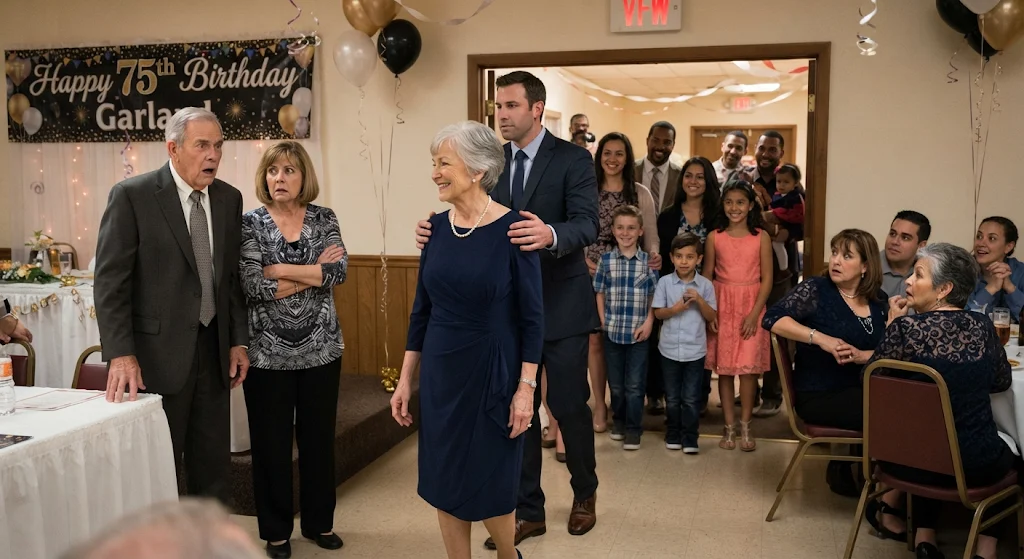
The entire birthday hall went silent.
“He left because another woman was already pregnant with his child.”
I felt the room tilt beneath my feet.
For forty-two years, I’d carried the shame of believing my body had destroyed my marriage.
Forty-two years of wondering whether Garland might have stayed if I’d been different.
And now his own son was standing in front of me, telling me the story I’d built my grief around was a lie.
Garland gripped the back of a chair.
“Thomas, that’s enough.”
“No, Dad,” Thomas replied. “I think forty-two years is enough.”
Bonnie stepped between them.
“You’re ruining your father’s birthday!”
Thomas looked at his mother.
“Then maybe somebody should’ve told the truth before we ordered the cake.”
A nervous murmur moved through the room.
I looked at the photograph again.
“Who is she?”
Garland wouldn’t answer.
Bonnie looked away.
Thomas spoke softly.
“Her name was Evelyn Mercer.”
I recognized the name.
Not the woman.
The name.
Evelyn Mercer had worked at the hospital in Greenville where Garland and I had gone for our fertility appointments.
She was a young receptionist with pretty dark hair and a soft voice.
She’d brought me water once when I cried in the waiting room.
I remembered thanking her.
I remembered thinking she was kind.
And now I was holding a photograph of her standing beside my husband with a baby in her arms.
“Oh, Garland,” I whispered.
He closed his eyes.
I had imagined this moment a thousand times over the years.
Sometimes I’d pictured him apologizing.
Sometimes I’d pictured myself shouting.
Sometimes I’d pictured telling him exactly what his leaving had cost me.
But standing there, surrounded by my children and grandchildren, I felt something I hadn’t expected.
Not anger.
Not even heartbreak.
Just an awful, exhausted sadness for the young woman I’d once been.
She had deserved the truth.
And nobody had given it to her.
“Tell her,” Thomas said.
Garland shook his head.
“Son, you don’t understand.”
“Then explain it.”
Bonnie grabbed his arm.
“Garland, don’t.”
He pulled away from her.
It was the first time I’d ever seen him refuse Bonnie anything.
He looked at me.
“Della, I made mistakes.”
I almost laughed.
Mistakes.
Forgetting to pay the electric bill was a mistake.
Putting salt instead of sugar in your coffee was a mistake.
Making your wife believe she was unworthy of love while you carried on with another woman was something else entirely.
“How long?” I asked.
Garland stared at the floor.
“How long were you seeing her before you left me?”
“About eight months.”
I counted backward.
Eight months.
That meant he’d already been seeing Evelyn when he held my hand in the doctor’s office.
He’d already been betraying me when I cried in our bedroom.
He’d already been planning another life while telling me to keep hoping.
“You sat beside me at those appointments,” I said.
“I know.”
“You watched me blame myself.”
“I know.”
“And you never said a word.”
His shoulders sagged.
“No.”
I nodded.
There was nothing else to say.
Then Thomas unfolded the letter.
“Dad wrote this after Evelyn’s baby was born.”
Garland reached for it.
“Thomas, please.”
But Thomas handed it to me instead.
My name was written across the top.
Dear Della,
There are things I should’ve told you before I left.
I know I hurt you, and I know I let you believe something that wasn’t true.
Evelyn had a baby boy last week.
His name is Benjamin.
I don’t know what kind of father I’ll be, but I know I wasn’t the husband you deserved.
You were never the reason our marriage failed.
I was.
I stopped reading.
My eyes burned.
For forty-two years, those were the words I’d needed.
Not because they could repair what happened.
But because they would’ve allowed a frightened twenty-three-year-old woman to stop blaming herself.
I looked at Garland.
“Why didn’t you send it?”
He swallowed.
“I was ashamed.”
Bonnie made a sharp sound.
“That’s not the whole story.”
Every head turned.
Garland looked at her.
“Bonnie.”
She lifted her chin.
“Tell her about the baby.”
Thomas frowned.
“What about him?”
Bonnie looked at Garland with an expression I couldn’t read.
Then she said something that changed the entire room.
“Benjamin wasn’t yours.”
Garland went still.
Thomas stared at his mother.
“What?”
Bonnie’s voice shook.
“Evelyn told you the truth before she died. You just never wanted to believe it.”
I looked from one face to another.
“Before she died?”
Thomas nodded slowly.
“Evelyn passed away when Benjamin was three.”
I held the photograph tighter.
“What happened to the little boy?”
Garland didn’t answer.
Bonnie stared at the floor.
Thomas looked toward Samuel.
And suddenly my oldest son stepped forward.
“Mama,” he said quietly, “I think we need to sit down.”
Something in his voice frightened me.
Samuel was seven when he came to live with me.
Seven years old.
In 1985.
He’d arrived with a coat two sizes too big and a broken toy truck.
He had no birth certificate in his little grocery sack.
No photographs.
No information about his father.
I looked at Samuel.
Then at the photograph.
Then back at Samuel.
His brown eyes.
His broad forehead.
The small scar beneath his chin.
I remembered the first time he’d told me about his mother.
He’d said her name was Evie.
Not Evelyn.
Just Evie.
My mouth went dry.
“Samuel,” I whispered, “what are you thinking?”
He looked at Thomas.
“Where was that baby born?”
“Greenville,” Thomas replied.
Samuel closed his eyes.
“What was his full name?”
Thomas checked the letter.
“Benjamin Samuel Mercer.”
I couldn’t breathe.
Samuel’s legal name had been Samuel Mercer when he came to me.
The county worker had told me his records were incomplete.
He’d been moved between temporary placements after a family crisis.
I’d never been given a clear account of his earliest years.
Samuel opened his eyes.
“My first name was Benjamin.”
The room seemed to disappear.
I heard somebody gasp.
Ruthie grabbed my hand.
And Garland looked at Samuel as though he were seeing a ghost.
“No,” he whispered.
Samuel’s voice remained steady.
“I was called Benjamin until I was little. After that, everybody called me Samuel.”
Garland took a step toward him.
“Ben?”
Samuel didn’t move.
Garland covered his mouth.
“Oh, my God.”
I felt my knees weaken.
Daniel pulled out a chair.
“Mama, sit.”
I sat.
Because there was only one thought moving through my head.
The little boy who’d come to my house in an oversized coat.
The boy I’d raised.
The boy who called me Mama.
The boy who’d held my hand through every hard season of my life.
Might have been the very child Garland left me to have.
Bonnie began crying.
Not quietly.
Loud, angry tears.
“This is ridiculous! You can’t prove anything!”
Thomas turned toward her.
“Then why are you so upset?”
“Because you’re making accusations!”
Samuel looked at Garland.
“Did you know where I was?”
Garland shook his head.
“No. I swear I didn’t.”
Samuel’s jaw tightened.
“Did you ever look?”
Garland opened his mouth.
Then closed it.
That silence answered more than words could have.
Thomas looked down at the letter.
“There’s another page.”
Garland’s face changed.
“Thomas, no.”
But Thomas unfolded the second sheet.
And read.
If anything happens to Evelyn, I’ve arranged for Benjamin to stay with her sister, Louise.
Bonnie says she knows Louise and will make sure the boy is cared for.
Bonnie suddenly stopped crying.
I turned toward her.
“Bonnie?”
She shook her head.
“I don’t remember.”
But I could tell she did.
Because her hands were trembling.
Thomas looked at her.
“You told Dad you knew where Benjamin was?”
Bonnie’s eyes darted toward the door.
“That was years ago.”
“Did you?”
She didn’t answer.
Garland’s voice rose.
“Bonnie, I asked you about him for years!”
“Because you wouldn’t let it go!”
“He was a child!”
“And we had children of our own!”
The words came out before she could stop them.
Every person in that room heard them.
Bonnie covered her mouth.
Garland stared at her.
“You knew.”
She shook her head.
“You don’t understand.”
“You knew where he was.”
“I knew he was being taken care of!”
Samuel stepped forward.
“Where?”
Bonnie began backing away.
“Don’t look at me like that.”
Samuel’s voice cracked for the first time.
“Where was I being taken care of?”
She looked toward me.
And something ugly flickered across her face.
“You were with her, weren’t you?”
My heart stopped.
Bonnie knew.
She’d known.
Maybe not everything.
Maybe not the full story.
But enough.
I stood slowly.
“Bonnie,” I said, “how long have you known Samuel was my son?”
She stared at me.
Then whispered:
“Since 1987.”
The year I’d written Garland that letter.
The year she’d sent me the cruel reply.
I remembered exactly what I’d written.
I’ve adopted a wonderful little boy named Samuel Mercer. He has brought more happiness into my life than I ever thought possible.
I’d even included a photograph.
A little boy standing beside my tomato patch.
Smiling with his missing front tooth.
Bonnie had seen that picture.
She’d recognized him.
And she’d hidden it.
I looked at Garland.
“She knew.”
His face had turned gray.
“Bonnie?”
She began shaking her head.
“I was protecting my family.”
I felt Samuel’s hand settle gently on my shoulder.
And I realized that for forty-two years, I’d thought Garland was the cruelest person in my story.
I had been wrong.
Thomas pulled out his phone.
“There’s something else.”
Bonnie’s eyes widened.
“Thomas, put that away.”
He ignored her.
“When I found Dad’s old letters, I also found a receipt from a private investigator.”
Garland frowned.
“What investigator?”
Thomas looked at him.
“One you hired in 1994.”
Garland nodded slowly.
“I wanted to find Benjamin.”
My chest tightened.
“You looked for him?”
“For years,” Garland whispered.
Thomas scrolled through his phone.
“The investigator found a woman named Della Mercer.”
I frowned.
“That wasn’t my name.”
“No,” Thomas said. “It wasn’t.”
He looked at Bonnie.
“But somebody gave the investigator that name and a false address.”
Garland turned toward his wife.
“Bonnie, what did you do?”
She shook her head.
“I don’t know what you’re talking about.”
Thomas held up his phone.
“I have copies of the investigator’s correspondence.”
Bonnie’s face drained of color.
“And one letter was signed by you.”
I felt Samuel’s hand tighten around mine.
Thomas took a breath.
“The letter said Benjamin had died in 1988.”
Garland stumbled backward.
He caught himself against the table.
“No.”
Thomas’s eyes filled.
“Dad, she told the investigator your son was dead.”
Bonnie began sobbing.
Garland stared at her.
For a moment, nobody spoke.
Then he whispered:
“All these years…”
He looked at Samuel.
“All these years, I thought you were gone.”
Samuel’s expression didn’t change.
“Well,” he said quietly, “I wasn’t.”
And then he looked at me.
“I was home.”
That was when I finally cried.
Not for Garland.
Not for Bonnie.
But for a little boy who’d spent his earliest years believing nobody wanted him.
And for the strange, impossible way life had brought him to my doorstep.
The birthday party was over.
Nobody announced it.
Nobody needed to.
Guests began gathering their purses and coats.
The sheet cake sat untouched beneath the gold balloons.
Garland remained standing beside the table, staring at Samuel.
Then he asked the question I had been dreading.
“Could we do a DNA test?”
Samuel looked at me.
I squeezed his hand.
“That’s your decision, sweetheart.”
He nodded.
Then turned toward Garland.
“Yes,” he said. “We can.”
Garland began crying.
But Samuel wasn’t finished.
“And whatever that test says, I want you to understand something.”
Garland nodded desperately.
Samuel put his arm around my shoulders.
“This woman is my mother.”
Garland lowered his eyes.
“Of course.”
“She raised me. She fed me. She stayed when I was sick. She showed up when I graduated. She helped me become a man.”
His voice trembled.
“You might be my biological father. But she was the one who never left.”
I covered my mouth.
Then Samuel said something that silenced the room.
“And if you really want to know what happened to me before I came to Mama Della, there’s a woman in Mississippi who can tell us.”
Thomas frowned.
“Who?”
Samuel looked at Bonnie.
“Her name is Louise Mercer.”
Bonnie grabbed the edge of the table.
Samuel continued.
“And I spoke to her yesterday.”
Bonnie whispered:
“No.”
Samuel looked at me.
“Mama, she told me something about the day I was taken away.”
My heart began pounding.
“What did she say?”
Samuel looked directly at Bonnie.
“She said I wasn’t abandoned.”
He paused.
“She said somebody paid her to give me up.”
And Bonnie’s knees buckled.
TO BE CONTINUED IN PART 4…
PART 4 — THE WOMAN WHO SOLD A LITTLE BOY’S FUTURE
Bonnie collapsed into a chair.
Her sequined dress glittered beneath the fluorescent lights as she covered her face with both hands.
Nobody rushed to comfort her.
Not even Garland.
Samuel stood beside me, his expression as hard as I’d ever seen it.
“Tell us,” he said.
Bonnie shook her head.
“Not here.”
“Then where?” Thomas demanded. “You’ve been hiding this for forty years. Where would you prefer we discuss it?”
Garland looked at his wife.
“Did you pay Louise to give up Benjamin?”
Bonnie lifted her head.
“I paid her to make sure he was taken care of.”
“That’s not what he asked,” I said.
She turned toward me.
There was hatred in her eyes.
Old hatred.
The kind that grows when somebody spends years blaming another person for choices they made themselves.
“You,” she whispered. “You always had to come back.”
I stared at her.
“Bonnie, I didn’t come back. You invited me.”
She looked away.
And for the first time, I wondered whether that birthday invitation had been more than cruelty.
Maybe Bonnie had wanted to see me humiliated.
Maybe she’d believed that if Garland saw me alone, old and childless, he’d finally stop thinking about the woman he’d left.
Instead, I’d walked through the door with the very son she’d tried to erase.
Life has a peculiar sense of timing.
Samuel took out his phone.
“Louise is still alive,” he said.
Garland’s head snapped up.
“Where?”
“Near Greenwood.”
I knew Greenwood well.
I’d driven school routes not far from there for years.
Samuel continued.
“She’s eighty-one now. She lives with her daughter.”
“How did you find her?” Thomas asked.
“I started looking after Mama received the invitation.”
I turned toward him.
“You never told me.”
He looked embarrassed.
“I wanted to surprise you.”
“By finding your birth family?”
“By finding out why my records never made sense.”
He paused.
“Mama, I’ve wondered for years. I just didn’t want you thinking you weren’t enough.”
Those words nearly undid me.
I reached for his hand.
“Samuel, there has never been a day when I thought you were anything less than my son.”
He smiled sadly.
“I know.”
Then he looked toward Garland.
“But when I saw his name on that invitation, something clicked.”
Samuel explained that he had been researching his early childhood for several months.
A retired county worker had helped him identify old case numbers.
He’d found a birth record under the name Benjamin Samuel Mercer.
Then he’d located Louise through a distant cousin.
“She remembered me,” Samuel said.
Bonnie whispered something I couldn’t hear.
Thomas leaned forward.
“What did Louise tell you?”
Samuel took a breath.
“She said my mother Evelyn died after a long illness. Louise took me in, but she was struggling financially.”
Garland nodded.
“That’s what Evelyn wanted.”
Samuel looked at him.
“Then why didn’t you help?”
Garland’s face crumpled.
“I thought Louise had moved away.”
“Because Bonnie told you that?”
He nodded.
Samuel turned back toward Bonnie.
“Louise said a woman came to her house with money.”
Bonnie stared at the floor.
“The woman told her my father had a new family and didn’t want me.”
Garland made a broken sound.
Samuel continued.
“She said the woman offered her fifteen hundred dollars to sign paperwork allowing me to be placed with another family.”
Thomas looked stunned.
“Fifteen hundred dollars?”
In 1985, that was a great deal of money to a struggling woman.
But no amount could excuse what had happened.
Samuel’s voice remained calm.
“Louise said she was told I’d go to a stable home. She was promised she could contact me later.”
He looked directly at Bonnie.
“She never saw me again.”
Bonnie began crying.
“I thought it was best.”
“For whom?” Samuel asked.
She couldn’t answer.
Garland sat down heavily.
His three sons stood nearby.
The oldest, Michael, had barely spoken since the confrontation began.
Now he looked at Bonnie.
“Mom, did Dad know?”
She shook her head.
“No.”
Michael closed his eyes.
Thomas turned away.
The youngest son, Andrew, looked sick.
These were grown men.
Men with families, careers, mortgages, and children of their own.
And in one afternoon, they’d learned that the foundation of their parents’ marriage contained a secret none of them had imagined.
I felt sorry for them.
I truly did.
Whatever Bonnie had done, those boys hadn’t done it.
They were as innocent as Samuel had been.
“Listen to me,” I said.
All three turned.
“Your mother’s choices aren’t yours.”
Michael nodded slowly.
I continued.
“And whatever happens between the adults in this room, you don’t have to choose sides today.”
Thomas looked at Samuel.
“He’s our brother.”
The words seemed to surprise him.
Samuel’s eyes filled.
“Maybe.”
Andrew shook his head.
“No. If the test confirms it, you’re our brother. And even before that, you deserve answers.”
Garland looked at his sons.
For a brief moment, I saw the young man I’d married.
Not the selfish husband.
Not the frightened old man.
Just somebody realizing how much of his life had been shaped by silence.
Then Bonnie stood.
“I’m leaving.”
She reached for her purse.
Thomas blocked the aisle.
“Mom, we need to talk.”
“I have nothing more to say.”
Garland spoke quietly.
“Let her go.”
Everyone looked at him.
He didn’t raise his voice.
He didn’t threaten.
He simply said:
“Let her go, Thomas. She’s told us enough for one day.”
Bonnie stared at him.
“Garland?”
He looked away.
And for the first time that afternoon, she seemed to understand that her husband might not follow her.
After Bonnie left, I sat at a table with Samuel, Ruthie, Daniel, Caroline, Marcus, and the rest of my family.
The hall had mostly emptied.
Somebody had cut the birthday cake.
I couldn’t tell you who.
I ate a small piece because my blood sugar was dropping, and because a woman my age has learned that even the most dramatic family revelation doesn’t excuse skipping supper.
Ernestine finally came inside.
She took one look at the room.
Then at Garland.
Then at me.
“What happened?”
I sighed.
“Sit down, Ernestine.”
She sat.
I told her.
All of it.
When I finished, she stared at Bonnie’s empty chair.
Then she said:
“Well, I’ll be.”
That was Ernestine’s way of expressing emotions too large for ordinary language.
She reached across the table and squeezed Samuel’s hand.
“Honey, I’ve loved you since you were little enough to hide biscuits in your pockets.”
Samuel laughed through his tears.
“I remember.”
“And I don’t care who your daddy is. You’re still the boy who broke my church van window with a baseball.”
“I was nine.”
“And you still owe me for that window.”
Everyone laughed.
Even Garland.
It was a strange sound coming from him.
Small.
Uncertain.
But human.
Later, Garland approached me while the others were gathering coats.
“Della?”
I turned.
He looked older than he had two hours earlier.
“Can we talk?”
I glanced toward Samuel.
He nodded.
“I’ll be right here, Mama.”
Garland and I walked to a quiet corner near the kitchen.
For a moment, neither of us spoke.
Then he said:
“I’m sorry.”
I looked at him.
“I know.”
“No, you don’t.”
His voice cracked.
“I’ve spent forty-two years telling myself I did what I had to do. That we were young. That I wanted children. That I deserved another chance.”
He wiped his eyes.
“But I was a coward.”
I didn’t argue.
He continued.
“I blamed you because admitting the truth would’ve meant looking at what I’d become.”
I stared at the old man before me.
Once, I’d loved him so much I thought the world would end if he left.
Now I could see him clearly.
Flawed.
Weak.
Capable of tenderness.
Capable of cruelty.
And terribly late with the truth.
“Garland,” I said, “I needed those words in 1984.”
He nodded.
“I know.”
“I needed them when I was crying alone in that bus barn.”
He lowered his head.
“I know.”
“I needed them when people at church whispered that you left because I couldn’t give you babies.”
His shoulders shook.
“I know.”
I took a breath.
“But I don’t need them anymore.”
He looked up.
I smiled sadly.
“I have a life. A good one. I have children who love me. Grandchildren who fight over who gets to sit beside me at Thanksgiving. I have a sister who drives like she’s escaping the law.”
He almost laughed.
“I have a tomato patch. A church family. Friends. Memories.”
I paused.
“And none of that belongs to you.”
He nodded.
“You’re right.”
I touched his arm.
“I hope you find peace, Garland. But I can’t give it to you.”
Before we left, Thomas approached Samuel.
“I’d like to get to know you,” he said.
Samuel hesitated.
“Maybe.”
“No pressure.”
Thomas pulled a business card from his wallet.
“My number’s on there.”
Samuel accepted it.
Andrew came over too.
Then Michael.
The four men stood together awkwardly.
Brothers who had never known one another.
I watched them.
And something inside me softened.
Not toward Garland.
Not toward Bonnie.
Toward the possibility that the next generation might do better.
Then Thomas turned toward me.
“Mrs. Della, would you be willing to meet Louise?”
I frowned.
“Why?”
“Because she has something that belongs to Samuel.”
Samuel looked surprised.
“What?”
Thomas glanced toward Garland.
“A packet of letters.”
Garland went still.
“What letters?”
Thomas lowered his voice.
“Letters Evelyn wrote before she died.”
Samuel’s face changed.
“My mother wrote letters?”
Thomas nodded.
“Louise kept them.”
Samuel swallowed.
“Why didn’t she tell me?”
“She was afraid.”
“Of what?”
Thomas looked at me.
“She said Bonnie threatened her.”
The room fell silent again.
I closed my eyes.
Forty-two years.
And still, the truth wasn’t finished.
We drove home late that night.
Ernestine kept both hands on the wheel.
For once, she drove slowly.
Samuel followed in his car.
The others had gone to their hotels or started their journeys home.
I watched the dark Mississippi fields pass outside the window.
After a while, Ernestine said:
“You all right?”
I thought about it.
“Not exactly.”
She nodded.
“Fair enough.”
I looked down at the wooden box Ellie had given me.
Twelve brass nameplates.
Twelve names.
Twelve lives connected by choices that had nothing to do with blood.
“I keep thinking about Samuel,” I said.
“He’s a good man.”
“He is.”
“You raised him right.”
I smiled.
“We raised him, Ernestine.”
She sniffed.
“Don’t start making me cry while I’m driving.”
We rode in silence.
Then she said something I’ll never forget.
“Della, you know what’s strange?”
“What?”
“Garland left because he thought you couldn’t give him a family.”
I nodded.
“And all these years, you were raising the son he thought he’d lost.”
I looked out at the dark road.
“Yes.”
Ernestine shook her head.
“Sometimes life writes a story nobody would believe.”
Three days later, Samuel called.
“Mama, the DNA results are back.”
I nearly dropped my coffee.
“Already?”
“We paid for expedited testing.”
My heart began pounding.
“Well?”
He was quiet.
Too quiet.
“Samuel?”
Then he said:
“Garland is my biological father.”
I closed my eyes.
Even though I’d suspected it, hearing the words felt different.
Real.
Final.
“How are you feeling?” I asked.
“I don’t know.”
“That’s all right.”
He took a breath.
“There’s something else.”
My stomach tightened.
“What?”
“The lab found something unusual.”
I gripped the phone.
“Samuel, don’t make an old woman guess.”
He hesitated.
Then said:
“Thomas isn’t Garland’s biological son.”
I sat down.
“What?”
“The results showed Thomas and I aren’t paternal half brothers.”
I stared at the kitchen wall.
“Could there be a mistake?”
“They’re checking.”
He paused.
“But Mama… Thomas already knows.”
I swallowed.
“And?”
Samuel’s voice became very quiet.
“He’s asking questions about Bonnie.”
I looked at the birthday invitation still sitting beside my landline.
The gold letters.
The cruel handwritten sentence.
Come see what a real family looks like.
For the first time, I wondered how many lies Bonnie had told to create that picture-perfect family.
Then Samuel said:
“Mama, Thomas found something in his mother’s old papers.”
“What?”
“A birth certificate.”
I held my breath.
“And the father’s name isn’t Garland.”
“Who is it?”
Samuel hesitated.
Then whispered:
“You’re not going to believe this.”
TO BE CONTINUED IN PART 5…