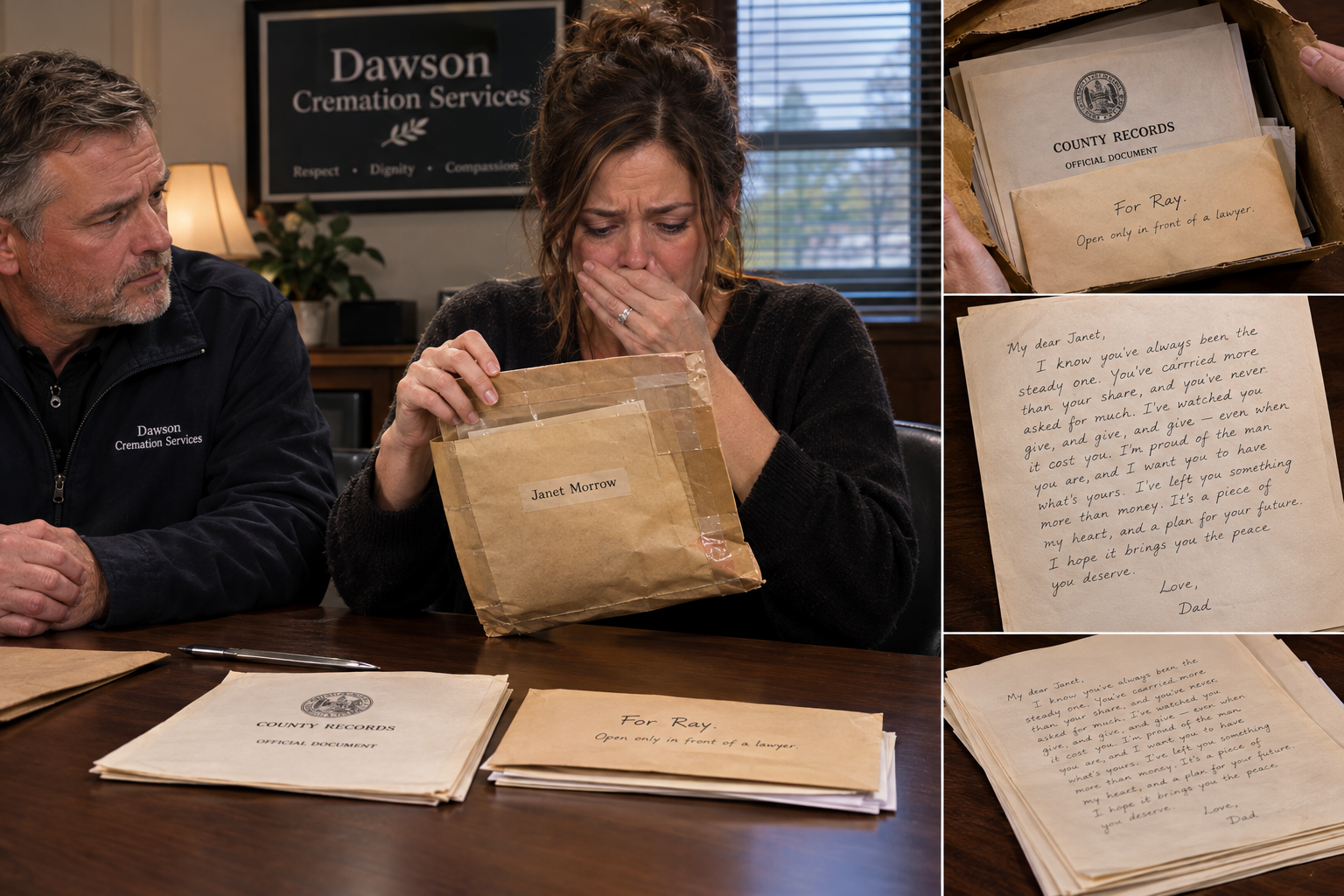
I read the first sentence of Dad’s letter three times. Not because I couldn’t understand it. Because I didn’t want to.
My dear Janet, if you’re reading this and your brother has told you I died without a will, then I’m afraid Ray has done exactly what I feared he would do.
I pressed my hand against my mouth.
Across the desk, Pete Dawson quietly pushed a box of tissues toward me.
“Would you like a moment alone, Mrs. Morrow?”
I shook my head.
“No. Please stay.”
I couldn’t explain why, but suddenly, I didn’t want to be alone with what I was reading.
I looked down again.
There is a will, sweetheart. There has been one for twenty-three years. I updated it after your mother died, and I updated it again last month.
Your brother knows about the first two.
He doesn’t know about the third.
My hands began trembling.
For the past nine days, Ray had spoken with such confidence.
He had told me there was nothing to discuss.
Nothing to divide.
Nothing to question.
He had made me feel like an inconvenient visitor in the house where I had grown up.
And all that time, he had known.
I continued reading.
Before I tell you what happened at the bank, I need you to promise me something.
Don’t confront your brother alone.
Don’t sign anything he puts in front of you.
And whatever happens, don’t let him convince you that I’ve lost my mind.
A strange, cold feeling spread through my chest.
Dad’s handwriting was unmistakable.
The capital letters.
The little hook at the end of his lowercase g.
The way he always underlined important words twice.
This was the same handwriting that had appeared on my birthday cards for fifty-eight years.
But I’d never seen fear in it before.
And now, somehow, I could.
I remembered our last telephone conversation.
Dad had asked whether I was planning to come home for Thanksgiving.
I told him I was.
“Good,” he’d said. “I’ve got something important to talk to you about.”
“What is it, Daddy?”
“Better in person, sweetheart.”
I had laughed.
“You’re not proposing to somebody, are you?”
He’d laughed too.
“No, honey. Nothing like that.”
Then he’d said something I hadn’t thought about until that moment.
“Just make sure you come.”
I had promised him I would.
Thanksgiving was supposed to be twelve days after his death.
He never made it.
And neither did our conversation.
I lowered the letter.
“Pete?”
“Yes, ma’am?”
“Did my father look frightened when he came here?”
The question escaped before I realized how foolish it sounded.
Dad had already been dead.
Pete’s expression softened.
“I wish I could tell you something that would help.”
I nodded.
“I’m sorry.”
“You don’t have to apologize.”
I looked at the other documents on the desk.
The smaller envelope addressed to Ray.
The folded paper bearing the county seal.
I opened that one carefully.
Across the top were the words:
CERTIFIED COPY OF RECORDED DEED
Below that was Dad’s name.
Then the address of his house.
The little brick house on Willow Creek Road where my mother had planted roses every spring.
The house where Ray and I had learned to ride bicycles.
The house Dad had spent forty-six years paying for, repairing, and loving.
I read further.
The property had been transferred into something called the Morrow Family Living Trust.
The recording date was October 28th.
Two weeks before Dad died.
I didn’t entirely understand what the document meant.
But I understood enough to know that my brother might not own what he thought he owned.
I returned to the letter.
The man you need to call is Samuel Bennett. His telephone number is at the bottom of this page. He was your mother’s lawyer when she was sick, and he’s been helping me quietly.
Show him everything.
Especially Ray’s envelope.
Do not open that envelope without Samuel present.
I know you’re going to have questions. I wish I could answer them myself.
But lately, sweetheart, I’ve been afraid that if something happens to me, nobody will hear my side of the story.
That was when I began to cry.
Not because of the house.
Not because of the will.
Because my eighty-one-year-old father had spent his final days wondering whether anybody would believe him.
And I hadn’t known.
I had been six hours away, going to work, buying groceries, complaining about traffic, and making ordinary plans for an ordinary Thanksgiving.
While Dad was sealing a desperate letter inside his brown corduroy jacket.
I wondered how many nights he had sat alone at his kitchen table, frightened of his own son.
I wondered how many times he had picked up the telephone to call me.
And how many times he had put it down again.
I turned to the second page.
What I read there made me forget, for several seconds, how to breathe.
On October 19th, I discovered that $96,400 had been moved out of my savings over the course of several months.
I didn’t authorize those withdrawals.
Ray told me I had.
Then he told me I was forgetting things.
Janet, I am getting old.
But I am not forgetting ninety-six thousand dollars.
I stared at the number.
$96,400.
My father had worked thirty-nine years repairing industrial machinery.
He had packed his lunch every morning in the same dented metal lunchbox.
He didn’t buy new clothes unless the old ones became impossible to mend.
When Mom died, he continued cutting coupons for groceries even though there was nobody left to remind him.
He had saved every dollar he could.
And nearly a hundred thousand of those dollars had disappeared.
I whispered, “Oh, Daddy.”
Pete looked toward the window, giving me what little privacy he could.
I forced myself to continue.
Ray has been in financial trouble for longer than he admits. Last year, I lent him money to help his business.
That was my choice.
What he did afterward was not.
When I confronted him, he became angry. He said he was entitled to compensation for everything he had done for me since your mother passed.
I asked him why he hadn’t simply talked to me.
He told me I would have said no.
He was right.
I closed my eyes.
I could almost hear Dad saying those words.
Quietly.
Without anger.
Just disappointed.
The next paragraph explained the bank visit.
There had actually been two trips, one on November 2nd, when Ray first brought Dad some paperwork, and another on November 3rd, when the bank manager asked Dad to return.
Ray wanted me to sign papers that would give him greater control over what remained of my money.
He said it was for my protection.
The woman at the bank asked whether I understood what I was signing.
I told her I understood it perfectly.
Then I asked her to speak to me without Ray in the room.
Your brother did not like that.
Not one bit.
I sat back.
For the first time since Dad’s death, I felt something stronger than grief.
Anger.
But there was more.
I told the bank what had been happening. They agreed to investigate and helped me protect the funds that were still there.
Ray drove me home without saying a word.
When we got to the house, he told me I’d made a terrible mistake.
He said one day I would need somebody, and there wouldn’t be anybody left.
I stopped reading.
I remembered Dad at seventy-six, sitting beside Mom’s hospital bed.
I remembered him feeding her tiny spoonfuls of pudding when she couldn’t hold the spoon herself.
I remembered him helping Ray buy his first truck.
I remembered him driving three hours through a snowstorm when my husband had emergency surgery.
My father had been there for everybody.
And his own son had threatened to leave him alone when he needed help.
I felt sick.
At the bottom of the third page, Dad had written:
There is one more thing your brother has been asking about.
The house.
He believes it will belong to him when I’m gone.
I have tried explaining that taking care of a parent does not mean owning a parent.
He doesn’t seem to understand the difference anymore.
Then came the last page.
The page that hurt the most.
I know you live far away, Janet. I know there were times you couldn’t come when I wanted you to.
Please don’t carry guilt about that.
You have a life because your mother and I worked hard to give you one.
I’m proud of the woman you became.
If I don’t get the chance to tell you again, know that being your father was one of the great privileges of my life.
I bent forward.
A sound came out of me that I didn’t recognize.
Pete stood and quietly closed his office door.
I cried until my throat hurt.
I cried for the father I had lost.
For the goodbye I had been denied.
For the lonely old man whose final days had been filled with things no father should ever have to endure.
And when I could finally see the words again, I read his closing instructions.
I still want to be laid beside your mother under the oak tree.
Please see to that if you can.
And remember, sweetheart, don’t spend the rest of your life fighting with your brother over what I left behind.
Money can be replaced.
Time cannot.
I’ve learned that too late.
All my love, always,
Dad.
Below his signature was Samuel Bennett’s telephone number.
And beneath that, in smaller handwriting, was one final sentence.
Ray thinks the only copy of my will is in the bottom drawer of my desk.
Let him keep thinking that.
I folded the letter.
Then I looked at Pete.
“May I use your telephone?”
He nodded.
“Of course.”
I dialed Samuel Bennett’s number.
A receptionist answered.
“Bennett and Associates. How may I help you?”
“My name is Janet Morrow. My father was Harold Morrow. He died last Monday.”
There was a brief pause.
Then the woman’s voice changed.
“Mrs. Morrow, please don’t hang up.”
I heard papers moving.
A door opening.
A muffled conversation.
Less than a minute later, a man’s voice came on the line.
“Janet?”
“Yes.”
“This is Samuel Bennett.”
I swallowed.
“I have a letter from my father.”
Silence.
Then he asked a question that sent a shiver through me.
“Did you find it in his jacket?”
I gripped the receiver.
“How did you know?”
He exhaled slowly.
“Because your father told me that was where he intended to keep it.”
I stared at the brown envelope.
“Mr. Bennett, what’s happening?”
“Where are you right now?”
“At the crematorium.”
“Is your brother with you?”
“No.”
“Does he know you’ve found the envelope?”
“No.”
“Good.”
His next words were spoken very carefully.
“Janet, I need you to bring those documents to my office. All of them. And please do not call your brother before you get here.”
“Why?”
“Because your brother called me yesterday.”
My heart started pounding.
“What did he want?”
Samuel hesitated.
“He wanted to know whether destroying an original will was enough to make it invalid.”
Samuel Bennett’s office occupied the second floor of an old building across from the county courthouse.
I’d walked past it hundreds of times as a girl without ever imagining I would one day climb those stairs carrying evidence against my own brother.
Samuel was seventy, perhaps a little older.
He had silver hair, kind eyes, and a photograph of his grandchildren beside a shelf of law books.
When he saw me, he didn’t immediately reach for the envelope.
Instead, he took my hand.
“I’m terribly sorry about your father.”
That simple sentence nearly undid me.
“Thank you.”
“Harold was a good man.”
I nodded.
“He was.”
Samuel offered me coffee.
I declined.
I didn’t think my hands were steady enough to hold a cup.
He sat across from me and examined the documents.
The letter.
The certified deed.
The smaller envelope marked for Ray.
He carefully placed that one aside.
“Your father was very particular about this.”
“What is inside it?”
“I know some of what he intended to include, but he packed and sealed it himself. We’ll respect his instructions.”
I looked at him.
“Did Dad really make another will?”
“Yes.”
Samuel unlocked a filing cabinet behind his desk.
He removed a thick green folder.
Inside was a document bearing my father’s signature.
There were witness signatures.
Dates.
Pages that had been carefully numbered.
Samuel turned it toward me.
“Your father signed this on October 25th.”
I touched the signature.
It was unmistakably Dad’s.
“Ray said Dad didn’t believe in wills.”
Samuel gave a sad little smile.
“Your father believed in being prepared. He was one of the most organized clients I’ve ever had.”
I laughed through my tears.
“That sounds like him.”
“He also established the trust you’ve just read about. The house was transferred into it before he died.”
“What does that mean?”
“It means Ray cannot simply declare the house his and sell it. Your father’s estate plan provides for the property to be managed according to his written instructions.”
Samuel pointed toward a section of the document.
“Your father named you to serve as successor trustee. He also nominated you to administer his estate, subject to the necessary court procedures.”
I stared at him.
“Me?”
“Yes.”
“But Ray has power of attorney.”
“That authority ended when your father died.”
“That’s what I told him.”
“You were correct.”
I sat quietly.
Then I asked the question I was almost afraid to ask.
“What did Dad leave to Ray?”
Samuel opened another document.
“Initially, your parents intended everything to be divided equally between you.”
I nodded.
“That sounds fair.”
“Your father’s final plan still recognizes both of you. But it accounts for previous loans, unauthorized withdrawals, and money that may need to be recovered.”
I thought about the missing $96,400.
“Did Dad know where it went?”
“Some of it.”
“Where?”
Samuel removed a packet of bank statements.
He turned several pages.
There were transfers to a business account.
Payments to a credit card.
Withdrawals that had occurred while Dad was recovering from his hip operation.
I recognized the name of Ray’s construction company.
Samuel tapped one entry.
“Your father did not dispute the original loan he voluntarily made to your brother. But these other transactions were different.”
“How much did he lend Ray willingly?”
“Forty thousand dollars.”
I looked up.
“On top of the missing money?”
“Yes.”
I sat back.
For a moment, neither of us spoke.
Then I whispered, “How could he?”
Samuel didn’t offer an answer.
Perhaps because there wasn’t one.
He opened another section of the folder.
“Janet, there is something else you should understand.”
I watched his face.
“Your father was worried that Ray might attempt to challenge his ability to make financial decisions.”
“Why?”
“Because Ray had been telling people Harold was becoming confused.”
I remembered several conversations with my brother over the previous year.
Dad forgets things now.
Dad doesn’t understand his statements.
Dad’s not as sharp as he used to be.
I had accepted those comments without questioning them.
After all, Dad was eighty-one.
I hadn’t realized those little remarks might have been preparing me to believe a much bigger lie.
Samuel continued.
“Your father knew what was being said about him. With his permission, we obtained an independent medical assessment around the time he signed the new documents.”
He handed me a letter.
The physician had recorded Dad’s understanding of his finances, his property, his family relationships, and the decisions he was making.
There was no indication in that assessment that he lacked the capacity to make those decisions.
My eyes filled again.
“He had to prove he knew his own mind?”
Samuel nodded gently.
“He wanted to remove as much uncertainty as possible.”
I looked out the window.
A woman was walking beneath the trees across the street, holding a little girl’s hand.
Life was moving normally outside.
Mine had stopped.
“Why didn’t he call me?” I asked.
Samuel folded his hands.
“He intended to.”
“He could have told me everything.”
“I know.”
“I would have come.”
Samuel looked at me for a long moment.
“Your father was embarrassed, Janet.”
“Embarrassed?”
“Ray was his son. Harold had spent his life believing that a father’s job was to protect his children. It was difficult for him to admit that he needed protection from one of them.”
I covered my face.
That was Dad.
Always protecting somebody.
Even the person hurting him.
“And there was another reason,” Samuel continued.
I lowered my hands.
“What?”
“Your father told me that if Ray knew he had involved you, Ray would accuse him of choosing one child over the other.”
Samuel paused.
“Harold wanted to give his son one last chance to put things right.”
My heart sank.
“Did he?”
Samuel looked down at the documents.
“No.”
My telephone rang while we were still sitting in Samuel’s office.
Ray.
His name flashed across the screen.
Samuel glanced at it.
“Would you like to answer?”
I shook my head.
But the ringing stopped and began again almost immediately.
Then a message appeared.
Where are you?
Another followed.
Call me. We need to settle some things about Dad.
And then a third.
I found a buyer for the house.
I read that one aloud.
Samuel’s eyebrows rose.
“Already?”
I couldn’t believe it.
Dad had barely been dead long enough for the flowers at his memorial table to wilt.
And Ray had found a buyer.
I called him.
He answered immediately.
“Jan, finally. Where’ve you been?”
“What’s this about selling Dad’s house?”
“Oh, good. You got my message.”
“Ray, he’s been gone less than two weeks.”
“Exactly. No point dragging things out.”
I gripped the telephone.
“What about his belongings?”
“I’ve started sorting them.”
“Without me?”
“You live six hours away. What am I supposed to do? Wait forever?”
I thought about Mom’s china.
Dad’s toolbox.
The family photographs.
The Christmas ornaments wrapped in newspaper upstairs.
“What have you gotten rid of?”
“Nothing important.”
“That’s not for you to decide.”
He sighed heavily.
“Jan, please don’t make this difficult.”
I looked at Samuel.
Then I asked, “How much are you selling the house for?”
“Why?”
“Because I’d like to know.”
“Two hundred and fifteen thousand.”
Samuel immediately reached for a notepad.
He wrote: Do not agree to anything.
Dad’s house sat on nearly three acres of land.
It had a detached garage, a workshop, and a beautiful garden.
I knew it was worth considerably more than Ray was asking.
“Who’s buying it?”
“A business associate.”
“What associate?”
“You don’t know him.”
“What’s his name?”
“Why are you interrogating me?”
“Because that was our father’s house.”
Ray laughed.
“Was. Past tense.”
My eyes burned.
“Ray.”
“What?”
“Have you looked for Dad’s will?”
There was a pause.
Only a second.
But I heard it.
“I told you there isn’t one.”
“Are you sure?”
“Absolutely.”
“Not even an old one?”
“Janet, stop.”
Something changed in his voice.
“Who’ve you been talking to?”
I looked at Samuel.
Then I said, “I’m coming to Dad’s house.”
“Now?”
“Yes.”
“Why?”
“Because I want to see what’s left of my father’s life before you sell it.”
He hung up.
Samuel leaned back.
“Janet, I would advise against going there alone.”
I nodded.
“Will you come with me?”
He looked at the clock.
Then he reached for his coat.
“Let’s go.”
The first thing I noticed when we arrived at Dad’s house was that the roses were gone.
Mom had planted those rosebushes the spring I graduated from high school.
Every year, Dad trimmed them himself.
Even after his knees began bothering him, he would carry a little wooden stool into the garden and sit beside them with his pruning shears.
Now there was nothing but freshly disturbed earth beneath the front windows.
I stared at it.
“What happened to the roses?”
Samuel followed my gaze.
“I don’t know.”
Dad’s old green pickup was gone too.
A white dumpster stood beside the garage.
And through the front window, I could see that the curtains Mom had sewn were missing.
I had to remind myself to breathe.
I walked onto the porch and tried my key.
It wouldn’t turn.
I tried again.
Nothing.
Ray had changed the locks.
I knocked.
A minute later, the door opened.
My brother stood there wearing one of Dad’s old flannel shirts.
“Jan?”
His eyes moved toward Samuel.
Then his face hardened.
“What is he doing here?”
Samuel spoke calmly.
“Good afternoon, Ray.”
Ray ignored him.
“Janet, what’s going on?”
“I’d like to come inside.”
“This isn’t a good time.”
I looked past him.
Dad’s favorite armchair was gone.
So was the grandfather clock.
The little table beside the stairs, where Mom had always kept a bowl of peppermints, was nowhere to be seen.
“Where’s Dad’s furniture?”
“I sold some of it.”
My mouth fell open.
“You sold it?”
“Nobody needs that old junk.”
Old junk.
That grandfather clock had been a wedding present from our grandparents in 1963.
Dad had wound it every Sunday evening for as long as I could remember.
“Who bought the clock?”
“Some antique guy.”
“Can you get it back?”
“Why would I?”
“Because it belonged to Mom and Dad!”
Ray rolled his eyes.
“You’re getting emotional.”
Samuel stepped forward.
“Ray, there are matters concerning your father’s property that need to be addressed before anything else is sold.”
Ray crossed his arms.
“I’m handling the estate.”
“On whose authority?”
“Dad’s.”
“Your father’s power of attorney is no longer effective.”
“Then I’ll handle it as his son.”
Samuel shook his head.
“Being his son does not automatically give you authority to sell his property.”
Ray stared at him.
Then he turned toward me.
“You’ve been digging around behind my back.”
I couldn’t believe what I was hearing.
“Behind your back?”
“That’s what you’re doing!”
“Ray, you changed the locks on our father’s house.”
“I’m protecting it.”
“From whom?”
He didn’t answer.
“From me?”
For a moment, something flickered across his face.
Then he stepped aside.
“Fine. Come in.”
I walked through the front door.
The house smelled wrong.
Dad’s house had always smelled faintly of coffee, furniture polish, and the peppermint candies he kept in his coat pockets.
Now it smelled of cardboard and dust.
Black garbage bags lined the hallway.
Someone had taken the photographs off the walls.
Pale rectangles remained where they had hung.
I went into the kitchen.
The little calendar beside the refrigerator was still showing November.
Dad had circled Thanksgiving in red.
Beside it, he had written:
Jan coming home.
I touched the words.
And suddenly, I couldn’t hold myself together anymore.
I turned away.
Ray sighed.
“See? This is why I didn’t want you coming.”
I faced him.
“Don’t.”
“What?”
“Don’t act as though my grief is an inconvenience to you.”
He looked startled.
Perhaps because I had never spoken to him that way before.
I pointed toward the calendar.
“He was expecting me.”
Ray said nothing.
“He asked me to come home. And you didn’t even let me see him before you had him cremated.”
“It was what he wanted.”
“No, it wasn’t.”
“He told me—”
“He wanted to be buried beside Mom.”
Ray’s expression tightened.
“He changed his mind.”
“When?”
“Recently.”
“Did he tell anybody else?”
“Why would he need to?”
“Did he write it down?”
“For God’s sake, Jan!”
Samuel interrupted.
“We can discuss the funeral arrangements separately. Right now, we need to deal with the property.”
He placed the certified deed on the kitchen table.
Ray glanced at it.
“What is that?”
“Your father’s recorded deed.”
Ray picked it up.
His eyes moved across the page.
Then he read it again.
I watched the color drain from his face.
“This isn’t right.”
Samuel remained standing.
“It was recorded on October 28th.”
“What trust?”
“The Morrow Family Living Trust.”
Ray looked at me.
“You did this?”
“I hadn’t seen that document until this morning.”
“You’re lying!”
“Ray,” Samuel said sharply, “your father made these arrangements himself.”
My brother shook his head.
“He couldn’t.”
“He did.”
“He didn’t understand what he was doing.”
“He understood.”
“He was eighty-one!”
Samuel opened his folder.
“Your father obtained an independent medical assessment. He discussed his intentions with me on several occasions. His instructions were consistent.”
Ray stared at him.
Then he said something that made my stomach turn.
“But I went through every drawer in his desk.”
Silence.
Samuel closed the folder.
I looked at my brother.
“What did you say?”
Ray blinked.
“Nothing.”
“No. You said you went through every drawer.”
“I was looking for insurance documents.”
“Or were you looking for something else?”
He looked away.
I took a breath.
“Ray, what happened to Dad’s old will?”
He shook his head.
“There wasn’t one.”
“Then why did you call Samuel yesterday and ask about destroying a will?”
My brother froze.
For several seconds, I heard nothing except the refrigerator humming.
Then he turned toward Samuel.
“That was a private conversation.”
“You were not my client,” Samuel replied. “And you did not tell me you were seeking advice about your own estate. We were discussing your father’s documents, which I was already responsible for safeguarding.”
Ray’s face darkened.
“This is ridiculous.”
I stepped closer.
“Where is the will?”
He didn’t answer.
“Ray.”
“It’s gone, all right?”
I felt the blood rush from my face.
“What do you mean, gone?”
He slammed his hand against the table.
“I got rid of it!”
Samuel went very still.
My brother continued.
“It was old! It didn’t reflect anything anymore!”
I stared at him.
“You destroyed Dad’s will?”
“It wasn’t relevant!”
“Who told you that?”
“He was going to change it anyway!”
I couldn’t believe it.
This was my brother.
The boy who had once put a dead mouse in my school lunchbox.
The teenager who had taught me how to drive Dad’s pickup.
The man who had stood beside me at Mom’s funeral and promised we would always look after each other.
And now he was standing in our childhood kitchen, admitting that he had destroyed our father’s will.
“Did Dad know you did that?”
Ray looked away.
I asked again.
“Did he know?”
Finally, Ray muttered, “I found it after he died.”
I swallowed.
“And you thought that if you destroyed it, everything would become yours?”
“I’m the one who stayed!”
His voice was suddenly enormous.
“I’m the one who took him to appointments! I’m the one who fixed his furnace! I’m the one who had to come over when he couldn’t get the television working!”
I stood perfectly still.
“You think you can disappear for twenty-five years and come back for half?”
“I didn’t disappear.”
“You weren’t here!”
“I called him every Sunday.”
“Oh, congratulations!”
“I came home whenever I could.”
“Whenever it suited you!”
His words hurt.
Because some of them contained a measure of truth.
Ray had lived close to Dad.
I hadn’t.
He had handled things I didn’t always see.
But caring for somebody did not give him permission to steal from them.
And it certainly didn’t give him permission to erase their wishes.
“Ray,” I said quietly, “if you needed help, why didn’t you ask?”
He looked at me.
“Would you have given me any?”
“Yes.”
He laughed bitterly.
“Sure.”
“I would have.”
“Too late.”
I felt tears coming again.
“Yes,” I whispered. “For Dad, it is.”
That was when a voice came from the hallway.
“Dad?”
Ray turned.
His daughter, Nora, stood near the stairs.
She was twenty-four, studying occupational therapy at a college two hours away.
I hadn’t seen her since the previous Christmas.
She looked frightened.
“Aunt Jan?”
I opened my arms.
She walked straight into them.
“Oh, sweetheart.”
She held me tightly.
“I didn’t know you were coming.”
“I didn’t either.”
When she stepped back, I noticed that her eyes were swollen.
Then she looked at her father.
“Dad, did you tell her?”
Ray’s jaw tightened.
“Go upstairs, Nora.”
“But—”
“Now.”
She didn’t move.
I glanced between them.
“Tell me what?”
Ray pointed toward the stairs.
“Nora, this is private.”
She shook her head.
“No. It isn’t.”
For the first time that afternoon, Ray looked genuinely afraid.
And when Nora reached into her jacket pocket and took out her telephone, my brother lunged forward.
“Don’t you dare.”
Samuel immediately stepped between them.
“Ray. That’s enough.”
My brother stopped.
Nora backed toward me.
Her hand was shaking.
“What is it, sweetheart?” I asked.
She looked at her father.
Then at me.
“Grandpa called me two days before he died.”
My heart jumped.
“He did?”
She nodded.
“I was in class. I couldn’t answer.”
She looked down at her telephone.
“He left me a voicemail.”
Ray closed his eyes.
“Nora, please.”
She ignored him.
“I didn’t listen to it until that evening. I called him back, but Dad answered Grandpa’s phone.”
I turned toward Ray.
Nora continued.
“He said Grandpa was asleep and that I shouldn’t bother him.”
I whispered, “What did Grandpa say in the message?”
She pressed the screen.
And then, for the first time since my father died, I heard his voice.
“Hello, little bird.”
That was what Dad had called Nora since she was a baby.
“If you get a chance, sweetheart, could you call your Aunt Janet for me? I’ve been having a little trouble with my telephone. I don’t know whether my messages are getting through.”
There was a brief pause.
I could hear his television playing in the background.
“Tell her I’m all right. But I’d like to see her before Thanksgiving if she can manage it. Nothing to worry about. Just tell her sooner would be better.”
Another pause.
“And don’t forget your winter tires. Your grandpa worries.”
Then he laughed softly.
“Love you, little bird.”
The message ended.
I had both hands against my mouth.
Nora was crying.
“I told Dad about it. I asked if I should call you.”
I looked at her.
“What did he say?”
She wiped her cheeks.
“He said he’d already spoken to you.”
My eyes moved slowly toward my brother.
Ray wouldn’t look at me.
“He said Grandpa was getting mixed up about the dates,” Nora whispered. “He said you were definitely coming for Thanksgiving, and I didn’t need to bother you.”
I sat down.
The room seemed to tilt.
Dad had asked for me.
He had tried to reach me.
And my brother had stopped the message.
“Ray.”
He remained silent.
“Why?”
His shoulders rose and fell.
“He was getting everybody worked up.”
“Why didn’t you tell me he wanted me?”
“Because you would’ve come down here making a fuss!”
I stared at him.
“Yes.”
My voice broke.
“I would have come.”
He finally looked at me.
I could hardly recognize his expression.
Anger.
Shame.
Exhaustion.
All tangled together.
“I would have driven six hours in the middle of the night,” I whispered. “I would have sat beside him. I would have listened. I would have made him coffee. I would have told him I loved him.”
Ray opened his mouth.
Nothing came out.
“And you took that away from me.”
Nora began sobbing.
“I’m sorry, Aunt Jan. I should’ve called you.”
I pulled her against me.
“No, sweetheart. You were told I already knew.”
“But I should’ve—”
“You trusted your father.”
I held her face between my hands.
“That’s not something you need to apologize for.”
She cried harder.
Across the kitchen, Ray turned toward the sink.
For a long time, nobody spoke.
Then Samuel broke the silence.
“Ray, there is something your father left for you.”
My brother turned around.
“What?”
Samuel took the smaller envelope from his folder.
The one Dad had sealed.
The one bearing the instruction that it should only be opened in front of a lawyer.
Ray stared at his name.
“Where did you get that?”
“Your father left it with some other documents.”
“Where?”
I answered.
“In his jacket.”
Ray looked at me.
“What jacket?”
“The brown corduroy jacket you sent him to the crematorium in.”
His face changed completely.
He reached for the envelope.
Then stopped.
“What’s inside?”
“I don’t know,” I said.
For the first time since we’d arrived, he looked less like an angry man and more like a frightened little boy.
Samuel placed the envelope on the table.
“Your father wanted you to open this in my presence. I’m here now.”
Ray sat down.
His fingers touched the handwriting.
For several seconds, he didn’t move.
Then he tore open the envelope.
A folded letter fell out.
So did several bank records.
And one small photograph.
Ray picked up the letter first.
He unfolded it.
I watched his eyes move across the opening lines.
His lips parted.
Then he whispered something so quietly I almost missed it.
“Oh, Dad.”
He continued reading.
His hands began to shake.
When he reached the bottom of the first page, he stopped.
He put the letter down.
Then he covered his face.
Nora looked at me.
I didn’t know what to say.
Samuel waited.
Finally, Ray picked up the photograph.
It showed Dad standing beside a little red bicycle.
Ray was about seven years old.
His hair was too long.
His front teeth were missing.
And his father was smiling down at him as though there was nothing in the world more wonderful than that little boy.
On the back, Dad had written something.
Ray read it.
And that was when my brother began to cry.
Not the quiet, dignified tears he had shed at Mom’s funeral.
These were different.
He bent forward.
His shoulders shook.
He pressed the photograph against his forehead.
“Dad,” he whispered again.
“Dad, I’m sorry.”
For several minutes, Ray didn’t speak.
Nora poured him a glass of water.
He took it but didn’t drink.
Finally, he pushed the letter toward me.
“Read it.”
I looked at him.
“Are you sure?”
He nodded.
I picked it up.
The first line was devastatingly simple.
Dear Raymond,
You were my first child, and the day you were born was one of the happiest days of my life.
I looked at the photograph resting on the table.
Then I continued reading.
When you were seven, I bought you a bicycle I couldn’t afford. Your mother was furious with me because we needed a new washing machine.
But you wanted that bicycle so badly.
You rode it until the tires wore out.
Every evening, you came running toward me when I got home from work, asking whether I wanted to watch you ride.
I would give a great deal to spend another evening watching you ride that bicycle.
I felt my throat tighten.
Even now, Dad hadn’t begun with accusations.
He had begun with love.
I don’t know exactly when things became so difficult between us.
Perhaps I made too many excuses for you.
Perhaps I helped you when I should have allowed you to learn from your mistakes.
You told me recently that I owed you something because you had taken care of me.
I have thought a great deal about that.
And you were right about one thing.
I should have thanked you more often.
Ray began crying again.
I kept reading.
I remember the winter you repaired my furnace. I remember the nights you brought me supper after your mother died. I remember you sitting beside me in the hospital after my operation.
I haven’t forgotten those things.
And I never will.
But, son, those acts of kindness do not excuse what you have done since.
I gave you forty thousand dollars when you told me your business was failing. I would have been willing to discuss the loan if you couldn’t repay it.
Instead, you began taking money without asking.
When I noticed, you told me I was confused.
When I questioned you, you became angry.
And when I asked you to stop, you threatened to leave me alone.
Your mother would have been heartbroken.
Ray looked down.
Nora put her hand on his shoulder.
He didn’t move.
I am not writing this because I hate you.
I couldn’t hate you if I tried.
But I cannot leave this world knowing that my silence has helped you become someone you were never meant to be.
I have made arrangements to protect what remains.
Your sister will know the truth.
You can hate me for that if you need to.
But please don’t punish her because I finally found the courage to tell her.
I turned the page.
Samuel has the documents you believe are in my desk.
He also has copies of our financial records.
There is no point searching the house for them.
My brother made a small, miserable sound.
Dad had known.
He had known exactly what Ray would do.
I was going to give you until Thanksgiving to explain everything to your sister yourself.
I still hope that is what happens.
But if I am not here, then I hope you will remember that you have a choice.
You can keep lying.
Or you can become my son again.
I pressed the paper against my chest.
Ray stared at the floor.
Then I read the final paragraph aloud.
“Raymond, money is not the worst thing you have taken from me.”
My brother lifted his head.
“You have taken away the feeling that I could trust my own child. That is something I cannot put back into a bank account.”
Nora began crying.
“But I hope that one day, you will become a man your daughter never has to protect herself from.”
Ray covered his eyes.
I continued.
“I love you, son. I have loved you through every mistake you’ve ever made. And I will love you until my last breath.”
“Your father.”
At the bottom were four words.
Please make this right.
I folded the letter.
Then I sat across from my brother.
He didn’t speak.
Neither did I.
Because sometimes anger has words.
And sometimes grief is simply too big for them.
Samuel eventually gathered the financial papers and examined them.
Among the records was a handwritten acknowledgment from Ray concerning the original forty-thousand-dollar loan.
There were notes Dad had kept about transactions he didn’t recognize.
There were copies of messages Ray had sent him.
One of them read:
You promised to help me. Don’t start counting every penny now.
Another said:
If you tell Jan, she’s going to turn this into something it isn’t.
But there was one message that Samuel read twice.
Then he looked at Ray.
“What was this about the property?”
Ray rubbed his forehead.
“Nothing.”
Samuel turned the paper toward him.
The message read:
The house will cover what I owe. You know that. Just get the paperwork done.
I looked at my brother.
“What did you owe?”
He sighed.
“Business debts.”
“How much?”
He didn’t answer.
Samuel repeated the question.
Finally, Ray whispered, “Seventy thousand.”
I stared at him.
“After taking all that money from Dad?”
“You don’t understand how bad things got.”
“Then explain.”
He looked toward Nora.
“Not in front of her.”
Nora shook her head.
“Dad, I’m tired of being the last person to know everything.”
He looked at her for a moment.
Then his shoulders dropped.
And slowly, the truth came out.
His construction business had been struggling for nearly three years.
He had lost two major contracts.
A customer had failed to pay him.
He had borrowed money privately to cover payroll.
Then he’d borrowed more to cover the first loan.
Somewhere along the way, he’d begun using Dad’s money.
At first, he told himself he was borrowing it temporarily.
Then the amounts became larger.
The business didn’t recover.
And the hole grew deeper.
“The buyer you mentioned,” Samuel said, “is he one of your creditors?”
Ray nodded.
“What arrangement did you make with him?”
Ray whispered, “He was going to buy the house.”
Samuel waited.
“And?”
“He was going to cancel my debt as part of the price.”
I stared at my brother.
“You were going to sell Dad’s house to pay your personal debts?”
“I was going to fix everything!”
“With Dad’s money!”
“I didn’t have another way!”
I pushed my chair back.
“Yes, you did.”
He looked at me.
“You could have told the truth.”
Ray started to argue.
Then stopped.
Perhaps because the letter was still lying in front of him.
Perhaps because his excuses were beginning to sound different now that Dad had answered them from beyond the grave.
Samuel requested a copy of the proposed sale agreement.
Ray hesitated.
Nora stood up.
“It’s on the printer in the spare bedroom.”
Ray looked at her sharply.
But she went upstairs anyway.
When she returned, she handed Samuel several pages.
He read them carefully.
Then he looked at me.
“This appears to be a proposed agreement. There are still substantial issues with it, including Ray’s claimed authority to sell the property.”
He turned toward my brother.
“You need to inform the prospective buyer that you cannot proceed with this transaction.”
Ray looked sick.
“What am I supposed to tell him?”
“The truth.”
My brother laughed bitterly.
“He’s not going to like that.”
Samuel closed the folder.
“Neither was your father.”
I stayed behind after Samuel left.
There was one question I still needed answered.
It wasn’t about the money.
It wasn’t about the house.
It wasn’t even about the destroyed will.
“Ray?”
He was standing at the sink.
“What?”
“Why did you have Dad cremated so quickly?”
His shoulders stiffened.
“I told you.”
“No. You didn’t.”
He turned.
“Jan, please.”
“I need to know.”
He looked toward the hallway.
Nora had gone outside to give us some privacy.
Ray sat down.
He rubbed his hands together.
“I panicked.”
“About what?”
“Everything.”
I waited.
“After Dad died, I knew people would start asking questions. The bank. The lawyer. You.”
My heart began pounding again.
“Did Dad’s death have anything to do with what was happening?”
Ray looked horrified.
“No!”
I watched him carefully.
“He collapsed in the kitchen, Jan. I called the ambulance. They tried everything.”
His voice broke.
“He was gone before we got to the hospital.”
I had no evidence that my father’s stroke was anything other than the medical emergency I’d been told it was.
But there was still something Ray wasn’t saying.
“Then why the cremation?”
He stared at his hands.
“I knew if we had a proper funeral, everybody would come.”
I didn’t answer.
“His friends. People from work. The neighbors.”
He swallowed.
“People he’d been talking to.”
I closed my eyes.
“You were afraid somebody would tell me.”
He nodded.
And there it was.
The reason I hadn’t been allowed to see my father.
The reason his friends hadn’t gathered around a coffin to say goodbye.
The reason my mother’s carefully purchased burial plot had remained empty beside her.
My brother had been afraid of a conversation.
I whispered, “You took away Dad’s funeral to protect yourself.”
Ray began crying.
“I didn’t think about it like that.”
“How did you think about it?”
“I just wanted it over with.”
I stared at him.
I could hardly speak.
“That’s our father you’re talking about.”
“I know.”
“No, Ray.”
My voice broke.
“That’s the man who carried you into the emergency room when you broke your arm. The man who taught you to fish. The man who never missed one of your baseball games.”
He covered his face.
“And when his life was over, you wanted the inconvenience of it finished as quickly as possible.”
“Jan, stop.”
I stood.
“I didn’t get to see him.”
Ray nodded.
“I know.”
“I didn’t get to kiss his forehead.”
“I know.”
“I didn’t get to hold his hand one last time.”
He began sobbing.
“I’m sorry.”
I wiped my eyes.
For months afterward, I would remember that moment.
My brother crying at the kitchen table.
Our father’s empty chair.
The Thanksgiving date marked on the calendar.
There are apologies that bring comfort.
And there are apologies that only confirm the size of what has been lost.
This was the second kind.
I walked toward the window.
Then I remembered something.
“The ashes.”
Ray looked up.
“What?”
“You gave me half of Dad’s ashes. Where are the rest?”
He hesitated.
“Upstairs.”
“Have you scattered any?”
“No.”
“Are you sure?”
“Yes.”
I turned around.
“I want them.”
He looked at me.
“All of them?”
“All of them.”
“Why?”
“Because we’re going to put him where he wanted to be.”
Ray looked down.
Then he nodded.
He went upstairs.
When he returned, he was carrying a small cardboard container identical to mine.
He held it for a moment.
Then he placed it on the kitchen table.
I looked at it.
Two cardboard boxes.
That was what remained of a man who had worked, laughed, loved, worried, saved, sacrificed, and raised two children.
I picked up the container.
And before leaving, I walked into Dad’s bedroom.
His bed was still made.
His slippers sat beneath it.
His glasses rested beside a bottle of hand lotion on the nightstand.
There was a book he’d been reading.
A paper bookmark stuck out halfway through it.
I sat on the edge of the bed.
Then I picked up his pillow and pressed my face into it.
There was still a little of his familiar scent.
Soap.
Peppermint.
And something I couldn’t describe.
Something that simply smelled like home.
“I’m here, Daddy,” I whispered.
“I’m sorry it took me so long.”
The following weeks were among the hardest of my life.
Samuel began the formal work necessary to establish my authority over Dad’s estate and protect the trust property.
The bank continued its investigation.
The proposed house sale stopped.
We arranged for the remaining belongings to be inventoried and secured.
And one by one, people began coming forward.
Dad’s neighbor, Mrs. Whitaker, told me he had started keeping his important papers in his jacket because he was worried about who had access to his desk.
His old friend Leonard told me Dad had borrowed his telephone twice because he couldn’t find his own.
A woman from the bank explained, once the appropriate permissions and paperwork were in place, how worried Dad had been about the withdrawals.
Every conversation revealed another piece of the life I hadn’t known my father was living.
And every evening, I returned to my hotel room and cried.
My husband, Mark, drove down the second weekend.
He found me sitting on the bed surrounded by photographs.
“Jan?”
I looked up.
“I missed so much.”
He sat beside me.
“You didn’t know.”
“I should have.”
“How?”
“I should’ve come more often.”
He took my hand.
“If your father wanted you to spend the rest of your life feeling guilty, why would he have written a letter telling you not to?”
I began crying again.
Mark pulled me against him.
I whispered, “I just want him back.”
“I know.”
“I don’t want the house. I don’t want the money. I don’t want any of this.”
He held me tighter.
“I know, honey.”
And for a little while, I let myself be somebody’s daughter instead of the person everyone expected to make decisions.
The investigation took months.
It wasn’t dramatic in the way people imagine these things happening.
There was no single afternoon when everybody admitted everything and the world became fair again.
There were statements.
Interviews.
Telephone calls.
Documents.
Arguments.
And long stretches of waiting.
Ray eventually admitted to making unauthorized transfers.
Some funds were recovered from an account connected to his business.
Other amounts had already been spent.
The disputed transactions and the original loan were accounted for separately, so the estate’s recovery arrangements would not count the same money twice.
He also faced criminal proceedings concerning his conduct.
I didn’t enjoy watching any of it.
He was still my brother.
When the prosecutor asked whether I wanted to provide information about Dad and the effect of what had happened, I agreed.
Ray later entered a negotiated guilty plea.
The judge imposed conditions that included probation, financial restitution, and supervision.
His business closed.
He sold his expensive truck.
He moved out of the large house he could no longer afford and began working for another construction company.
For the first time in years, he was earning a regular paycheck instead of trying to keep a failing business alive with money that belonged to somebody else.
Some relatives blamed me.
One cousin called and said, “Did you really have to take things this far?”
I answered, “Dad asked for his wishes to be respected.”
“He’s gone, Janet.”
I looked at his photograph on my mantel.
“That doesn’t make his wishes meaningless.”
Another relative told me that family matters should stay within the family.
I asked her whether she would say the same thing if somebody had taken nearly a hundred thousand dollars from her retirement savings.
She didn’t call again.
But other people surprised me.
Dad’s former coworkers contacted me.
His neighbors brought casseroles.
Nora began coming to see me whenever she could.
And through all of it, Samuel kept reminding me of something Dad had said during one of their meetings.
“Harold wasn’t interested in ruining Ray.”
I looked at him.
“What was he interested in?”
Samuel smiled sadly.
“Being treated like his life still belonged to him.”
That sentence stayed with me.
Because I think that’s what frightened Dad most.
Not the possibility that he might die.
At eighty-one, he had made peace with that.
What frightened him was the possibility that he might stop being allowed to make decisions while he was still alive.
In early spring, Samuel called me into his office.
“I have something for you.”
He handed me a small velvet box.
I opened it.
Inside was my mother’s wedding ring.
I stared at it.
“Where did you find this?”
“Your brother brought it in yesterday.”
My eyes filled.
I’d searched everywhere for that ring.
Dad had kept it in a little wooden box beside his bed.
After Mom died, he sometimes took it out and held it while watching television.
I had assumed it was lost when Ray emptied the bedroom drawers.
Samuel handed me a note.
It was written by Ray.
Jan,
I took this before Dad died. I was going to sell it.
I couldn’t bring myself to do it.
I’ve kept it hidden in my toolbox ever since.
It should have gone to you. Dad told me that years ago.
I’m sorry.
I lifted the ring from the box.
It was worn thin on one side.
Mom had worn it for fifty-eight years.
Through dishes.
Laundry.
Gardening.
Birthday parties.
Hospital visits.
And every ordinary day of a marriage that had lasted longer than most people could imagine.
I slipped it onto my finger.
It fit.
And I cried.
Samuel quietly handed me another document.
“What is this?”
“Your father’s written wishes concerning some of the personal belongings.”
I read through the pages.
Mom’s ring was indeed intended for me.
Dad’s tools were intended for Ray.
Nora was to receive a small collection of books and the money Dad had separately set aside to help with her education.
And the grandfather clock was supposed to remain in the family if possible.
I looked up.
“The clock is gone.”
Samuel smiled.
“Actually, it isn’t.”
“What?”
“Your niece found the name of the antique dealer on a receipt. She contacted him.”
My mouth opened.
“He still had it?”
“Yes. We arranged for its return.”
I covered my face.
The clock.
The sound of every Sunday evening of my childhood.
Mom’s ring.
Dad’s handwriting.
Little pieces of home that I had believed were gone forever.
There were things we couldn’t recover.
No lawyer could give me back my father’s final days.
No judge could restore the opportunity to hold his hand.
But that afternoon, carrying Mom’s ring and knowing the clock would tick again, I felt something I hadn’t felt since November.
A little peace.
We buried Dad’s ashes beside Mom on the eighteenth of May.
It would have been his eighty-second birthday.
The morning was bright and cool.
The old oak tree had begun filling with green leaves.
There were folding chairs beneath its branches and a little table covered with a white cloth.
On that table stood a photograph of Dad and Mom taken on their fiftieth wedding anniversary.
They were holding hands.
Dad was wearing a suit that didn’t quite fit anymore.
Mom was laughing at something he’d whispered in her ear.
I had chosen that photograph because it showed them the way I wanted to remember them.
Together.
Happy.
Still in love after fifty years.
We invited the people who should have been given the opportunity to say goodbye in November.
Neighbors.
Former coworkers.
Friends from church.
People Dad had helped over the years.
Pete Dawson came too.
When I saw him walking toward us, I hurried over.
“You came.”
He smiled.
“I wouldn’t have missed it.”
I hugged him.
“Thank you for calling me.”
He returned the hug.
“I’m glad I did.”
I pulled away.
“I don’t know what would have happened if you hadn’t.”
Pete looked toward Dad’s photograph.
“I think your father was determined to make sure that letter reached you.”
I smiled through my tears.
“He was always a stubborn man.”
“So I’ve heard.”
We laughed softly.
Then Mark touched my shoulder.
“Jan.”
I turned.
Ray was standing at the other end of the cemetery path.
Alone.
He wore a dark suit and carried a small bunch of yellow roses.
Mom’s favorite.
For a moment, I didn’t know whether he would come closer.
He hadn’t been invited personally.
But Nora had told him when the service would take place.
And I had told her that I wouldn’t prevent him from attending.
This was his father too.
He approached slowly.
When he reached me, he stopped.
“Jan.”
“Ray.”
He looked toward the photograph.
“Is it all right if I stay?”
I nodded.
“Yes.”
He swallowed.
“Thank you.”
He took a seat in the back row.
Nora sat beside him.
When the service began, Leonard spoke about their years working together.
Mrs. Whitaker remembered how Dad had cleared snow from her sidewalk every winter without being asked.
A retired mechanic told a story about Dad repairing his daughter’s car and refusing payment.
People laughed.
People cried.
And I realized how many different lives my father had touched without ever telling us about it.
When it was my turn, I stood beside the photograph.
I had prepared several pages.
But when I looked at Dad’s smiling face, I folded them.
“My father was eighty-one years old when he died.”
My voice trembled.
“He wasn’t rich in the way people usually understand wealth. He bought his shirts on sale. He saved screws in old coffee tins. He didn’t believe in throwing something away just because it was broken.”
Several people smiled.
“He loved my mother. He loved his children. And he worked hard because he wanted us to have opportunities he never had.”
I looked toward Ray.
“Sometimes, I think we became so accustomed to his generosity that we forgot how much it cost him.”
Ray lowered his head.
“But I don’t want his final days to become the only thing anybody remembers about him.”
I looked around at the gathering.
“He lived eighty-one years. He deserves to be remembered for more than the circumstances surrounding his death.”
My tears began falling.
“He was my daddy.”
I couldn’t continue for several seconds.
Mark reached for my hand.
I took a breath.
“And today, we’re finally bringing him home.”
When I finished, I returned to my seat.
Then something unexpected happened.
Ray stood.
He looked at me first.
“May I?”
I nodded.
He walked toward Dad’s photograph.
He didn’t bring a prepared speech.
For a long time, he simply stood there.
Then he said, “My father was a better man than I’ve been.”
The cemetery became silent.
“He helped me more times than I can count.”
Ray looked at his hands.
“And when he needed me, I didn’t always give him the kindness he deserved.”
Nora covered her mouth.
My brother swallowed.
“I wish I had another afternoon with him.”
His voice broke.
“I wish I could go back to his kitchen, sit across from him, and tell him everything I was too proud to admit.”
He wiped his eyes.
“I can’t.”
For a moment, I thought he would walk away.
Instead, he turned toward me.
“And I wish my sister had been given the goodbye she deserved.”
I began crying.
Ray looked back at Dad’s photograph.
“I’m sorry, Dad.”
He lowered his head.
“I heard you.”
Those three words meant more than any speech he could have prepared.
Because Dad’s last letter had been asking for something very simple.
To be heard.
And finally, beneath that old oak tree, his son was listening.
After the service, we remained at the graveside while the cemetery staff completed the burial arrangements.
Dad’s ashes had been reunited.
He was laid beside Mom, exactly where he had wanted to be.
I placed my hand against their headstone.
“Happy birthday, Daddy.”
A gentle wind moved through the branches above us.
I closed my eyes.
And for the first time since his death, I didn’t picture him alone in his house, frightened and worried about what Ray might do.
I pictured him with Mom.
Holding her hand.
Finally able to rest.
When I turned around, Ray was standing several feet away.
Everybody else had begun walking toward their cars.
“Jan?”
“Yes?”
He approached.
“I know saying sorry isn’t enough.”
I nodded.
“It isn’t.”
He looked down.
“I know.”
We stood together in silence.
Then he asked, “Do you think you’ll ever forgive me?”
I had imagined that question many times.
Sometimes, in my imagination, I screamed at him.
Sometimes I walked away.
Sometimes I gave him an answer that made everything simple.
But standing beside our parents’ graves, I realized there wasn’t a simple answer.
“I don’t want to hate you, Ray.”
His eyes filled.
“I don’t.”
“But I can’t pretend none of this happened.”
He nodded.
“I wouldn’t ask you to.”
“You lied to me. You hurt Dad. And you took away something I can never get back.”
He swallowed.
“I know.”
I looked at Mom’s name on the headstone.
“Forgiveness doesn’t mean I have to trust you the way I used to.”
He wiped his cheek.
“I understand.”
“And being your sister doesn’t mean I’m responsible for rescuing you.”
He nodded again.
Then I said, “But if you really want to make things right, you can start by becoming the man Dad hoped you’d be.”
Ray looked at me.
“What if I don’t know how?”
I thought about our father.
About his patience.
About every broken appliance he had repaired at the kitchen table.
“Start with telling the truth,” I said.
Ray stood quietly.
Then he whispered, “All right.”
We didn’t hug that day.
We weren’t ready.
But when I walked toward my car, he didn’t follow me asking for money, favors, or another chance.
He simply remained beside Dad’s grave.
And somehow, that felt like a beginning.
Dad’s house was eventually sold.
Not to Ray’s creditor.
Not through a rushed private arrangement.
It was sold after the necessary estate and trust matters had been addressed, at a fair market price, to a young couple with two little children.
The proceeds were handled according to Dad’s instructions, including the accounting for money Ray had already received or taken.
Ray’s eventual share was substantially reduced.
The house wasn’t a solution to his personal debts anymore.
Those responsibilities belonged to him.
Before the new family moved in, I went through every room one final time.
The little marks on the pantry door showed how tall Ray and I had been at different ages.
There was a scratch on the kitchen floor where Mom had dropped a cast-iron skillet.
The basement door still had the handle Dad had repaired when I was fourteen.
I touched the walls.
I opened the cupboards.
I stood in the bedroom where I’d spent eighteen years dreaming about everything I wanted to become.
I had thought selling the house would feel like losing Dad again.
But then I watched the young couple’s little boy run across the backyard.
“Mommy, can we put a swing here?”
His mother laughed.
“We’ll ask Daddy.”
I smiled.
My father would have liked that.
Another child would learn to ride a bicycle in that driveway.
Another family would celebrate Christmas in that living room.
Another kitchen calendar would be filled with birthdays, appointments, and ordinary plans.
The house wasn’t dying.
It was carrying on.
And I think Dad would have wanted that.
Before I left, I gave the new owners a small rosebush.
“These were my mother’s favorite flowers,” I explained.
The young woman smiled.
“We’ll plant it by the front window.”
I thanked her.
Then I went outside, climbed into Mark’s car, and looked back one last time.
“Goodbye, home,” I whispered.
The following November, I hosted Thanksgiving at my house.
Nora came.
She brought a pumpkin pie and a photograph she’d found in a box of her childhood belongings.
It showed Dad sitting in a lawn chair with Nora asleep against his chest.
I placed it beside Mom’s photograph on the mantel.
At about four in the afternoon, while I was setting the table, Nora approached me.
“Aunt Jan?”
“Yes, sweetheart?”
“Dad asked me to give you something.”
She held out an envelope.
For a moment, I stared at it.
Envelopes had changed my life.
I wasn’t sure I was ready for another one.
But I opened it.
Inside was a short handwritten letter.
Jan,
I’ve been working six days a week.
I’m keeping up with the payments required of me.
I’ve also started seeing someone who has been helping me understand why I kept making excuses for myself.
I know you don’t owe me a response.
I know Dad didn’t owe me what I took from him.
For years, I thought being a good son meant being the one who lived closest.
I understand now that being close to somebody and treating them well are two different things.
I hope you have a peaceful Thanksgiving.
Love, Ray.
I read it twice.
Then I folded it.
Nora looked nervous.
“Are you okay?”
I nodded.
“Yes, sweetheart.”
“He’s really trying.”
“I hope so.”
She smiled faintly.
“Grandpa would have wanted him to.”
I looked at Dad’s photograph.
“Yes. He would.”
I didn’t call Ray that evening.
I wasn’t ready.
But the following morning, I sent him a message.
Thank you for the letter. Keep going.
He responded ten minutes later.
I will.
That was all.
And for the time being, it was enough.
It’s been two years since my father died.
The grandfather clock stands in my living room now.
Every Sunday evening, I wind it.
The first few times, I cried.
These days, I usually smile.
There’s something comforting about hearing the same familiar sound that followed me through my childhood.
Mom’s wedding ring sits beside my own every day.
Sometimes, when I’m washing dishes or folding laundry, I catch sight of it and remember her hands.
Dad’s letter remains in a wooden box in my bedroom.
I take it out occasionally.
Not to remind myself of what Ray did.
To remind myself of what Dad wanted me to know.
That he loved me.
That he was proud of me.
That I didn’t need to carry guilt for the distance between our homes.
And that the life he had helped me build was something he wanted me to enjoy.
Ray and I speak occasionally now.
Our relationship is different.
It may always be different.
He continues to face the consequences of his choices.
I don’t pay his bills.
I don’t excuse his past.
And I don’t allow him to rewrite what happened.
But he has been showing up for Nora.
He has been making his payments.
And he has been learning how to live within the boundaries of what he earns.
I hope he continues.
Not because I need him to prove anything to me.
Because I know how desperately our father wanted him to find his way back.
Last month, Ray called me on a Sunday evening.
“Jan?”
“Yes?”
“I’ve got a question.”
“What is it?”
“Do you remember how Dad used to make pancakes?”
I smiled.
“With too much butter?”
He laughed.
“That’s the one.”
We talked about Dad for twenty minutes.
Not his money.
Not his property.
Not his will.
Just Dad.
The man who burned hamburgers and insisted they were supposed to taste that way.
The man who fell asleep during every movie he picked.
The man who could fix almost anything except the little things Mom asked him to fix first.
And when we hung up, I realized it was the first conversation Ray and I had shared in years that hadn’t involved something one of us wanted.
I sat beside the grandfather clock and cried.
But those weren’t entirely sad tears.
There is one final thing I have never told my brother.
On the back of Dad’s four-page letter to me, beneath his signature and the lawyer’s telephone number, there was another little message.
I hadn’t noticed it at the crematorium.
I found it weeks later when I was carefully making copies.
The handwriting was smaller than usual.
As though Dad had nearly run out of room.
It said:
P.S. Janet, I still have the Father’s Day card you made me when you were nine.
You wrote that I was your favorite person in the whole world.
I hope you know you were always one of mine.
I cried when I found those words.
I cried because at fifty-eight years old, I was suddenly nine again.
Standing on a kitchen chair.
Holding a homemade card.
Waiting for my daddy to come home from work.
And in that moment, I understood something that had taken me almost my entire life to learn.
The greatest inheritance my father left me wasn’t written into his will.
It wasn’t the house.
It wasn’t the money my brother had tried so desperately to claim.
It was knowing that even during the most painful days of his life, my father had been thinking about his children.
Trying to protect us.
Trying to teach us.
Trying to remain our father until the very end.
My brother once believed that destroying a piece of paper could erase Dad’s wishes.
He believed that getting rid of the will would silence our father’s voice.
He believed that arranging a quick cremation would allow him to bury the truth along with everything else.
But Dad knew him better than that.
He had one final lesson to teach.
And he hid it in the inside pocket of an old brown corduroy jacket.
Sometimes I think about how easily that envelope could have been overlooked.
How it could have disappeared into a drawer forever.
How close I came to spending the rest of my life believing my father had died without telling me what he wanted.
Instead, a careful employee found it.
A decent man made a telephone call.
And eleven days of my father’s final thoughts changed the course of our entire family.
I still have Nora’s copy of that last voicemail.
Every now and then, I listen to it.
I hear Dad worrying about winter tires.
I hear him laughing.
I hear him asking her to tell me to come home.
And although I know he cannot hear me, I always whisper the same thing when the recording ends.
“I love you too, Daddy.”
Last Sunday, I visited the cemetery.
I brought yellow roses for Mom and a bag of peppermint candies for Dad.
I sat beneath the old oak tree until the afternoon sunlight began disappearing.
Before leaving, I brushed a few fallen leaves away from their headstone.
Then I touched my father’s name.
“You were right, Dad,” I whispered.
“Money can be replaced.”
I looked at my mother’s wedding ring shining on my finger.
“But nobody could ever replace you.”
A soft breeze passed through the branches.
I closed my eyes.
For a moment, I could almost imagine him standing on the porch of our old house, wearing that brown jacket, waving as I backed out of the driveway.
Just as he had done every time I left.
I smiled through my tears.
Then I stood, gathered my things, and began walking toward my car.
For the first time in two years, leaving him didn’t feel like abandoning him.
Because I finally understood that a daughter doesn’t stop being her father’s little girl when he dies.
She carries him with her.
In the lessons he taught her.
In the memories he left her.
In the courage she finds when life asks her to stand up for what is right.
Ray thought he had taken everything from our father.
But he was wrong.
He could take his savings.
He could destroy his old will.
He could empty his house and sell his furniture.
He could even deny me the chance to say goodbye.
But he could never take away the fifty-eight years I had spent being loved by that wonderful, stubborn, hardworking man.
And that was the one inheritance nobody could ever steal from me.