PART 3
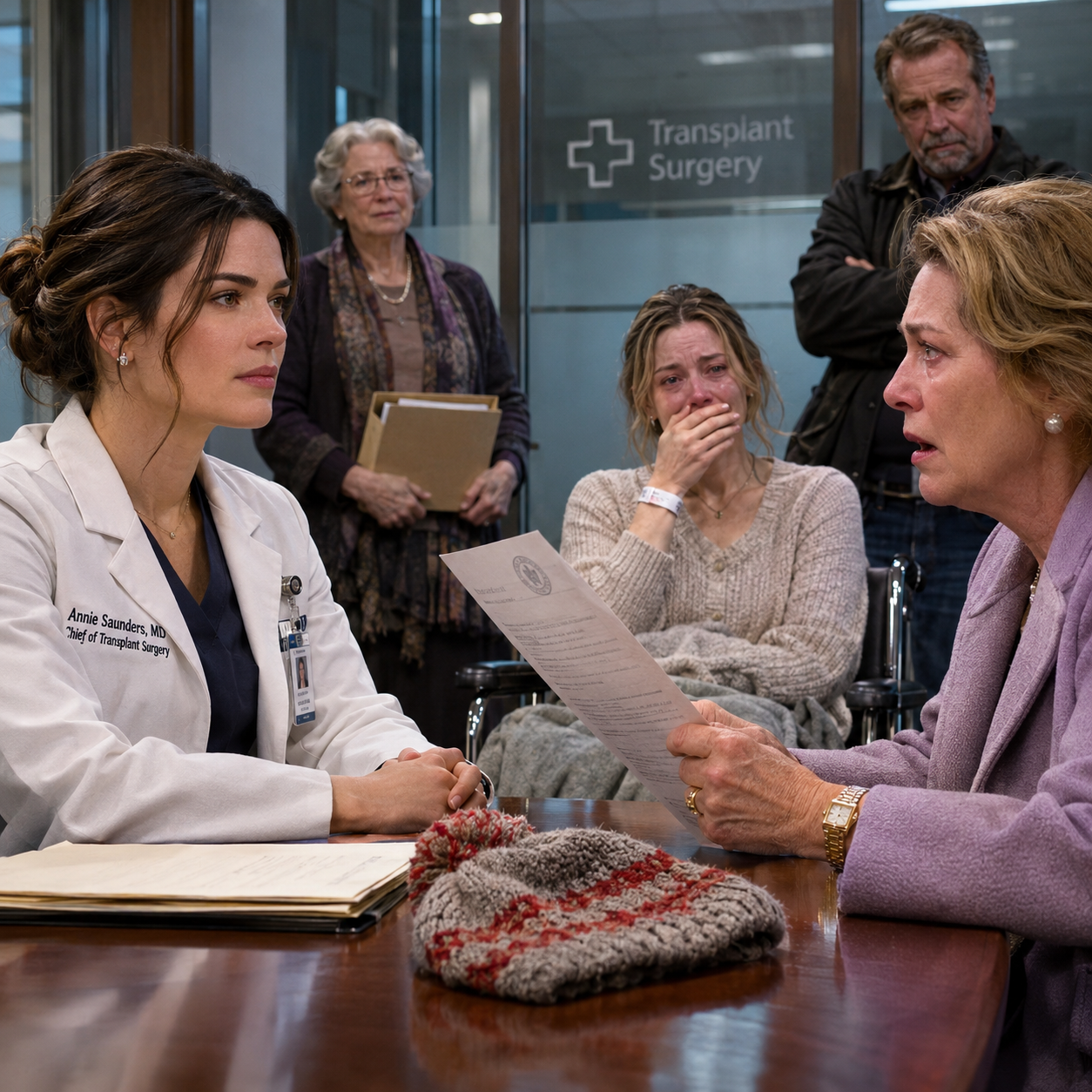
The same woman who had spent the previous week telling a national television audience that her daughter had disappeared without her knowledge was now staring at the very document proving she had known exactly where she left me.
Vince shifted uncomfortably.
“Gail, maybe we should—”
“Be quiet,” she snapped.
Then she looked at me again.
“Who gave you this?”
I didn’t answer immediately.
Instead, I reached for the second document.
“This is the original intake record from Saint Jude’s. It records the date you brought me there, the clothes I was wearing, the belongings you left with me, and the name of the person who signed me into the facility.”
Mom’s lips parted.
I continued.
“This is also the adoption record confirming that Michael and Olivia Kingsley legally adopted me two years later.”
Tori slowly lifted her head.
“Wait…”
Her eyes moved from the papers to my face.
I looked at her.
“My name is Annie.”
She stared at me.
“My birth name was Annie Saunders. My adoptive parents gave me their surname, but I never changed my first name.”
Tori’s hands began trembling.
“Nia?”
I nodded.
For a moment, she looked like a little girl again.
Then she covered her mouth.
“Oh my God.”
Her wheelchair moved slightly as she pushed herself forward.
“You’re Annie?”
I reached across the table and took her hand.
“Yes, Tory Bear.”
She started crying.
Not quietly.
Not politely.
She cried the way someone cries when they discover that a piece of their childhood they thought was lost forever has been sitting in front of them all along.
“I knew it,” she whispered. “I knew that song. I knew I wasn’t imagining it.”
I squeezed her fingers.
“I’m sorry it took so long.”
She shook her head.
“No. No, don’t say that.”
Then she leaned forward and wrapped her arms around me.
I held her carefully.
For thirty years, I had imagined what it would feel like to see my little sister again.
I had imagined that I might be angry.
I had imagined asking her why she never looked for me.
But as I held her, I understood something.
She had been five years old when I disappeared from her life.
She hadn’t abandoned me.
She had simply grown up inside the same story our mother had told everyone else.
Across the table, Mom suddenly stood.
“This is ridiculous.”
Nobody moved.
She pointed at me.
“You knew who I was when I came into your office?”
“Yes.”
“And you let me sit there without telling me?”
“I wanted to understand what you were looking for.”
“I was looking for my daughter!”
I looked directly at her.
“Which daughter?”
Her mouth opened.
Then closed.
I continued.
“You spent thirty years telling Tori that I ran away. You went on television and said you didn’t know what happened to me. Yet here is your signature on the document showing you personally surrendered me.”
Mom shook her head.
“We were young. We were struggling. You don’t understand what things were like back then.”
“I was five, Mom.”
The word slipped out before I could stop it.
Mom froze.
It was the first time I had called her that in thirty years.
I hadn’t planned to.
I hadn’t rehearsed it.
But hearing myself say it made the room feel smaller.
“I was five years old,” I repeated. “I didn’t understand bills, rent, groceries, or how difficult life could become. I only understood that my mother put me in a building, gave someone my clothes, and drove away with my sister.”
Mom looked down.
For the first time, she seemed unable to find an immediate answer.
But the silence didn’t last.
“We couldn’t afford two children,” she said defensively. “We had to make a decision.”
I nodded slowly.
“And somehow, thirty years later, you still believe I was the extra one.”
Vince cleared his throat.
“Annie, nobody is saying that now. We just need to focus on Tori.”
I turned toward him.
“You’re right. We do need to focus on Tori. That’s why we’re here.”
I opened the third document.
“This is my preliminary compatibility report.”
Mom immediately leaned forward.
“Then it’s true? You’re a match?”
“Yes.”
Her entire expression changed.
The anger disappeared.
Her shoulders relaxed.
She even smiled.
“Oh, thank goodness. I knew everything would work out.”
She reached across the table as if she intended to touch my hand.
I moved my hand away.
“There’s something else you need to understand.”
Her smile faded.
“The transplant evaluation is being handled by an independent team. My medical records and donor evaluation have been separated from my surgical responsibilities. I will not be making the final decision about my sister’s treatment.”
Mom frowned.
“What does that mean?”
“It means I am not going to operate on my own sister, and I am not going to influence the medical team.”
“Fine. Whatever. When can you schedule the surgery?”
I looked at her for a long moment.
“You haven’t asked whether I want to donate.”
She gave a small laugh.
“Why wouldn’t you?”
“Because it’s my body.”
Her expression hardened.
“Annie, don’t start this.”
I looked at Tori.
She had stopped crying.
Her eyes were fixed on our mother.
Mom continued.
“You have two kidneys. Your sister is dying. What kind of person would refuse to help her own family?”
I felt something inside me settle.
Not anger.
Not even sadness.
Just a strange clarity.
For thirty years, I had wondered whether my mother regretted leaving me.
Now I had my answer.
She regretted losing access to me.
There was a difference.
I turned to the fourth document.
“This is the donor consent policy. It explains that living donation must be completely voluntary. Nobody can force me, pressure me, threaten me, or use family obligation to make the decision.”
Mom rolled her eyes.
“Doctors and their paperwork.”
“No, Gail.”
She looked up sharply.
I had stopped calling her Mom.
“This isn’t paperwork. This is my life.”
The room became silent again.
Then Tori spoke.
“Mom, stop.”
Gail turned toward her.
“What?”
“Stop asking her like that.”
“Victoria, stay out of this.”
Tori swallowed.
“She just told you she’s my sister. She’s the person you’ve been telling me abandoned me. And instead of asking her how she feels, you’re asking when she can give me a kidney.”
Mom’s face tightened.
“I am trying to save your life.”
“I know. But she’s a person, Mom. Not a spare-parts department.”
The transplant coordinator lowered her eyes, trying not to react.
I almost smiled.
My little sister had grown up.
And she was stronger than either of us realized.
Mom grabbed her handbag.
“This meeting is going nowhere.”
She turned toward me.
“I want to speak to you privately.”
“There is nothing we need to discuss privately.”
“I’m your mother.”
I looked at the document with her signature.
“You were my mother when you signed that form, too.”
Her eyes filled with something I couldn’t identify.
Then she walked out.
Vince followed her.
The conference room door closed.
For several seconds, nobody moved.
Tori looked at me.
“I’m sorry.”
I shook my head.
“You don’t have to apologize for anything.”
“But she shouldn’t have said those things.”
I smiled sadly.
“She’s been saying those things for thirty years.”
Tori reached into the pocket of her sweater and pulled out a small folded piece of paper.
“I brought something.”
She placed it in front of me.
It was an old photograph.
A little girl with dark hair was sitting on the floor beside a baby in a white blanket.
I recognized myself immediately.
I was holding a stuffed bear.
Tori was barely old enough to sit up.
On the back, written in faded blue ink, were four words.
Annie and her Tory Bear.
I touched the photograph.
“Where did you get this?”
“I found it in an old box at home. Mom said she’d thrown everything away, but she must have missed this one.”
I stared at the picture.
For thirty years, I had believed that the only photograph of my childhood was the one Mom had brought into my office.
Apparently, she wasn’t the only person who had kept a memory.
Tori wiped her cheeks.
“I used to look at this when I was little. I thought you were somewhere waiting for me.”
My throat tightened.
“I was.”
She looked at me.
“Did you have a good life?”
I considered the question.
Then I nodded.
“Yes. I did.”
I told her about Michael and Olivia.
About the first Christmas when they let me choose whatever I wanted for dinner.
About how Olivia taught me to bake.
About how Michael used to bring home medical textbooks and pretend he needed my help studying, even when I was only twelve.
I told her about medical school.
About the long nights.
About the first time I assisted in a transplant operation.
And about the day I became chief of transplant surgery.
Tori listened to every word.
When I finished, she smiled.
“I’m glad somebody loved you.”
I looked at her.
“Somebody loved you, too. Even if they didn’t always know how to show it.”
She looked down.
Then she asked the question I had been avoiding.
“Are you really going to give me your kidney?”
I took a breath.
“I want to make sure you’re medically safe. I want an independent team to evaluate everything. And I want you to understand that you don’t owe me anything either.”
She shook her head.
“Annie, I don’t want you to risk your life because of me.”
“I know.”
“I mean it. I would rather stay on dialysis than lose you again.”
I reached across the table.
“You’re not losing me.”
She started crying again.
This time, I cried with her.
Three days later, the situation became more complicated.
Mom called the hospital administration.
She claimed I had deliberately delayed Tori’s transplant because of a personal disagreement.
She also accused me of using my position to obtain confidential adoption documents.
The hospital attorney requested a meeting.
I wasn’t worried about the documents.
Every record I had obtained was either part of my own legal adoption history or provided through the appropriate channels.
But I was concerned about the pressure being placed on Tori.
She was already dealing with kidney failure, dialysis, exhaustion, and the fear of an uncertain future.
She didn’t need her family turning her medical treatment into a public argument.
That afternoon, I received a call from the transplant coordinator.
“Dr. Kingsley, there’s something you should know.”
“What is it?”
“Your mother has contacted two local news stations. She’s telling people that you are refusing to save your sister unless she apologizes for abandoning you.”
I closed my eyes.
Of course.
Mom had found another way to make herself the victim.
“Has Tori seen it?”
“Not yet.”
“Please don’t let anyone show it to her.”
“I understand.”
After the call, I sat alone in my office.
I had spent years learning how to remain calm during emergencies.
I had stood beside patients whose families were falling apart.
I had delivered difficult news.
I had watched people receive second chances through organ transplantation.
But nothing in medical school had prepared me for the strange pain of sitting across from the woman who had abandoned me and discovering that she still believed she had the right to decide what happened to my body.
That evening, I went to see Dad.
He was sitting in his kitchen, reading a newspaper.
He looked up when I entered.
“You look tired.”
“I am.”
He put the newspaper down.
I told him about the meeting, the television calls, and Mom’s latest accusation.
He listened without interrupting.
When I finished, he poured me a cup of tea.
“Annie, do you remember what you told me when you were sixteen?”
I shook my head.
“You said you wanted to become a doctor because you wanted to make sure nobody ever felt helpless in a hospital.”
I smiled faintly.
“I remember.”
“You’ve done that. You’ve helped people. You’ve built a life. But don’t confuse being a good person with allowing people to hurt you.”
I stared into my cup.
“What if I don’t donate?”
“Then you don’t donate.”
“What if Tori dies?”
Dad reached across the table.
“Then you will grieve. And you will wonder whether you could have done something differently. But that doesn’t mean anyone had the right to force you into surgery.”
He paused.
“Your sister deserves compassion. You deserve it, too.”
I looked at him.
“Would you be disappointed if I decided not to?”
He shook his head.
“I would be disappointed if you made the decision because someone frightened you into it.”
Then he smiled.
“But if you choose to help her because you genuinely want to, I’ll be proud of you. Either way, you’re my daughter.”
I reached for his hand.
And for the first time in several days, I felt like I could breathe.
The following Monday, I received an unexpected visitor.
Lorraine Miller.
She was seventy-two now, with silver hair and a walking stick.
I hadn’t seen her in almost six years.
When she entered my office, I stood immediately.
“Lorraine!”
She smiled.
“Look at you. The little girl who used to hide apples under her pillow.”
I laughed.
“You remember that?”
“Of course. You were convinced someone would take them.”
She sat down carefully.
Then she placed a small brown envelope on my desk.
“I brought something I should have given you years ago.”
I looked at the envelope.
“What is it?”
“Something your mother left behind.”
My stomach tightened.
“Another document?”
Lorraine shook her head.
“No. Something different.”
She opened the envelope and removed a small piece of paper.
It was a handwritten note.
The paper had turned yellow, and the edges were soft from years of handling.
I recognized my mother’s handwriting immediately.
Lorraine watched me carefully.
“Your mother wrote it the day she left you. She gave it to me and told me to keep it with your belongings.”
I stared at her.
“Why didn’t you tell me?”
“I wanted to. But when your adoption was finalized, the agency advised us to preserve the records. Later, when you were old enough to understand, I didn’t know whether showing it to you would help or hurt.”
I unfolded the note.
There were only a few lines.
Annie,
Your sister is too young to understand what’s happening. Please don’t let her forget that she had a big sister.
I hope someday you will understand that we had no choice.
Take care of her if you ever see her again.
Mom.
I read it once.
Then again.
My fingers trembled.
Lorraine spoke softly.
“I never understood why she wrote that. She had just signed the surrender form. But she seemed to believe you would somehow remain responsible for your sister.”
I placed the note on the desk.
For years, I had imagined that my mother might have cried after leaving me.
I had imagined her looking in the rearview mirror.
I had imagined her returning to the group home.
But now I understood something more painful.
Even in the moment she left me, she had thought about what I could do for the child she kept.
Not what I needed.
Not whether I was frightened.
Not whether I would have enough to eat.
She had written instructions for a five-year-old to take care of someone else.
I wiped my eyes.
“Did she ever come back?”
Lorraine shook her head.
“Not once.”
“Did she ever call?”
“No.”
I nodded slowly.
Then Lorraine reached into her handbag and removed another small item.
The gray-and-red knitted hat.
The one I had worn the day my mother left me.
I picked it up carefully.
It was smaller than I remembered.
The gray wool had faded, and one red thread had come loose near the edge.
I pressed it against my chest.
“I thought this was gone.”
Lorraine smiled sadly.
“You left it on a chair that afternoon. I picked it up because I thought you might want it someday.”
I looked at her.
“Thank you.”
She squeezed my hand.
“You were a very brave little girl, Annie. But you shouldn’t have had to be.”
That sentence broke something open inside me.
I cried.
Not because I wanted my mother back.
Not because I regretted the life I had built.
I cried because, for the first time, someone had acknowledged what had happened without explaining it away.
Two days later, Tori’s condition worsened.
Her blood pressure dropped during dialysis, and she developed a serious infection.
The medical team stabilized her, but her doctors warned that her condition was becoming increasingly fragile.
I visited her that evening.
She was awake, staring at the ceiling.
When she saw me, she smiled weakly.
“Hey, Nia.”
“Hey, Tory Bear.”
She shifted slightly.
“Mom came to see me.”
I pulled a chair closer.
“What did she say?”
Tori looked toward the window.
“She said you were punishing her.”
I sighed.
“I’m sorry.”
“She also said she never meant to abandon you.”
I didn’t answer.
Tori continued.
“She said she thought the group home would take care of you until she could come back.”
I looked at my sister.
“Did she tell you why she never came back?”
Tori shook her head.
“Not really.”
I sat quietly for a moment.
Then I told her about the note.
I showed her the photograph and the old knitted hat.
When she saw the note, her eyes filled with tears.
“She wrote that?”
“Yes.”
Tori read it slowly.
Then she handed it back.
“I think she wanted me to believe you were responsible for leaving.”
I nodded.
“She told you I ran away.”
“Yes.”
“She told the television audience she didn’t know where I was.”
“Yes.”
Tori closed her eyes.
“I don’t know what to believe anymore.”
I reached for her hand.
“You don’t have to figure everything out tonight.”
She squeezed my fingers.
Then she asked quietly:
“Did you hate me?”
I stared at her.
“What?”
“When we were little. When Mom kept me and left you. Did you ever hate me for being the one they chose?”
I felt my throat tighten.
“Tori, you were five.”
“But I was the one who stayed.”
“You were a child. Just like me.”
She started crying.
“I wish I could remember more.”
I brushed a tear from her cheek.
“You don’t have to remember everything for it to be real.”
She looked at me.
Then she smiled faintly.
“Will you sing the bear song again?”
I laughed softly.
“Of course.”
I began humming the little melody.
The same one I had sung in the back of that red Ford Escort.
The same one I had hummed while waiting for her blood pressure to stabilize.
The same one she remembered from a childhood she had almost forgotten.
Her eyes slowly closed.
And as I continued humming, I realized that the little girl in the red car had never really disappeared from either of our lives.
We had simply been separated by thirty years of silence.
The next morning, I made my decision.
I called the independent transplant coordinator and requested a formal donor evaluation.
I wanted every medical test completed.
I wanted an independent physician to explain every risk.
I wanted psychological counseling.
And I wanted the decision documented as mine alone.
The coordinator agreed.
A few weeks later, after extensive testing and review, the independent transplant team confirmed that I was medically suitable to donate.
They also confirmed that I understood the risks and had made the decision without coercion.
When the coordinator asked me one final time whether I wanted to proceed, I looked at the photograph of two little girls sitting together on the floor.
One holding a stuffed bear.
The other wrapped in a white blanket.
Then I answered.
“Yes.”
Not because my mother demanded it.
Not because she had given birth to me.
Not because I owed anyone a kidney.
I said yes because Tori was my sister.
And because I wanted her to have the chance to live a long life.
But there was one more thing I needed to do before the surgery.
I needed to speak to my mother.
Not as the chief of transplant surgery.
Not as the donor.
Not as the daughter she suddenly remembered.
As the little girl she had left behind.
And this time, I would not let her change the story.
PART 4
The day before surgery, I asked my mother to meet me.
Not at my office.
Not in the hospital conference room.
I asked her to come to the small family waiting room on the fourth floor, where Tori had spent so many afternoons waiting for dialysis appointments.
She arrived twenty minutes late.
She was wearing the same lilac coat she had worn the first day she walked into my office.
Vince followed her, carrying a paper cup of coffee.
Mom looked around.
“Where is Victoria?”
“She knows we’re meeting. She wanted some time alone.”
Mom frowned.
“Why are we doing this now? The surgery is tomorrow. We should be celebrating.”
I gestured toward the chair opposite me.
“Please sit down.”
She sat.
I placed three things on the table.
The old photograph of Tori and me.
The knitted gray-and-red hat.
And the handwritten note she had left at Saint Jude’s thirty years earlier.
Mom stared at the items.
Her expression changed.
“Where did you get those?”
“Lorraine kept them.”
She picked up the photograph.
For a moment, she looked almost human in her sadness.
Then she put it down.
“I remember that day.”
I waited.
She rubbed her forehead.
“You were always attached to your sister. You followed her everywhere. You wouldn’t even let me carry her without asking where you were going.”
I smiled sadly.
“I was five. She was my little sister.”
Mom looked at the photograph again.
“You don’t understand what happened back then.”
“Then explain it to me.”
She sighed.
“Your father had lost his job. We were behind on rent. Tori was sick all the time, and we couldn’t afford everything. Someone at the social services office told us there were families who could take care of children temporarily.”
I looked at her.
“Temporarily?”
“Yes.”
“Then why did you sign a voluntary surrender form?”
She shifted in her chair.
“I didn’t know what else to do.”
“Why didn’t you come back?”
She didn’t answer.
“Why didn’t you call?”
Silence.
“Why did you tell Tori I ran away?”
Her eyes lifted.
“I didn’t want her to grow up thinking her parents abandoned her.”
I stared at her.
“So you gave her a different story and made me the person who abandoned everyone.”
“That wasn’t what I intended.”
“But that’s what happened.”
Vince finally spoke.
“Annie, people make mistakes. Your mother was under enormous pressure. We shouldn’t spend the rest of our lives punishing her for something that happened thirty years ago.”
I turned toward him.
“Were you there?”
He looked confused.
“What?”
“When I was left at Saint Jude’s. Were you there?”
He shook his head.
“No. I met your mother later.”
“Then you weren’t part of that day. But you’ve spent years helping her maintain the lie.”
He looked down.
I turned back to Mom.
“I need you to understand something. I had a good life. Michael and Olivia loved me. They gave me everything I needed. I’m grateful for that every day.”
Mom nodded quickly.
“Of course. That’s wonderful.”
“But having a good life doesn’t erase what happened when I was five.”
Her expression hardened.
“I said I was sorry.”
“No. You said you had no choice. Those are different things.”
She stared at me.
I continued.
“You came into my office because Tori needed a kidney. You didn’t recognize me. You didn’t ask whether I was happy. You didn’t ask what happened to me. You didn’t even wonder whether I had survived.”
Mom looked away.
“I didn’t know it was you.”
“That is exactly the point.”
For several seconds, the only sound was the air conditioning.
Then I pushed the handwritten note toward her.
“Read it.”
She hesitated.
Then she picked it up.
Her eyes moved across the words.
Please don’t let her forget that she had a big sister.
Take care of her if you ever see her again.
Mom.
When she finished, she put the paper down.
“I was hoping you would always love your sister.”
I swallowed.
“I did.”
She looked at me.
“I never stopped.”
Mom’s eyes filled.
Then she said something I wasn’t expecting.
“I was afraid.”
I waited.
“I thought you would hate us. I thought if you ever found out what happened, you would never want anything to do with us.”
I nodded slowly.
“Maybe you were right.”
She started crying.
“But now you have come back,” she said. “And you’re saving your sister. Maybe we can finally be a family again.”
I looked at her for a long moment.
Then I shook my head.
“Tomorrow, I’m donating a kidney to Tori. I’m not donating my life back to this family.”
Her face fell.
“Annie…”
“I can love my sister without pretending you didn’t hurt me.”
She reached across the table.
I didn’t move.
“I don’t know whether I’ll ever be able to have a relationship with you,” I said. “Maybe someday. Maybe never. But if we ever try, it has to begin with the truth.”
She wiped her cheeks.
“What truth?”
“The truth that you left me. That you didn’t come back. That you told Tori I ran away. And that you went on television and lied about not knowing what happened.”
Mom lowered her head.
I stood.
“I don’t need you to give me anything. I don’t need an apology for the cameras. I don’t need money. I don’t need you to call me your daughter in front of strangers.”
I paused.
“I needed a mother when I was five. I needed one when I was ten. I needed one when I was sixteen and wondering why nobody had ever come looking for me.”
My voice trembled.
“But I don’t need to keep waiting.”
I picked up the photograph.
“Tomorrow, I’m going into surgery because I choose to. Please don’t turn that into proof that you were right to abandon me.”
Then I walked out.
Behind me, my mother began crying.
I heard her say my name.
But I didn’t turn around.
For once, I didn’t feel guilty about walking away.